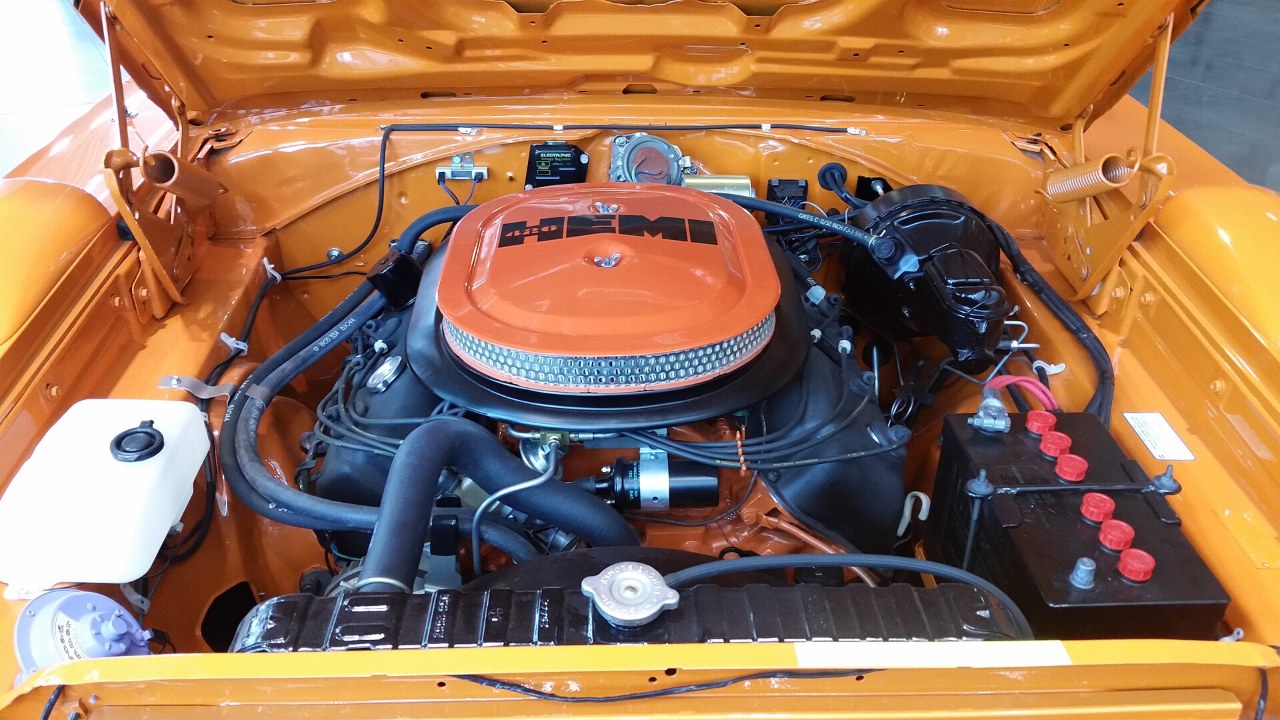
Chrysler’s 426 got the Hemi name from the shape of its combustion chambers. Each chamber is a dome cut into the cylinder head, with the spark plug close to the middle. That layout breathes well, and it made power that won races. Here is where the word came from, what it describes and why the 426 made it famous.
The short answer is geometry. The longer answer runs through a wartime aircraft engine, a 1951 Chrysler V8 and a clean sweep at Daytona. Along the way, a slightly inaccurate engineering term became the name everyone remembers.
What the Hemi Name Describes
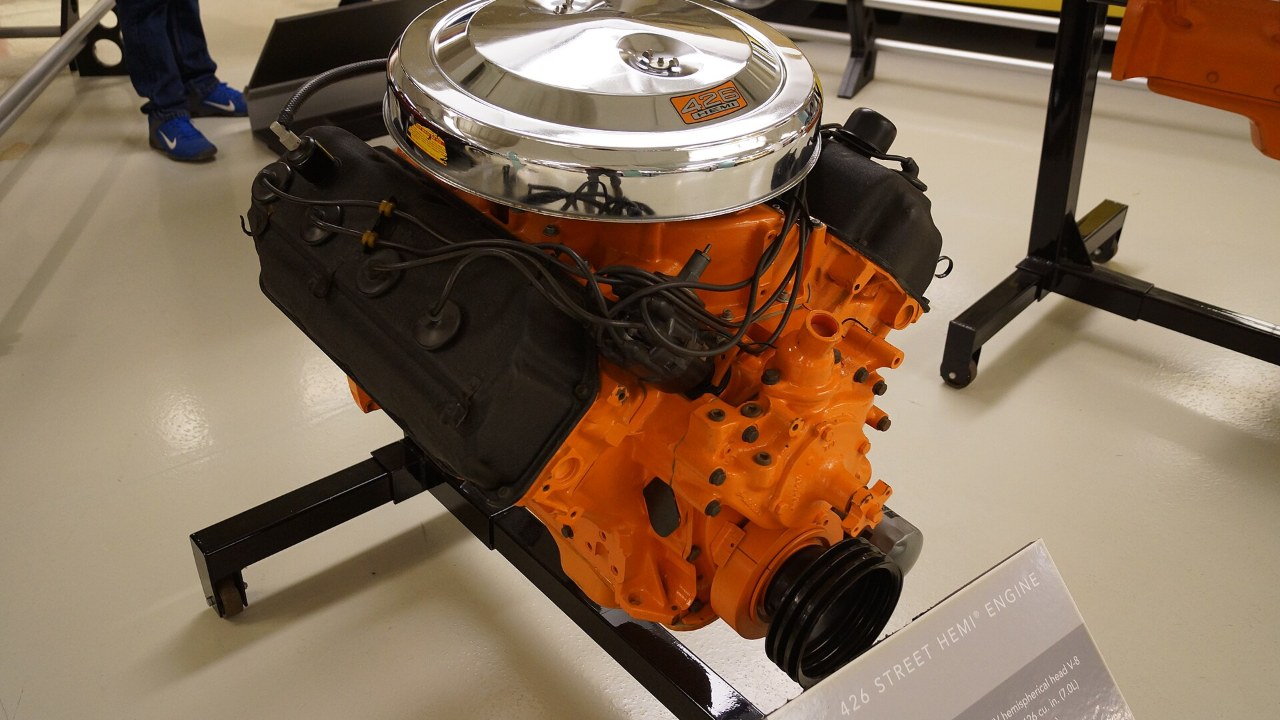
“Hemi” is short for hemispherical, meaning shaped like half a sphere. In a Hemi engine, the top of each combustion chamber is a rounded dome rather than a flat or wedge-shaped pocket. So the name describes the head, not the block or the displacement.
Chrysler’s own heritage material says so plainly. According to Chrysler’s HEMI heritage release, a nearly centrally located spark plug in a hemispherically shaped combustion chamber “gave the classic HEMI engine its name.” The same release credits that layout with an inherent airflow “that translates into big power.”
Two other features come with the dome. First, the intake and exhaust valves sit opposite each other across the chamber, both canted at an angle. Second, the spark plug can sit near the center. In fact, those two details matter as much as the curve itself.
A Dome That Isn’t Quite Half a Sphere
Here’s the twist: the name is not exactly accurate. Hagerty’s history of the Hemi points out that “hemi” is the Greek word for half. However, the shape on Chrysler’s blueprints “is best described as a spherical cap or dome.” In other words, the chamber is a shallower slice of a sphere, not a full half.
According to Hagerty, those terms simply lacked cachet. Instead, the engineers chose the more evocative Hemi name. Hagerty even calls the engine a “Mighty Misnomer,” which is fair. The dome is real, but the “half” is a little generous.
Still, the shape earns its keep. Hagerty lists three advantages. First, a machined dome lets air and fuel flow in, and burned gas flow out, more freely than the wedge chambers GM and others used. Second, a hemi gives the least surface area for the volume it holds. Third, the central plug position shortens the distance the flame must travel during ignition.
From a Wartime V-16 to the 1951 FirePower
The dome did not start in a car. During World War II, the U.S. Army Air Forces hired Chrysler to develop a 2,220-cubic-inch, 2,500-hp V-16 for the P-47 Thunderbolt fighter, according to Hagerty. Development wasn’t finished by the end of the war. Even so, Hagerty reports that one test flight topped 380 mph at 20,000 feet.
That program fed straight into the passenger car. Hagerty says what Chrysler learned shaped its 1951 FirePower V-8, a 331-cubic-inch engine rated at 180 hp. Chrysler’s heritage release confirms the 1951 debut and the 180-hp rating. It also says the New Yorker and Saratoga were the first cars to carry it.
Notice the official name: FirePower, not Hemi. According to Hagerty, “Hemi” is what the FirePower “came to be known” as. Hagerty also notes that the engine borrowed heavily from Cadillac’s V8 of two years earlier. The bore, stroke and compression matched, yet Chrysler’s version made 20 more horsepower. That came at a cost in size, because the Chrysler heads were wider and heavier than Cadillac’s.
Why the 426 Made the Hemi Name Famous
The second-generation engine is the one most people mean today. According to Hagerty, Chrysler asked its engineers in December 1962 for an engine and car that could win stock car races. The answer was the 426, and it went racing just over a year later.
On February 23, 1964, cars with the 426 Hemi took first, second and third in the Daytona 500, according to Chrysler’s heritage release. The same release says the engine set a track record average speed of 154.33 mph. Richard Petty won in his Plymouth. Meanwhile, Hagerty reports his engine block had been cast only 13 days before the race.
The power figures depend on who you ask. A Mopar 426 HEMI anniversary release says the 1964 race engine was rated at 400 hp with a 12.5:1 compression ratio. By contrast, Hagerty reports the single four-barrel oval-track engine produced 550 hp at 6,800 rpm.
The anniversary release also explains the 426’s other nickname. The 426 earned the “elephant” moniker, Mopar says, because of its imposing size, strength and power. In fact, the design Mopar announced for the engine’s 50th anniversary in 2014 incorporated an elephant.
The 426 Street Hemi and the End of the Run
In 1966, Chrysler brought the 426 to showrooms as the Street Hemi. According to the heritage release, it wore dual four-barrel carburetors on an aluminum intake manifold. Its advertised ratings were 425 hp and 490 lb-ft of torque. Hagerty gives the same numbers, at 5,000 rpm and 4,000 rpm respectively.
With the Street Hemi in production, the Hemi also made a return to NASCAR racing, the anniversary release notes. Two years later came a small run of race-only cars. Mopar says only 75 each of the 1968 Dodge Dart and Plymouth Barracuda carried the 426 Race Hemi.
Then the clock ran out. Hagerty says the second-generation Hemi lasted eight years, from 1964 to 1971. Tighter emissions rules and rising insurance premiums ended it, according to Hagerty. By then, nearly 11,000 had been sold, which Hagerty calls far more than anticipated.
More from Fast Lane Only
- Unboxing the WWII Jeep in a Crate
- 15 rare Chevys collectors are quietly buying
- 10 underrated V8s still worth hunting down
- Police notice this before you even roll window down
This article was created with the help of AI and was reviewed and edited by Fast Lane Only editors before publication.