
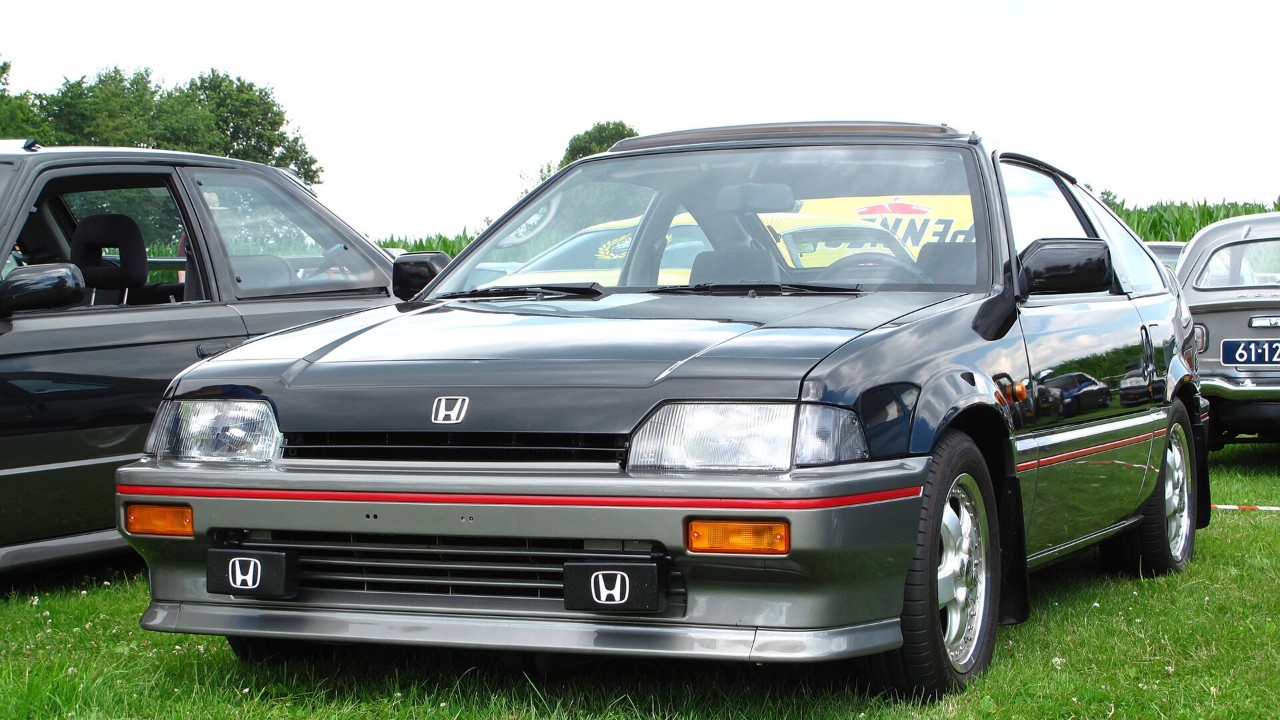
The Honda CRX was built on a simple idea: keep the car tiny, keep it light and let a small engine do the rest. That formula went out of style as cars grew heavier. Yet the CRX never really aged out. Fans keep them running, values keep climbing and the driving lesson holds up.
These are our picks for the seven CRX versions that refuse to become obsolete, from the first Japanese car to the targa that followed. The verdicts are our take, and the figures come from the sources listed at the end.
1. 1983 Honda Ballade Sports CR-X

This is where it started. First, Honda launched the Ballade Sports CR-X in Japan toward the end of June 1983, selling it through its Honda Verno stores. With a full tank, it weighed about 1,800 pounds. As a result, even the carbureted 1.3-liter version, rated at 80 PS, felt lively. The fuel-injected 1.5i, meanwhile, made 110 PS. In our view, that low weight is exactly why the original design never went stale: modern hot hatches chase the same feeling with twice the mass.
2. 1988 Honda CRX

The second-generation car arrived for 1988 with a longer wheelbase and a much smarter chassis. Specifically, Honda swapped the old torsion beam and beam axle for independent double-wishbone suspension at all four corners. Meanwhile, the body slipped through the air with a drag coefficient of 0.29. The frugal HF version earned a 53 mpg EPA combined rating. That’s why we think this generation refuses to look dated next to today’s economy cars. Honda sold 51,784 of them in the U.S. that first year.
3. Honda CRX Si

The Si arrived in 1985 with fuel injection and 91 hp, and it cost $7,999. By comparison, a Toyota MR2 listed at $11,194, so the Si undercut it by a wide margin. Back then it was cheap fun, but times changed. Today it’s a collectible, which is the opposite of obsolete. Hagerty puts a #2-condition first-generation CRX at about $17,000. In addition, a 1987 Si with 58,000 miles sold for $22,000 on Bring a Trailer in October 2021. Our earlier look at how the CRX Si made efficiency fun covers its early appeal.
4. 1987 Honda CRX 1.6i-16

Europe, however, got something American buyers never saw. The 1.6i-16 arrived in 1986 with a twin-cam, 16-valve 1.6-liter engine rated at 125 PS DIN. That gave the little coupe real high-rev character, and it pulled away from the 100 PS 1.5i sold alongside it. Fittingly, the car pictured here was photographed at the Montlhéry circuit in France, which suits it. For us, this is the version that proves the CRX was a proper sports car, not just a thrifty commuter with a sporty face.
5. 1990 Honda CRX SiR VTEC

Japan’s CR-X SiR got Honda’s B16A VTEC engine about five months after the Integra introduced it in April 1989. Moreover, the 1,595 cc four made 160 PS JIS at a screaming 7,600 rpm. In contrast, the U.S. Si topped out at 108 hp. The SiR cost ¥1,547,000 at home. VTEC is still part of Honda’s performance story decades later, so this car feels less like an antique and more like a prototype for everything that followed. If we could pick just one, it would be this one.
6. 1987 Mugen Honda CR-X Pro Suzuka safety car

Mugen, the Honda specialist, sold an aero kit called the CR-X Pro for the first-generation car. Race-car aerodynamicist Takuya Yura of Mooncraft designed it, with a longer nose, vented B-pillars and a rear spoiler. In addition, a version served as a safety and pace car at Suzuka Circuit, and that’s the car shown here. Tamiya made the CR-X Pro as a 1:24 model kit and a radio-control car. Then, in 2023, Tomytec added a 1:64 model of the Suzuka car. Few cars stay this relevant to toymakers.
7. Honda CRX del Sol

Finally, the del Sol debuted in Japan in February 1992 and swapped the hatchback for a targa roof. Outside the U.S., buyers could order the TransTop, a powered roof that tucked itself into the trunk in about 45 seconds. However, American cars, sold as the Civic del Sol from 1993, used a manually removable top. For years it lived in the hatchback’s shadow. Now, though, it’s the cheapest way into a CRX badge. Most del Sols on Bring a Trailer sold for about $7,000 to $10,000, according to Garage Dreams.
Sources: Ate Up With Motor’s CRX history; Hagerty’s 1984–91 CRX buyer’s guide; Garage Dreams on the del Sol; Jalopnik on the TransTop; Japanese Nostalgic Car on the Mugen CR-X Pro; HobbyLink Japan on the Suzuka car model.
More from Fast Lane Only


