
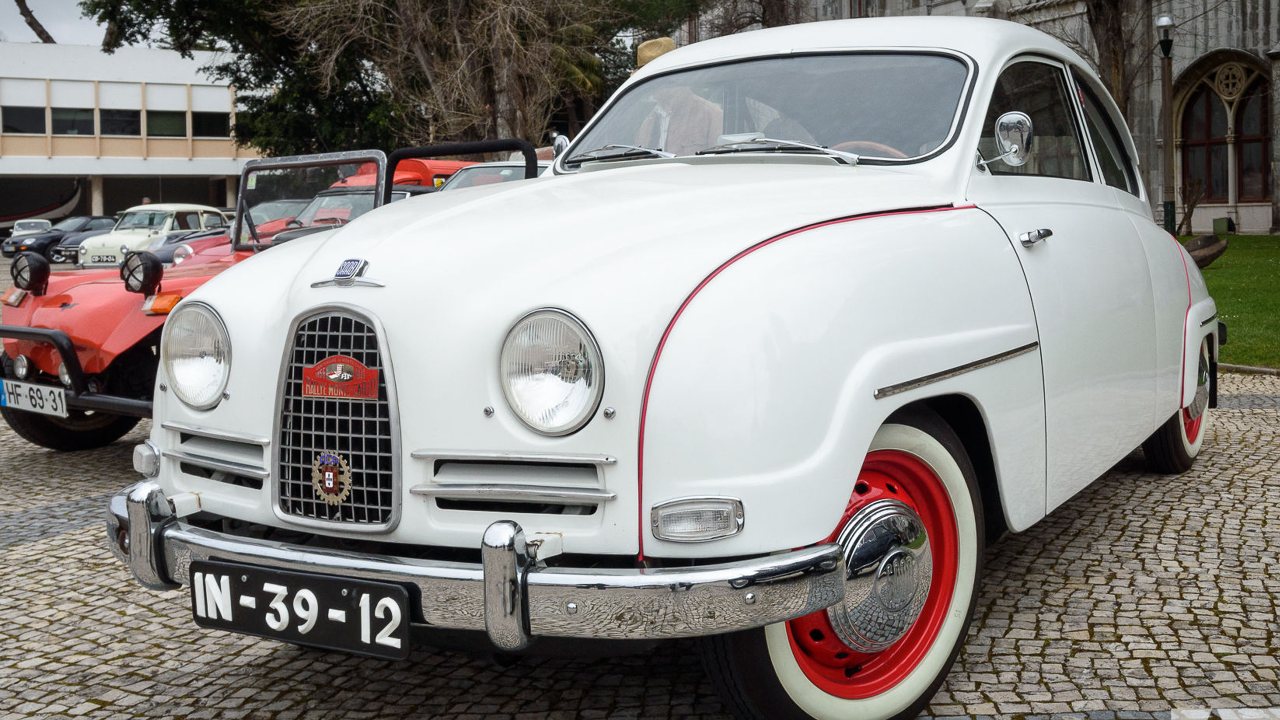
The 1958 Saab 93 arrived at a moment when most family cars still treated the air as an afterthought, yet it was shaped by people who spent their days thinking about wings and drag. Instead of chrome-laden fins and upright grilles, Saab wrapped its compact two stroke sedan in a rounded shell that treated airflow as a design brief, not a side effect. That decision, rooted in the company’s aviation DNA, made the 93 an early proof that aerodynamic thinking could shape even a modest everyday car.
From aircraft hangar to wind‑cheating family car
Saab did not begin life as a carmaker, and that origin story matters when you look at the 93. The company’s name, spelled out in Saab Name Facts The phrase Svenska Aeroplan Aktiebolaget Google and translated as Swedish Aeroplan Share Company The, points directly to its first business of building aircraft for a northern nation that stretches into the Arctic Circle. As the product of an aircraft company based in a large country that extends far into the Arctic Circle, Saabs were engineered from the outset to be stable, predictable machines that could handle long distances and harsh weather rather than just look fashionable in a showroom.
That aerospace mindset carried over when Saab turned to cars in Tolahettan north of Gertborg, where the Swedish firm applied lessons from wings to wheels. In aviation, drag is the enemy of range and performance, and Aerodynamics has become a central priority in modern vehicles for the same reason. Saab’s engineers were already fluent in airflow, lift and stability, so when they created the 93 they treated the body as a low speed fuselage, smoothing its surfaces and tapering its tail to help it slip through the air more efficiently than the upright sedans that dominated European roads.
A teardrop in a world of tailfins
Viewed against its contemporaries, the 1958 Saab 93 looks almost modest, but that understatement hides deliberate aerodynamic choices. During the fifties and sixties, with the exception of Citroen, Saab and a few other minor adherents, aerodynamics was largely ignored in favor of flamboyant but aerodynamically blunt designs. Where rivals chased tailfins and towering grilles, Saab kept the 93’s nose low and rounded, its fenders integrated into the body, and its roofline flowing in a continuous curve into a narrow rear, a profile much closer to a teardrop than a brick.
Modern guidance on drag reduction still highlights Sleek, Rounded Shapes and notes that Cars with smooth, rounded edges allow air to flow more cleanly around them, which in turn helps maximize performance and fuel efficiency. The 93’s bodywork anticipated that logic, with minimal protrusions and a gently curved front that encouraged air to split and rejoin without excessive turbulence. Even details like the small frontal area and tightly packaged cabin helped reduce the volume of air the car had to push aside, a quiet rejection of the era’s fashion for wide, square silhouettes.
Sixten Sason and the integrated aero package
The 93’s shape was not an accident of packaging, it was the work of a designer who understood how to blend form and airflow. It was styled by Sixten Sason and features a 748cc three cylinder Saab engine mounted lengthwise and horizontally, a powertrain layout that freed him to keep the hood low and the front overhang short. By tucking the compact engine deep in the nose and avoiding tall cylinder banks, Sason could maintain a smooth, descending bonnet line that met the wind with a gentle curve instead of a vertical wall.
That packaging choice also helped the 93 maintain stability at speed, a trait that later Saab models would refine further. Analysis of the later SAB 93 shows that what some described as terrible aerodynamics in terms of pure drag actually contributed to high speed stability, with the body generating predictable forces that kept the car planted. In the 1958 car, Sason’s integrated approach, from the rounded front to the tapered rear and carefully managed lift, created a cohesive aero package that favored stability and efficiency over headline top speed, a philosophy that would become a Saab hallmark.

Engineering details that served the airflow
Under the skin, the 93’s mechanical layout and innovations also supported its aerodynamic mission. The 93 series engine was Saab’s response to competitor DKW’s upcoming three cylinder, two stroke engine under development in the mid 1950s, and Saab’s own unit was compact enough to sit low and far forward without demanding a tall hood. In 1958 the 93B continued this approach, pairing the streamlined body with a drivetrain that did not fight the designer’s desire for a low profile, while also introducing safety belts as standard equipment, a reminder that Saab was thinking about how the car behaved in motion, not just how it looked at rest.
Contemporary descriptions of the 1958 car highlight that this classic Saab boasts a two stroke inline 3 displacing just 750 cc, a configuration that eliminated bulky valve gear and allowed the engine to remain physically small. That compactness, combined with the lengthwise and horizontal mounting described in 93 era material, meant the front of the car could stay low and rounded, reducing the frontal area that directly feeds aerodynamic drag. There are many important innovations on the new model of Saab 93 now put on the market, and the most striking feature of the Saab 93B, beyond its mechanical upgrades, was how thoroughly its engineering choices supported the slippery shape that met the wind.
Aerodynamic thinking that arrived ahead of its time
In hindsight, the 1958 Saab 93 looks like an early chapter in a story that would only become mainstream decades later. Today, Aerodynamics has become a central priority for electric vehicles because drag reduction directly influences range, and modern guidance stresses that Sleek, Rounded Shapes and carefully managed airflow are essential to maximize performance and efficiency. Saab embedded that logic in its earliest designs, long before wind tunnel numbers became a marketing line, by treating the family car as a small, low speed aircraft fuselage that needed to move cleanly through the air.
Historical surveys of vehicle design note that during the fifties and sixties, with the exception of Citroen, Saab and a few other minor adherents, most manufacturers chose flamboyant but aerodynamically blunt designs that sacrificed efficiency for visual drama. The 93’s rounded nose, flowing roof and tapered tail put it firmly in the minority that took the air seriously, and its combination of a compact 750 cc three cylinder engine, low frontal area and smooth bodywork showed how even a modest sedan could benefit from aerodynamic discipline. As the product of an aircraft company that built Saabs for a country reaching into the Arctic Circle, the 93 proved that thinking like an aeronautical engineer could reshape the everyday car, decades before the rest of the industry caught up.
More from Fast Lane Only:



Leave a Reply