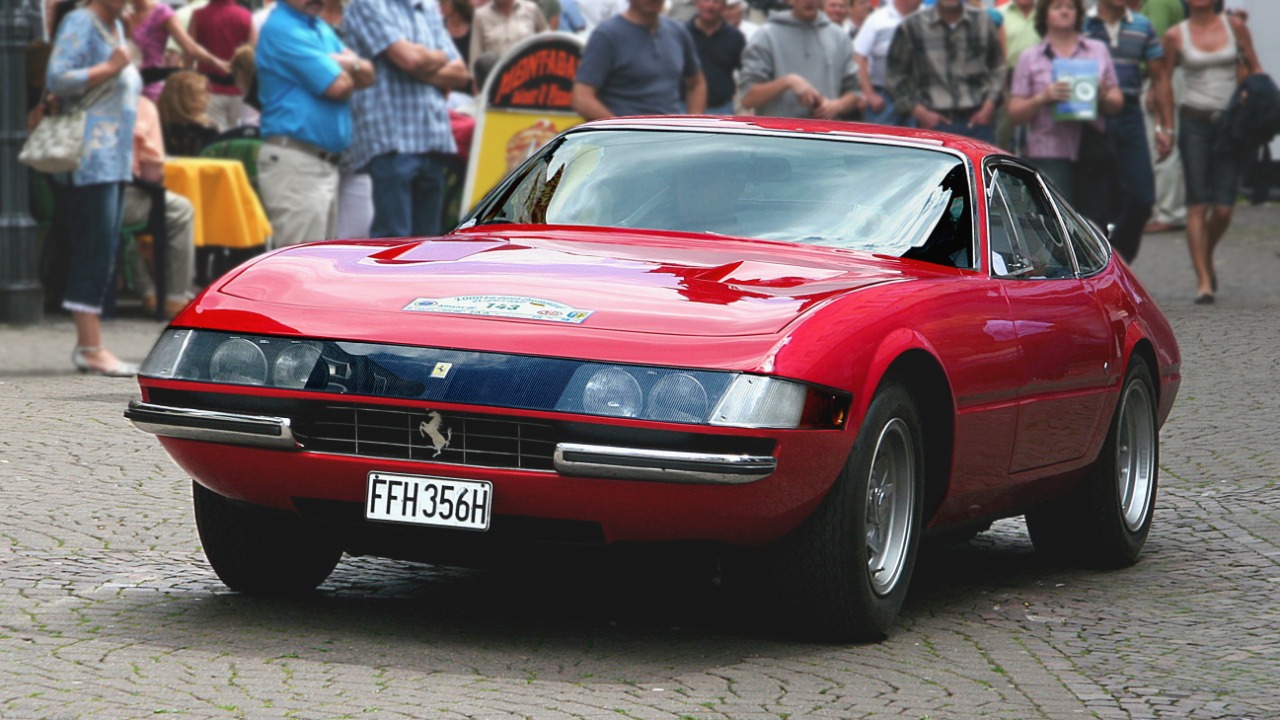
The 1971 Ferrari 365 GTB/4 Daytona arrived at a moment when the supercar world was pivoting toward radical mid‑engined shapes, yet it doubled down on a long‑bonnet, front‑engined layout and old‑school mechanical drama. Rather than chase fashion, it sharpened what Ferrari already did best, turning a supposedly outmoded recipe into one of the most feared and admired grand tourers of its era. I see its refusal to bend to the trend as the key to why the car still feels so purposeful today, from its racing exploits to the way it dominates modern auction catalogues.
The front‑engined rebel in a mid‑engine age
By the late 1960s, the supercar conversation had been hijacked by the Lamborghini Miura and its mid‑mounted V12, a car that made Ferrari’s earlier 275 GTS and related 275 G models look suddenly old. When a rolling chassis of the mid‑engined Lamborghini Miura appeared at the Turin Motor Show, it underlined how quickly the goalposts had moved for Ferrari. Yet instead of flipping its flagship to a mid‑engine layout, Ferrari kept the engine ahead of the driver and focused on making that configuration faster, more stable, and more usable at very high speed. The result was a car that looked conservative on paper but felt anything but on the road.
Contemporary reviewers and later historians have often described The Daytona as the last and perhaps greatest expression of the classic front‑engined GT idea, a machine that proved old wisdom could still beat spectacular new shapes. One detailed assessment notes that The Daytona might have been the final car of its generation, yet it emerged as the definitive front‑engined GT. I read that as a quiet rebuke to the notion that progress always means flipping the engine around. Ferrari chose evolution over revolution, and the 365 GTB/4 turned that restraint into an advantage, especially for drivers who wanted to cross continents rather than just pose outside a café.
Design that chased speed, not fashion
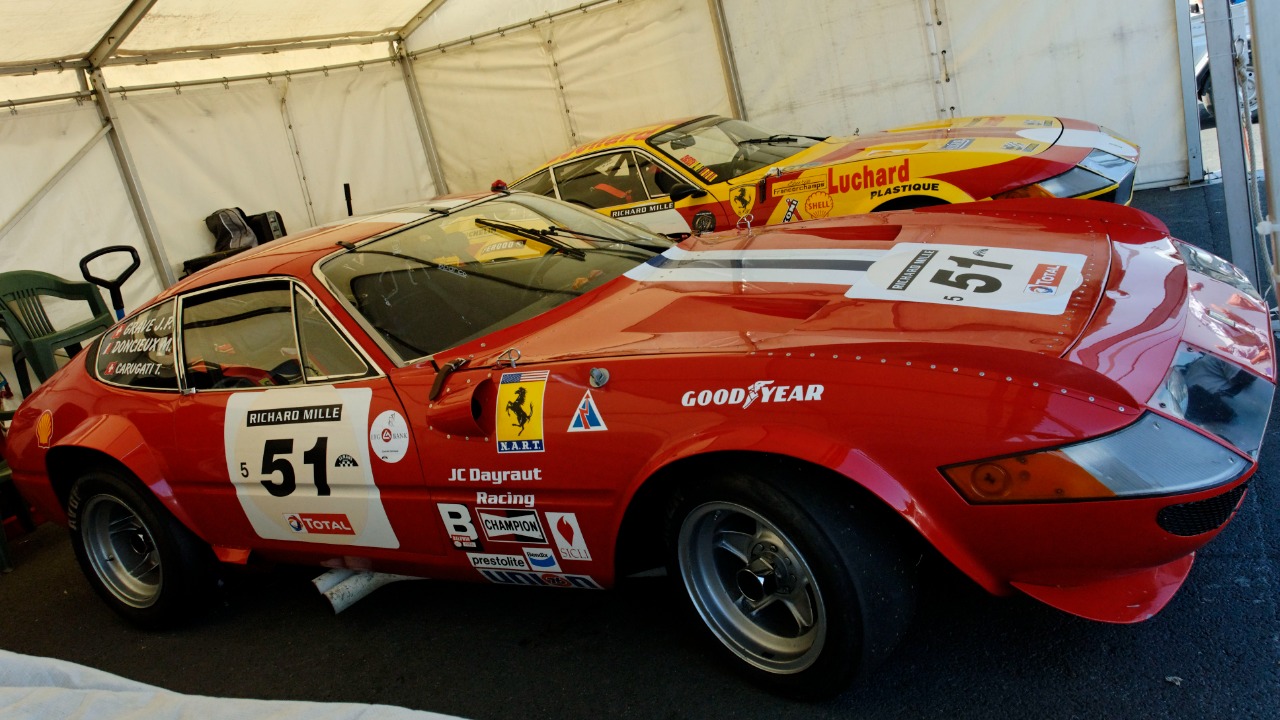
Visually, the 365 GTB/4 is often remembered for its long, shark‑like nose and low roofline, but what strikes me is how little of it feels like styling for its own sake. The basic proportions came from Pininfarina, yet the production body was executed by Scaglietti with an emphasis on stability at speed and structural integrity. With their sights squarely set on the Lamborghini Miura, Ferrari developed an immensely impressive rival powered by The Tipo 251 Colombo V‑12, and the chassis of the berlinetta gained additional bracing within the doors to keep the structure tight at racing velocities, details that are laid out in period‑correct descriptions of the Ferrari 365 GTB/4. That kind of hidden engineering tells me the car was shaped in the wind and on the stopwatch, not just on the drawing board.
Later reflections on the model underline how its shape has aged with a kind of purposeful honesty. One auction profile of a 1971 example leans into the idea that the car is where speed meets style, describing how the 365 G designation, the GTB badge and the DAYTONA nickname came together in a package that still turns heads. The same write‑up notes how the car, framed as THE FERRARI GTB DAYTONA, is presented as a piece of rolling sculpture that never lost sight of its job as a high‑speed tool, a balance captured in the phrase Where Speed Meets Style. I read that as validation of Ferrari’s decision to avoid the more flamboyant, wedge‑heavy look that some enthusiasts later described as “more Lamborghini‑like style” on other cars, a contrast that becomes clear when you see how The Daytona (Ferrari 365 GTB 4) is discussed as an audacious, endurance‑minded machine in buyer guides for the Ferrari GTB.
A V12 that stayed gloriously old‑school
Under that long bonnet, Ferrari doubled down on a naturally aspirated V12 that felt almost defiantly mechanical. The road‑testers who have revisited the car in recent years keep coming back to the same point: the 4.4-litre engine is not just powerful, it is demanding and alive in a way that modern drivetrains rarely are. One detailed video review of the Daytona points out that it made sense to tackle Ferrari icons in chronological order, starting with this car and its 4.4-litre Col‑derived V12, a combination that still delivers towering performance decades on, as captured in a modern Daytona road review. I find it telling that the reviewer treats the car not as a fragile antique but as a serious driver’s machine that demands respect.
Competition‑focused accounts go even further, describing how sleek and modern Pininfarina lines were matched by a development of the same 4.4-litre V12, here fed by six Weber twin‑choke 40 m carburetors to create a Group IV weapon. That combination of carburetion and displacement is laid out in detail in profiles of the Daytona Group IV conversion, which also highlight the car’s carefully tuned balance. When I compare that to later Ferrari choices, such as the shift toward more user‑friendly, side‑straked flat‑twelve cars, it is hard not to hear the echo of critics who argue that And the Testarossa, despite its huge commercial success, was part of a lineage of Ferraris that pulled the brand away from their successful front‑engine layout, a point made bluntly in a spotlight on Ferrari history. Against that backdrop, the Daytona’s engine feels like the last word in a philosophy Ferrari would later sideline.
Racing, road trips, and a taste for endurance
The 365 GTB/4’s refusal to compromise was not just a matter of spec sheets, it played out on race tracks and open roads. During the 1972 race season, White’s dealership was partially responsible for campaigning a Daytona Competition car in endurance racing, and that same network later sent a road‑registered example on another cross‑country road trip, details that surface in the story of how During the early 1970s White used the model. I see that dual life, pounding around circuits and then blasting across the United States, as proof that the car’s grand touring brief was not marketing fluff. It was built to live at high speed for long stretches, and owners treated it that way.
The competition narrative only gets more intense when you look at individual chassis histories. With Group 5 cars like the Porsche 917 and Ferrari 512 outlawed from most major championships in 1972, Kirk F. White’s focus shifted to the Daytona as a more adaptable weapon, a story told through the saga of a particular 365 GTB/4 that later underwent restoration. That account of how With Group 5 cars like the Porsche 917 and Ferrari 512 sidelined, the Ferrari Kirk White backed turned into a long‑distance hero, underlines how the Daytona stepped into a vacuum left by more extreme prototypes. Even away from the factory, private outfits embraced the car’s raw potential: Then Bell Classics bought a fearsome Michelotto‑built example simply because they liked how it looked and how terrifyingly it drove, a sentiment captured in a profile of how Then Bell Classics came to own their car. That kind of language does not attach itself to machines that have been softened for comfort.
Living with a legend, from cockpit to auction block
For all its racing pedigree, the Daytona is still a road car, and modern reviewers who slide behind the wheel tend to sound both awed and slightly relieved. One breakdown of a 1971 example spells out that this car is a 1971 Ferrari, the model according to the factory is 365 G, and it is commonly known as a Daytona, a reminder that even its nickname came from enthusiasts rather than official branding, as explained in a detailed Ferrari the Daytona breakdown. Another presenter, reflecting on a test drive, admits that the car sits firmly in his top 10 list of machines he had always wanted to drive and that he was fortunate to finally experience it, a sentiment shared in a classic Daytona review. Listening to those reactions, I get the sense that the car’s weighty controls and unfiltered feedback are part of the appeal, not drawbacks to be engineered out.
The market clearly agrees. Recent polishing and detailing have enhanced the finish of at least one 1971 Ferrari 365 GTB/4 Daytona, ensuring it still presents with a deep gloss that evokes the design ethos of the 1960s, a point made in a follow‑up note that the same 365 G Ferrari GTB Daytona continues to draw crowds wherever it appears, as described in an article on its presentation. Even rarer variants, like the NART Spider conversions, have their own lore: chassis 14299, for example, began life as a standard coupe with air conditioning and power windows before being reimagined as an open car, a transformation traced in the story of how Daytona chassis 14299 became a NART Spider by Michelotti. Those cars, too, trade on the idea that the underlying machine is robust enough to carry a second life.
Why its stubbornness still matters
Looking back, I see the Daytona as a fork in the road that Ferrari briefly took, then largely left behind. The Ferrari 365 GTB/4, nicknamed Daytona after Ferrari’s 1‑2‑3 finish at the 24 Hours of Daytona in 1967, is often described as a leap forward in performance and design that still kept the engine in front, a balance captured in a profile of The Ferrari GTB Daytona prototype. Yet within a few years, the company was already experimenting with softer, more accommodating front‑engined V12s like the 365 GTC/4, a car explicitly designed as a smoother, easier‑going GT to satisfy the lucrative US market, while the Daytona played the role of the more focused driver’s car with big power by 1971 standards, as set out in an analysis that begins, As the GTC/4 was conceived as a contrast to the Daytona. That divergence tells me the 365 GTB/4 was already an outlier inside its own family.
Even in the way enthusiasts talk about specific cars, the Daytona seems to attract stories that underline its uncompromising character. One walk‑around of a 1971 example casually references Aug and a Caribbean souvenir watch while the presenter is distracted by the car’s instrument cluster, a small moment in a 1971 Daytona video that still hints at how the cockpit pulls focus from everything else. Another deep dive into a 1971 Spyder conversion recalls how a group of ambitious young engineers at Lamborghini created the Miura and in doing so spurred a supercar war between Ferrari, Maserati and Lamborghini, a conflict that the front‑engined 365 GTB/4 Spyder waded into on its own terms, as outlined in the story of the Lamborghini Miura rivalry. When I put all of that together, from the Hours of Daytona inspiration to the way later Ferraris chased comfort and fashion, the 365 GTB/4 stands out as the moment Ferrari proved it could ignore the crowd and still build the car everyone else had to measure themselves against.
More from Fast Lane Only: