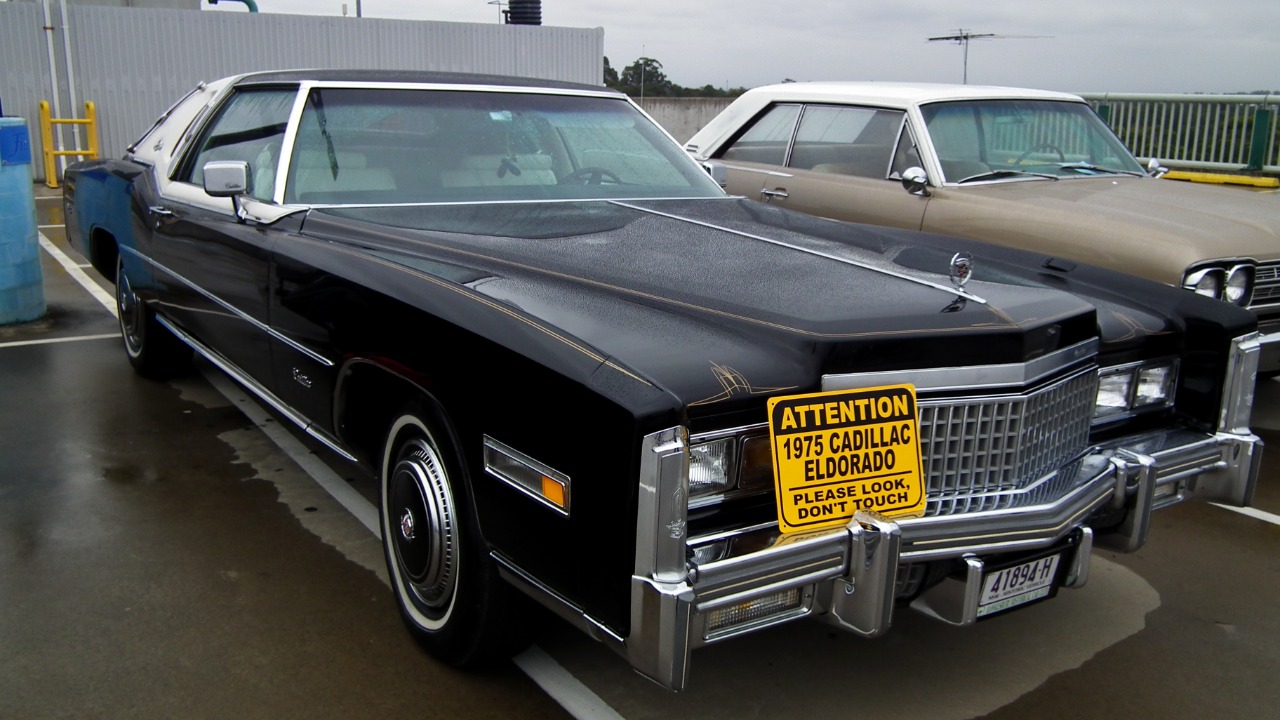
The 1975 Cadillac Eldorado did not just flirt with excess, it treated extravagance as a design brief. At a moment when regulators, fuel prices, and shifting tastes were all pushing Detroit toward restraint, this front-drive giant doubled down on size, power, and spectacle. To understand why, I have to look at the Eldorado not as an outlier, but as the last confident shout of a certain American idea of luxury.
The last big breath before downsizing
By the mid 1970s, the American car industry was under pressure to shrink. Fuel crises and new efficiency rules were already reshaping engineering plans, yet the 1975 Eldorado arrived as a massive personal luxury car that seemed almost indifferent to the storm clouds. It still rode on the same broad-shouldered body shell Cadillac had introduced earlier in the decade, a shape that made no apologies for its footprint even as rivals began to trim theirs. That decision to stay large was not laziness, it was a deliberate signal that Cadillac believed there was still room in the market for unapologetic comfort and presence.
Regulators were not subtle about their expectations. Federal fuel economy standards, which took effect in the mid 1970s, forced manufacturers to think seriously about weight, aerodynamics, and engine size, and only when those fuel economy standards were enacted in 1975 did a comprehensive approach to downsizing really begin to take hold across Detroit. As one analysis of that period notes, the shift gathered momentum only after companies were confronted directly with the new government targets, a turning point that framed cars like the Eldorado as the last of the pre diet era. In that context, the 1975 model reads like a final, confident inhale before the industry exhaled into smaller, lighter shapes, a stance that makes its excess feel almost defiant rather than careless, a point underscored by the way the fuel economy standards are described as the moment when downsizing truly began.
A 500-cubic-inch promise of effortless power

Nothing captures the Eldorado’s taste for excess more clearly than its engine. Cadillac had already set the tone earlier in the decade when the Eldorado adopted a 500 cubic inch V8, described as Cadillac’s largest ever regular production V8, a figure that still sounds audacious in an era of turbocharged fours. That 500 number was not just a specification, it was a marketing statement that told buyers they were purchasing surplus power, the kind of torque that could move a heavy front drive coupe or convertible with a lazy, almost indifferent ease.
By 1975, that same 500 cubic inch V8 remained central to the Eldorado’s identity, especially in the open top version that enthusiasts now see as a pinnacle of 1970s indulgence. Contemporary descriptions of the 1975 Cadillac Eldorado Convertible emphasize that massive 500 cubic inch V8 and its front wheel drive layout as defining traits, pairing brute displacement with a drivetrain that prioritized smoothness over sharpness. When I picture that combination, I see a car built to flatten distance, not attack corners, a rolling lounge that treated acceleration as another form of comfort. The fact that a modern listing still highlights the 500 cubic inch V8 as a selling point shows how deeply that excess is woven into the car’s appeal, while the earlier adoption of the 500 in the Eldorado line explains why the 1975 model felt like the mature expression of that big block philosophy.
Styling that refused to blend in
Excess at Cadillac in the 1970s was not only about what sat under the hood, it was also about how the car occupied visual space. The 1975 Eldorado carried over the long, crisp body introduced earlier in the decade, but Cadillac kept updating the details so the car still looked current even as regulations reshaped bumpers and lighting. Designers had to respond to new impact rules that required lamps to survive low speed collisions, which led to bulkier front and rear treatments and, eventually, the shift to square sealed beams. Instead of hiding those changes, the Eldorado leaned into them, turning the mandated bulk into a kind of visual armor that made the car look even more imposing.
Seen from the side, the Eldorado’s proportions were almost theatrical, with a long hood, short deck, and a beltline that seemed to stretch on for blocks. The convertible version amplified that drama when the roof was folded, leaving a vast, uninterrupted expanse of sheet metal and interior trim that made the car look like a land yacht cruising above the fray. Period commentary on the 1975 Eldorado notes that, while it shared its basic shell with earlier years, Cadillac updated the front and rear styling and refined the way the convertible top stowed so the car looked cleaner and more expensive with the roof down. That willingness to treat regulatory compromises as design opportunities is part of why the Eldorado still reads as stylish rather than simply large, a point that becomes clear when you look at how the bumper and lamp rules described in Jun era legislation reshaped the front end, and how later retrospectives describe the 1975 Eldorado as being above the fray once the roof was folded down.
Luxury as a safety and comfort spectacle
When I look at the Eldorado’s spec sheet, I see a car that treated safety and comfort as another arena for excess. Cadillac’s Triple Braking System, which used a dual chamber hydraulic master cylinder to provide independent operation for the front and rear circuits, was standard on the 1975 Eldorado, a reminder that the brand wanted to project technological seriousness even as it chased indulgence. That system, combined with front wheel drive and a heavy, planted chassis, turned stopping and stability into part of the luxury pitch, reassuring buyers that their rolling living room could also look after them when traffic got messy.
Inside, the Eldorado’s cabin doubled down on the idea that more was more. Thickly padded seats, generous use of brightwork, and a dashboard that wrapped around the driver all contributed to a sense of cocooning that matched the car’s exterior bravado. Owners and fans still talk about the way these cars soak up miles, and in enthusiast discussions of the 1975 Eldorado you can see that attitude distilled into simple, almost affectionate shorthand. In one Aug thread, a user in the Comments Section responds to a question about pros and cons by insisting there are Only pros and, when pressed for an Example, another voice chimes in to describe the ride as almost Miserable in how softly it isolates the driver from the road, a kind of backhanded compliment that captures the car’s personality. That mix of overbuilt braking hardware and plush isolation is why the Triple Braking System and the way fans talk about the car in places like Aug era threads both feel like expressions of the same philosophy, one that equates luxury with an almost theatrical sense of security and ease.
A symbol of a changing American idea of luxury
To me, the 1975 Eldorado also tells a story about shifting American values. Earlier in the decade, the Eldorado’s growth in size and power had tracked a broader confidence in big, expressive cars, but the Arab oil embargo and its aftermath began to chip away at that consensus. Enthusiasts looking back on the Eldorado’s evolution point out that The Eldo got smaller when the Arab oil embargo occurred, then grew again later, a pattern that mirrors the industry’s push and pull between efficiency and opulence. By the time the 1975 model rolled into showrooms, it was already clear that this kind of excess would not last forever, which only heightens its aura today.
That tension between old and new ideas of luxury is part of why the Eldorado still sparks debate among designers and fans. In discussions of Cadillac’s design language, people compare the Eldorado’s swagger to later cars like the CTS Coupe, which tried to reinterpret American luxury with sharper lines and more overt references to performance and technology. When I line those cars up in my mind, the 1975 Eldorado feels like the closing chapter of a story that equated prestige with length, displacement, and softness, while the CTS Coupe represents a newer script built around agility and tech. The fact that enthusiasts still argue about which vision better suits Cadillac shows how powerful the old one remains, a point that surfaces in design conversations about how The Eldo shrank after the Arab crisis and how later cars like the CTS Coupe tried to capture a different kind of desirability.
More from Fast Lane Only: