
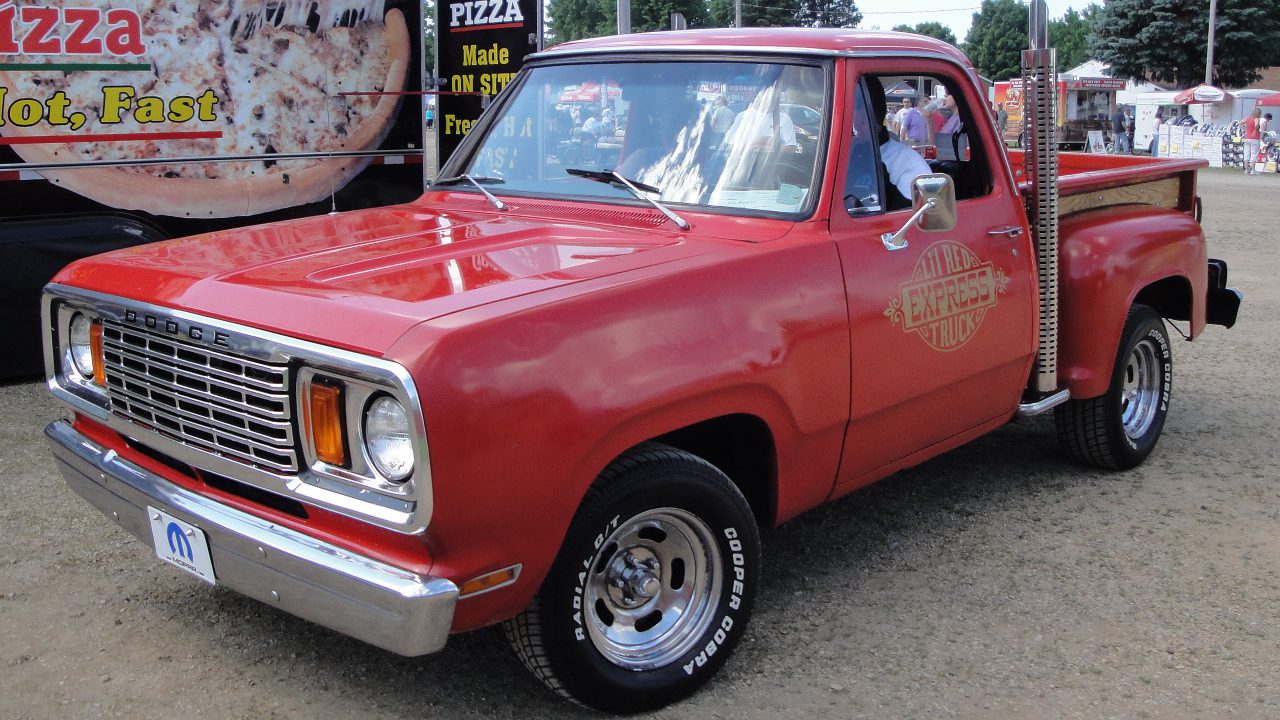
The 1978 Dodge Lil’ Red Express arrived at a moment when performance was supposed to be dead, yet it managed to outrun contemporary muscle cars while still wearing a factory window sticker. By slipping through a regulatory gap that treated light trucks differently from passenger cars, Dodge built a bright red pickup that embarrassed coupes and sedans and forced regulators to confront how uneven their own rulebook had become.
Instead of quietly accepting the era’s emissions and fuel economy clampdown, Dodge used the Lil’ Red Express to probe the limits of what was legal, then pushed right up against that line. The result was a short‑run special that turned a work truck into a loophole hot rod, and in the process exposed how the government’s clean‑air strategy left surprising room for mischief.
Regulations that strangled cars but spared trucks
By the late 1970s, federal emissions rules had transformed the typical American performance car into a shadow of its former self, yet those same standards did not land evenly on every vehicle. Passenger cars were expected to carry catalytic converters, run on unleaded fuel, and sacrifice compression and timing to keep tailpipe numbers in check, while light trucks operated under more lenient requirements that reflected their supposed workhorse role. That split created a gray zone where a manufacturer willing to treat a pickup like a sports car could legally build something far quicker than the era’s coupes.
Dodge recognized that the regulatory language focused on vehicle class rather than outright performance, which meant a half‑ton pickup could avoid some of the hardware that had dulled cars. Contemporary coverage of the Dodge Lil’ Red Express notes that it was not required to have catalytic converters, a crucial distinction that let engineers preserve more traditional V8 tuning and exhaust flow. In effect, the government’s attempt to clean up family sedans left a back door open for any company bold enough to turn a “truck” into a performance flagship.
Dodge’s loophole hot rod takes shape
Instead of treating that gap as a footnote, Dodge built an entire package around it and gave the result a name that made no attempt to hide its intent. The Dodge Lil’ Red Express Truck combined a small‑block V8 with aggressive gearing and a distinctive exhaust layout that took full advantage of the lighter emissions burden on pickups. With no catalytic converters choking the system, the vertical stacks behind the cab were not just styling flourishes, they were functional pipes that signaled how far this truck sat from the era’s smog‑strangled cars.
Production numbers underline how experimental the idea was. The Dodge Lil’ Red Express Truck was a hit with the public, yet only 2,188 were produced in 1978, a volume that kept the risk manageable while Dodge tested whether regulators or consumers would push back. With the success of that first run, Dodge followed up with a 79 Lil’ Red Truck, confirming that the company saw enough demand to keep exploiting the same basic formula. The limited build also helped the truck feel like an insider’s secret, a factory special that existed precisely because someone in Auburn Hills had read the rulebook more creatively than the competition.

Fastest from 0 to 100, in a pickup
The most stinging part for regulators and rival automakers was not the Lil’ Red Express’s styling, it was the stopwatch. In period testing, the Dodge Lil’ Red Express was recorded as the fastest American made production vehicle from 0 to 100 mph, a title that would traditionally belong to a sleek coupe, not a square‑shouldered pickup. That performance edge came directly from the mechanical freedoms trucks still enjoyed, including the absence of catalytic converters and the ability to run a more assertive tune than contemporary passenger cars.
Enthusiast walkarounds and modern retrospectives highlight how out of step the truck’s acceleration was with its official mission as a light‑duty hauler. Commentators who examine surviving examples point to the combination of the small‑block engine, the free‑flowing exhaust, and the relatively light curb weight as the ingredients that let the Lil’ Red Express punch above its visual weight. When a vehicle that looks like a work rig can out‑sprint the period’s pony cars, it becomes a rolling critique of how unevenly performance had been regulated across the market.
Styling that advertised its defiance
Dodge did not try to hide what it had built behind subtle paint and quiet pipes. The Lil’ Red Express wore bright red bodywork, bold door graphics, and polished vertical stacks that made the truck impossible to miss in traffic. That visual loudness matched the mechanical audacity, turning the pickup into a kind of mobile billboard for the idea that performance was not entirely dead, it had just moved into a different vehicle class. The styling choices made the loophole visible, which in turn made it harder for regulators to ignore.
Modern walkarounds, including segments featuring Steve Magnante at High Octane Classics, linger on details like the wood‑trimmed bed, the DODGE lettering, and the LIL’ RED EXPRESS callouts that frame the truck as a deliberate throwback to pre‑regulation muscle. Those cues were not nostalgia for its own sake, they were part of a strategy to signal that this was a performance product hiding in plain sight within the truck lineup. By leaning into the visual drama, Dodge ensured that the Lil’ Red Express would be remembered not just as a spec sheet anomaly, but as a cultural statement about where speed could still live in a tightly regulated era.
Legacy and the regulators’ response
The Lil’ Red Express did not immediately rewrite the emissions rulebook, but it did highlight a structural problem that regulators would eventually have to address. By proving that a light truck could be tuned into the quickest American production vehicle while still complying with the letter of the law, Dodge exposed how the policy distinction between “cars” and “trucks” no longer matched how people actually used or perceived those vehicles. Over time, tightening standards for pickups and SUVs would narrow that gap, but the 1978 experiment showed how much performance had been left on the table for anyone willing to play in the truck category.
Later performance pickups, including the Ram SRT10 with its Viper V10, can be read as spiritual descendants of that original Audacity, even as they operated under a more mature regulatory framework. Enthusiast histories that trace the line from the Lil’ Red Express to those later halo trucks often frame the 1978 model as the moment Dodge realized a pickup could carry the brand’s performance flag as effectively as any coupe. In that sense, the truck did more than shock regulators, it helped shift the center of American performance culture toward vehicles that had once been treated as mere tools, and forced policymakers to recognize that their categories had become invitations for creative workarounds.
More from Fast Lane Only:



Leave a Reply