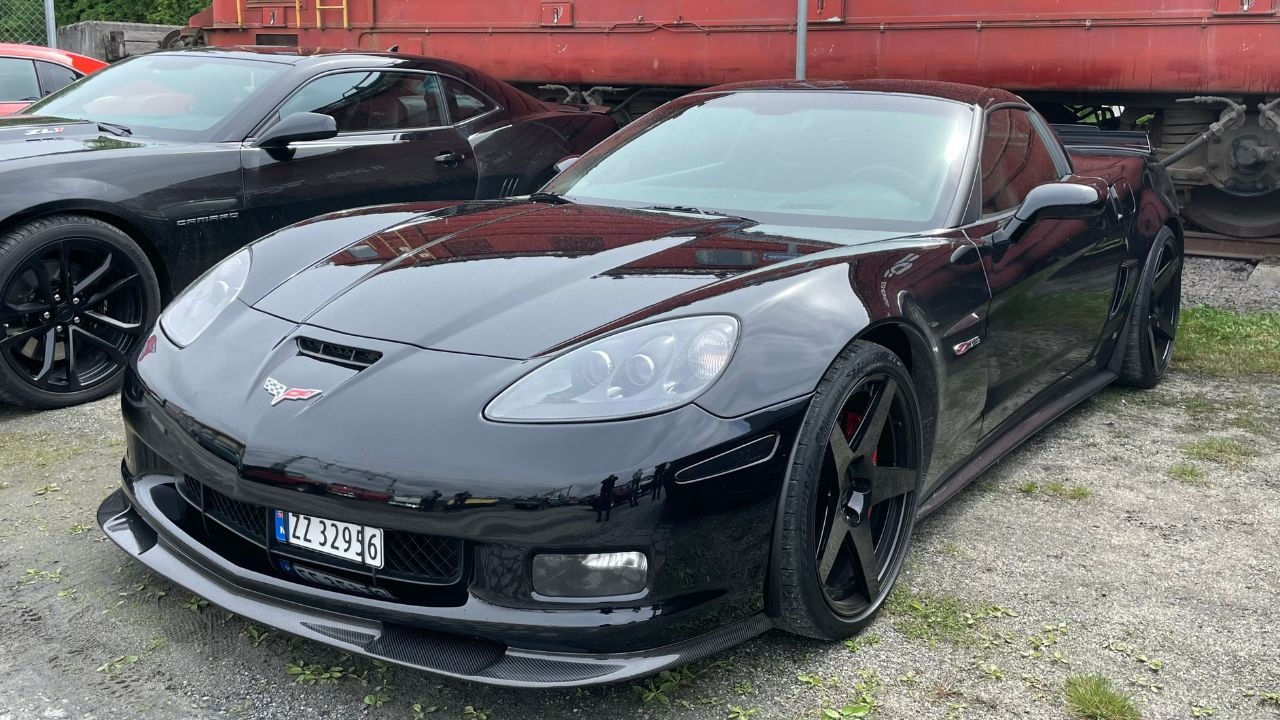
The 2006 Corvette Z06 did not stumble into supercar territory by accident. It arrived there by stripping mass out of almost every component that did not absolutely need to be heavy, then pouring the savings into a hand built 7.0 liter V8 and serious track hardware. When I look at how it was engineered, I see a car that treats weight as an enemy to be hunted, not just a number on a spec sheet.
The aluminum backbone that changed the Corvette playbook
Lightweight engineering on the 2006 Z06 starts with the structure you cannot see. Instead of the steel frame used on the standard C6, the Z06 rides on an aluminum body structure that was developed alongside the factory C6.R race car to deliver high stiffness with far less mass. Official specs describe an aluminum body structure with one piece hydroformed side rails and other advanced manufacturing tricks, a clear sign that the road car was borrowing heavily from the race program.
That structural rethink continues with the fixed roof layout and unique hardtop shell. The Z06 has a distinct Body configuration that is optimized for stiffness and low weight, rather than the removable roof panels that define many other Corvettes. By locking in a lighter, more rigid platform, engineers created a foundation where every pound saved translated directly into sharper responses on track, instead of being soaked up by flex or compromise.
Carbon, composites, and the quiet revolution in panels

Once the aluminum skeleton was in place, the team turned to the skin. I am always struck by how methodically they used composites to shave ounces from broad, flat surfaces that add up quickly. For the hood, doors, trunk lid and tonneau cover, the C6 generation leaned on For the broad flat parts SMC, or Sheet Molded composite, delivered strength with less weight than traditional steel, while the floorboards were carbon fiber to drop mass low in the chassis where it helps handling most.
That mix of SMC and carbon fiber panels did more than pad a marketing brochure. By trimming weight from the extremities of the car, the Z06 reduced its polar moment of inertia, which is a fancy way of saying it could change direction more eagerly. It is the same principle that makes a figure skater spin faster when they pull their arms in, and it aligns perfectly with the idea that Lighter cars accelerate faster, brake shorter, and corner sharper because there is less mass to move and control, especially when that mass sits far from the center of the car.
LS7: a big cube V8 built like a race motor
Under the hood, the Z06’s weight strategy takes a different form. The LS7 7.0 liter V8 is famous for its displacement, but the real story is how obsessively its internals were lightened to let such a large engine rev and respond like a smaller one. The LS7 is a Gen IV V8 that shares basic architecture with the Corvette’s 6.0 liter LS2, but it uses a different cylinder block, lightweight reciprocating components, and unique heads and manifolds to support its higher output and track duty.
On paper, the LS7’s numbers are still startling. The engine displaces 427-cubic-inch in a Gen IV package with lightweight reciprocating parts, and it delivers 505 horsepower and 377 kilowatts in factory trim. That same displacement figure appears again in the official options list, where the Z06 Included a 427 engine as part of its base equipment, underscoring how central the LS7 was to the car’s identity.
Race bred heads and the C5R connection
Dig deeper into the LS7 and the racing DNA becomes even clearer. The cylinder heads look a lot like those from the C5R race car, with ports that are computer milled and valves that stand up at a more efficient angle than standard C6 parts, a detail that was highlighted in early Dec testing. That geometry lets the big V8 breathe more freely at high rpm, which is crucial when you are asking a naturally aspirated engine to make 505 horsepower while still being tractable on the street.
The combustion chambers themselves carry a direct link to the Corvette C5R racing program. Engineers describe Their design as another legacy of that effort, with 70-cc combustion chambers that are cast for excellent port and chamber shapes and require minimal finishing operations. In practice, that means the LS7 could be built in meaningful volume while still delivering the kind of airflow and efficiency you would expect from a hand ported race head, a neat example of motorsport tech filtering directly into a showroom car.
Chasing grams everywhere else
What I appreciate most about the 2006 Z06 is how the weight savings do not stop at the frame and engine. The official press material is explicit that But for all its comfort, engineers did sacrifice a few components in the quest for lower weight and higher performance, including some sound deadening and convenience items, to allow more aural feedback of the powertrain. That tradeoff is classic lightweight thinking: remove what does not help you go, stop, or turn, and accept a bit more noise and rawness as the price of sharper dynamics.
The chassis and suspension follow the same philosophy. The Z06’s unique aluminum structure and composite panels are paired with track focused wheels, tires, and brakes that cut unsprung mass, which is exactly the kind of rotating weight that matters most according to the principle that But reducing weight like wheels, tires, and suspension parts pays outsized dividends. Every pound trimmed from those components lets the dampers control the tires more precisely, which is a big reason the Z06 feels so composed at speeds that would fluster softer sports cars.
From spec sheet to supercar performance
All of this careful dieting would not matter if the Z06 did not deliver on the road, but period tests and owner experiences make it clear that it did. The combination of the LS7’s 505 horsepower, the aluminum and composite structure, and the track tuned suspension gave the car acceleration and grip that lined up with far more expensive exotics. One detailed breakdown of the 2006 Engine and Performance notes that at the very heart of the Chevrolet C6 2006 Z06 lies the LS7 7.0 liter V8, and that the car features an aluminum frame and other critical upgrades for track performance, which ties the whole lightweight story together.
From the driver’s seat, that engineering translated into a car that could deliver supercar performance while still returning respectable fuel economy and everyday usability. Contemporary reviews of the 2006 Chevrolet Corvette Z06 highlighted how the big LS7 could sip fuel gently at highway cruise yet unleash its full 427-cubic-inch fury on demand, a dual personality made possible by the same careful attention to friction, airflow, and mass that defined the rest of the car. When I look back at the Z06 today, I see a blueprint for how to go all in on lightweight engineering without turning a road car into a stripped out toy.
More from Fast Lane Only: