The 2017 Ford GT arrived as more than a nostalgic tribute to Le Mans glory. It was a rolling proof of concept that the United States could engineer a modern supercar with the speed, sophistication, and exclusivity to stand beside the best from Europe, while quietly serving as a laboratory for future road cars. By pairing radical aerodynamics and lightweight materials with a downsized turbocharged engine, Ford used the GT to show that American performance could be as innovative as it was loud.
From secret skunkworks to statement piece
The reborn Ford GT did not emerge from a traditional product cycle, and that unconventional origin is part of why it mattered. Ford developed the car in near secrecy, with internal design work on the Ford GT kept away from the usual corporate spotlight, a process highlighted in a Feb video feature that asked how Ford could build such a machine without anybody knowing. That quiet gestation allowed engineers and designers to chase extreme solutions without being forced to justify every curve and carbon panel against mass‑market constraints, which is exactly what a supercar program needs if it is going to reset expectations rather than simply decorate a showroom.
When the wraps finally came off, the GT instantly read as a declaration that American engineering could play in the same rarefied space as Italian and German exotics. Reporting on the car’s debut noted that it was Unveiled at the North Ameri auto show, a stage usually dominated by European halo models, and that context mattered. Instead of a retro pastiche, the new GT wore a fuselage-like body, flying buttresses, and a cabin pushed far forward, all of it shaped around airflow and cooling rather than nostalgia. That visual shock signaled that Ford was not just revisiting history, it was trying to write a new chapter in how a U.S. brand approaches the supercar brief.
Aerodynamics that could fight at Le Mans and cruise on Main Street
What truly separated the 2017 Ford GT from earlier American performance cars was the way its bodywork worked as hard as its engine. Ford’s own technical material on Racing to the Future described how the GT’s shape was sculpted to Test Technologies for Tomorrow and reduce drag while generating serious downforce, with the fuselage around the engine and the dramatic buttresses channeling air in ways more common to prototype race cars than road‑legal coupes. The active rear wing, described as using a patent‑pending design that changes the shape of the aerofoil, could alter its profile and angle depending on speed and driver input, effectively giving the car multiple aerodynamic personalities in one package.
Independent first drives backed up the claim that this was not styling theater. Testers reported that the active aerodynamics delivered superb high‑speed stability through fast corners and under heavy braking, making the GT feel locked down on a circuit yet surprisingly composed on public roads. That dual character is crucial to the car’s significance: it showed that an American manufacturer could integrate complex, race‑grade aero into a package that owners could actually drive to dinner. Instead of a crude straight‑line missile, the GT behaved like a fully modern supercar, using airflow management as a primary performance tool rather than an afterthought.
Lightweight engineering and a downsized powerhouse
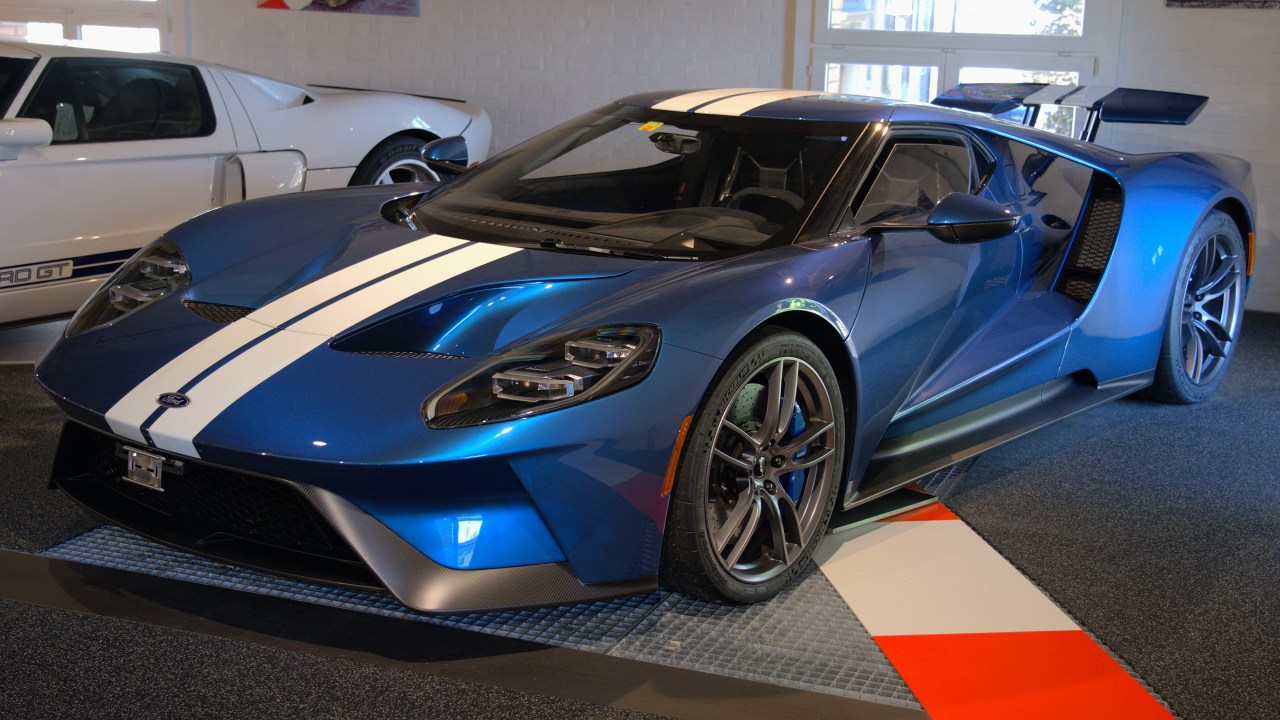
If the shape proved Ford could think like a European race team, the structure and powertrain proved it could execute like one too. The GT’s carbon fiber monocoque and extensive use of composite body panels were central to the Racing to the Future philosophy, which framed the car as a way to Test Technologies for Tomorrow’s Vehicles rather than a one‑off vanity project. Ford’s own description emphasized that All of the weight savings and engine advancements served a singular purpose, creating the fastest and most efficient Ford GT it could build. That meant obsessing over every kilogram, from the carbon tub to the Optional 20 x 11.5 in. carbon fiber rear wheels that wore massive 325/30R20 Michelin Pilot Sport Cup 2 tires, a combination that underlined how serious the company was about grip and unsprung mass.
Under the rear glass, Ford made an even bolder statement by rejecting the traditional big‑displacement V8 in favor of a twin‑turbocharged V6. Official figures confirmed that the 2017 Ford GT was rated at 647 horsepower and capable of 216 m top speed, numbers repeated in separate performance summaries that described the car as a 647 HP 2017 Ford GT Goes 216 M P machine. Those metrics were not just bragging rights, they were proof that a smaller, more efficient engine could deliver world‑class performance when paired with advanced aerodynamics and lightweight construction. In a market where American muscle had long been equated with cubic inches, the GT’s downsized powerhouse showed that the United States could embrace the same efficiency‑driven philosophy that shaped contemporary European supercars, without giving up on headline speed.
Race-bred credibility and a global supply chain
For any supercar, competition success is the quickest way to silence skeptics, and Ford built the GT with racing in mind from the outset. The Racing to the Future program framed the car as a tool to Test Technologies for Tomorrow in real competition, not just a marketing exercise. The same active aero, carbon structure, and compact engine that defined the road car were developed in parallel with the GT race program, creating a tight feedback loop between track and street. That approach echoed the way European brands like Ferrari and Porsche have long used endurance racing as a development lab, and it signaled that Ford was serious about playing in that arena on equal terms.
The way the GT was brought to life also reflected a more global, sophisticated model of American performance. A detailed profile of the project described the car as Designed, engineered, powered by Ford and built by Multimatic, a Canadian specialist with deep experience in advanced structures and racing programs. That partnership showed that Ford was willing to tap into a broader Technology Group of expertise rather than insisting on a purely in‑house solution, a strategy more commonly associated with boutique European makers. By orchestrating this international supply chain while keeping the design and powertrain under the Ford and banner, the company demonstrated that an American supercar could be both proudly domestic in identity and globally sourced in execution.
Exclusivity, image, and the new American supercar template
Performance numbers and engineering tricks only tell part of the story. The way Ford controlled access to the GT was just as important in positioning it as a true supercar rather than a high‑volume halo model. Allocation reporting showed that Ford vetted potential buyers and limited production, with notable figures like Interestingly, Zak Brown, the executive director of the McLaren Technology Group, being selected to receive a GT. Brown, a prominent figure in international motorsport, choosing to park a Ford GT alongside European exotics sent a powerful signal about how the car was perceived among people who live and breathe high‑end performance. That curated exclusivity mirrored the practices of brands like Ferrari, where ownership is as much about being admitted to a club as it is about writing a check.
The combination of scarcity, technology transfer, and motorsport credibility reshaped what an American supercar could look like. A contemporary analysis labeled it a Supercar that was Designed, engineered, powered by Ford and built by Multimatic, underlining that this was not a tuner special or a one‑off concept but a fully realized, factory‑backed effort. Ford’s own performance site framed the project as being developed From the Ground Up, stressing that Whether on the road or on the track, every single element of the Ford GT was designed to deliver extraordinary performance. In practice, that meant a car that could touch 216 m, lean on active aero and a carbon tub, and still serve as a test bed for technologies destined for more attainable Vehicles. By proving that such a machine could come from Detroit’s orbit, Ford did more than revive a famous nameplate. It showed that America could build a supercar that met the world on equal terms, not by copying old formulas, but by racing toward the Future with its own ideas.
More from Fast Lane Only: