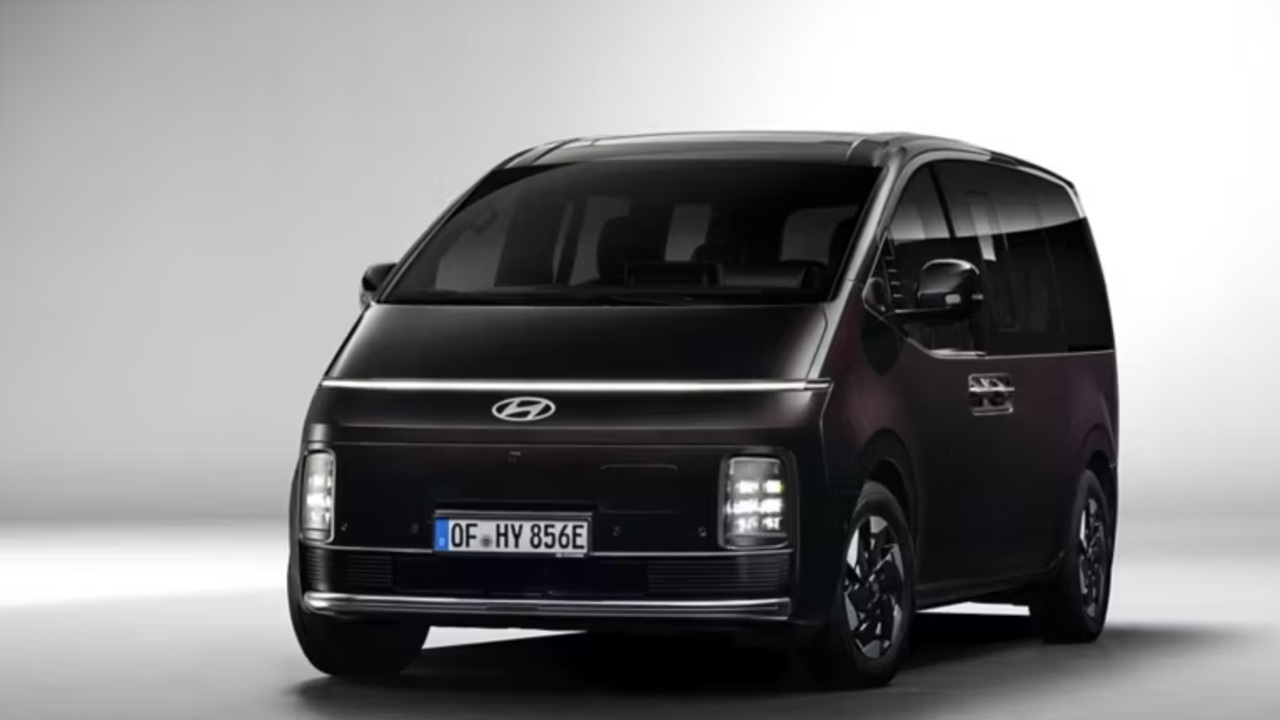
Hyundai has turned its most futuristic van into a full battery electric model, and the result looks like a sci-fi shuttle that happens to seat an entire family or work crew. The new Staria Electric keeps the dramatic one-box silhouette of the existing Staria MPV while adding a dedicated electric platform, long-range battery and rapid charging that aim to move people carriers into the same spotlight as headline-grabbing SUVs. I see it as a clear signal that the people mover segment is finally being treated as a showcase for design and technology rather than a utilitarian afterthought.
A spaceship van with real-world priorities
From the outside, the Staria Electric leans hard into its space-age persona, yet the design choices are rooted in practicality. The body is still a large, van-shaped MPV based on the same platform as the Santa Fe SUV, with a low beltline that creates massive windows and a panoramic feel for passengers. The front light bar, smooth surfacing and almost monolithic profile give it the presence of a concept car, but the tall roof and generous headroom show that Hyundai has not sacrificed usability in pursuit of style.
What strikes me is how closely the electric version tracks the existing gasoline Staria while still signaling its new powertrain. Reports note that although the electric version shares a similar design with the current gas model, it stands out with EV-specific elements such as a closed-off grille and aero-focused wheels that help efficiency. The cabin continues the futuristic theme with wide digital displays across the dashboard and a minimalist layout that still leaves plenty of physical storage, including a driver-specific cup holder that has already become a talking point among those who have seen the Staria Electric in person.
Powertrain, range and charging that target long-haul duty
Underneath the sci-fi bodywork, the Staria Electric is engineered for serious daily use rather than short urban hops. Hyundai has confirmed an 84 kWh battery for the Staria MPV, paired with an electric motor that delivers performance tuned for a fully loaded people mover rather than outright speed. The company is quoting a driving range of about 400 km on a charge, a figure that positions the van for regional family trips and airport shuttle duty without constant charging stops.
What gives the Staria Electric an edge in its class, in my view, is its 800-volt architecture, a specification that is still rare among vans. Debuting in Brussels, the 800-volt minivan is designed to support high-power DC charging, with reports indicating that it can sustain average charging speeds of around 180 kW when conditions allow. An 11 kW AC onboard charger is also offered for home or depot use, and the front-mounted CCS2 port is heated to avoid tricky situations during winter, a small but telling detail that shows Hyundai has thought about real-world cold weather operation rather than just brochure numbers.
Cabin flexibility and seating for seven or nine
Inside, the Staria Electric is unapologetically a people mover, and I see that as one of its greatest strengths. Seven people can be accommodated with two captain’s chairs in the second row and a three-person rear bench, a layout that suits families who want easy access to the third row and more comfort for long journeys. Hyundai is also offering a nine-seat configuration that targets hotel shuttles, ride-hailing fleets and large families, using a more traditional bench arrangement while still taking advantage of the van’s generous headroom.
The electric packaging helps here, because the battery is integrated under the floor, leaving a flat interior and improving access throughout the cabin. Reports highlight that the roofline has been worked to maximize headroom, which, combined with the low window line, creates an airy, lounge-like feel that is rare in vehicles this practical. The paint palette includes sober colors such as black alongside brighter options, and the interior design mixes a clean digital instrument panel with practical storage spaces, so the Staria Electric feels modern without becoming fragile or fussy for everyday family use.
Market positioning, rivals and the US-shaped gap
Hyundai is not shy about the role it wants this van to play in its global lineup. Official statements describe the Hyundai STARIA Electric Debuts, Setting a New Standard for Spacious, Everyday Zero, Emission Mobility, language that underlines the company’s ambition to make this more than a niche shuttle. STARIA Electric is set for global sales in 2026, with Hyundai confirming that it will go on sale in Korea and Europe in the first half of the year, and that the model is being prepared for a UK launch as part of a broader push into electric MPVs.
At the same time, there is a conspicuous gap in the rollout. Meanwhile, Over Here In The US, reports make clear that the STARIA Electric minivan is not coming to the US, at least in the near term. One analysis framed the question directly with the line Will the Hyundai STARIA Electric Come to the US? and answered with a Short response that it probably will not anytime soon, even as Hyundai has confirmed sales for Korea and Europe. For now, American buyers who want a futuristic electric van will have to look elsewhere, while European and Korean customers get a model that many commentators argue does what the Volkswagen ID. Buzz has promised, combining a distinctive design with a genuinely spacious, nine-seat-capable interior.
What the Staria Electric signals about the future of family EVs
For me, the most interesting aspect of the Staria Electric is what it says about where the electric market is heading. The automotive world has been waiting for a fully electric version of the Staria MPV, and Hyundai has finally pulled the cover off a model that treats family and commercial transport as a first-class use case for advanced EV technology. By pairing a dramatic, spaceship-like body with an 84 kWh battery, 400 km range and 800-volt charging, Hyundai is effectively arguing that large, multi-row vehicles can be just as innovative as sleek crossovers or performance sedans.
That shift matters because it broadens the appeal of electric vehicles beyond early adopters and into the realm of everyday logistics, from school runs to hotel transfers. Hyundai has unveiled the all-electric version of its Staria MPV at the Brussels Motor Show, called the Staria Electric, and framed it as a model that sets a new standard for modern lifestyles rather than a compliance product. As I see it, the combination of sci-fi styling, serious charging hardware and flexible seven and nine seat layouts turns the Staria Electric into a bellwether for how quickly electric powertrains will permeate the most practical corners of the market, even if some regions, notably the United States, will have to watch that transformation from afar for now.
More from Fast Lane Only: