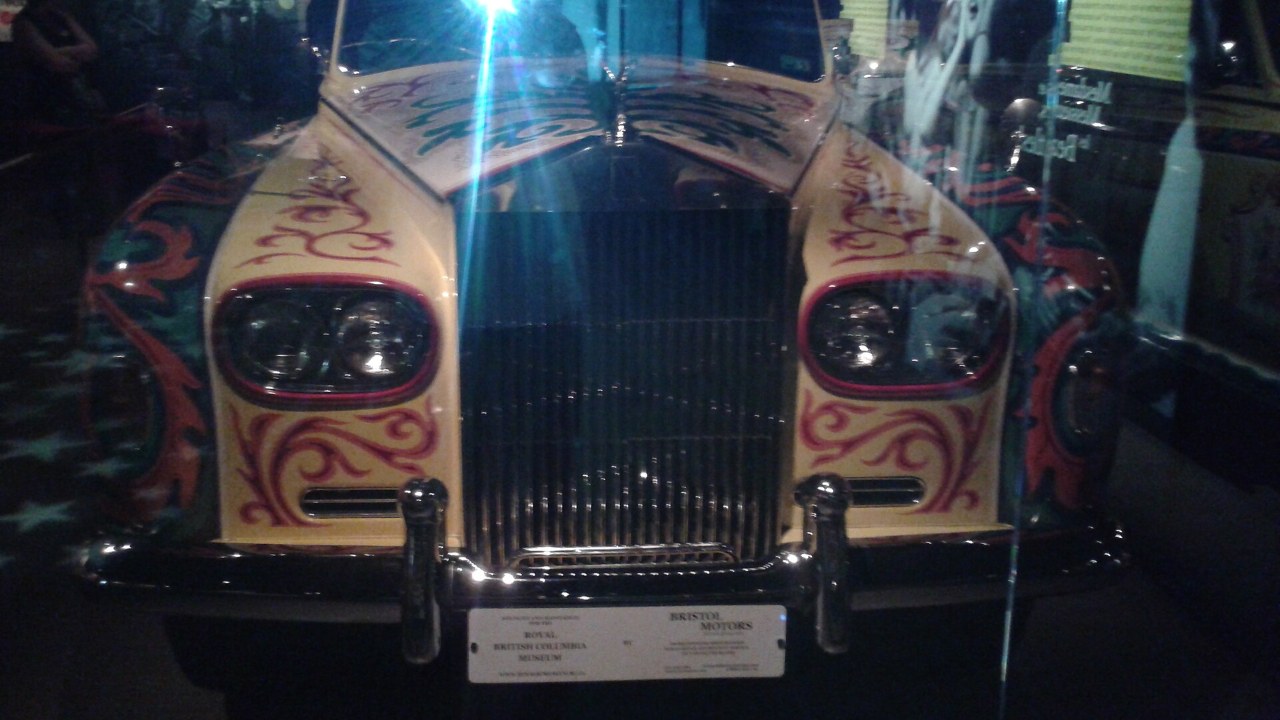
John Lennon’s Rolls-Royce left the factory in plain black and came back from the painters bright yellow. Later, in 1985, Sotheby’s sold the psychedelic 1965 Phantom V for $2,299,000. That was more than seven times its estimate.
The buyer was Jim Pattison, a Vancouver businessman. So the car crossed into Canada, where it has spent most of the years since. However, the story of how it got to that sale runs through London, Spain, New York and a Smithsonian museum.
Here is how a black limousine became a rolling piece of 1960s art, and what it fetched when it came up for sale.
A Black Phantom V Delivered in June 1965
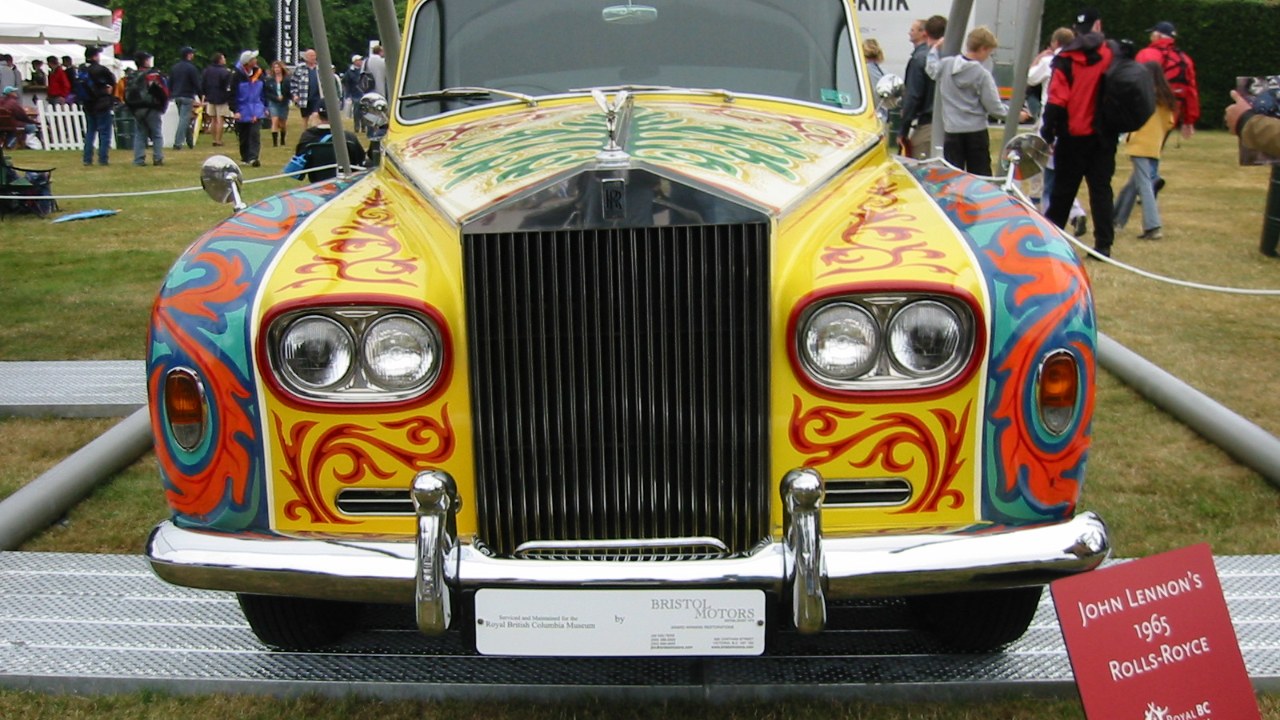
Lennon ordered the car in December 1964, after the release of Beatles for Sale. Then the factory delivered it on June 3, 1965, according to Montecristo magazine’s history of the car. It was finished in black with black leather upholstery. The magazine puts its weight at 3,000 kilograms and its length at 19 feet.
The Royal BC Museum identifies it as a 1965 Phantom V Touring Limousine. Its original colour, the museum says, was Valentine Black. Meanwhile, a Vancouver Courier report gives the engine as a 6.23-litre V8.
The car joined Beatles history almost at once. On June 11, 1965, the band rode in it to Buckingham Palace to receive the Order of the British Empire from the Queen, according to the Royal BC Museum.
Lennon Rolls-Royce Upgrades: A Bed, a Record Player and a Loudhailer
Lennon did not leave the Lennon Rolls-Royce stock for long. In December 1965, he had the rear seat converted into a double bed, according to the Vancouver Courier archive. He also added a Philips Auto-Mignon record player, a Philips reel-to-reel tape deck and a Sony TV. In addition, one-way darkened Triplex glass went into the windows.
Montecristo lists more additions. They include a radio-telephone, a refrigerated trunk and a 10-watt loudhailer. Even the horn changed, because Lennon had it play “Lili Marlene.”
The May 1967 Paint Job That Cost £290
The famous colours came in spring 1967. According to Montecristo, artist Steve Weaver painted the car at coachworks J.P. Fallon Ltd. and finished in May 1967. He used a Romany-style design, with a yellow body and floral panels.
The bill was £290, which Montecristo puts at about $9,200 in today’s dollars. Notably, the Royal BC Museum says the car came back shortly before the release of Sgt. Pepper’s Lonely Hearts Club Band. That timing tied the car to the album in the public mind from the start.
From New York to the Smithsonian
Next, the car followed Lennon across the Atlantic. AutomotiveHistory.org says it moved to the U.S. in 1970, when Lennon relocated to New York. According to Montecristo, Lennon then lent it to Bob Dylan, the Rolling Stones, Elton John and the Moody Blues.
In 1977, the car went to the Cooper-Hewitt Museum, part of the Smithsonian. The Courier archive calls the move a donation. Similarly, AutomotiveHistory.org says Lennon gave it in exchange for a $225,000 tax credit. Montecristo, by contrast, describes a sale that settled a tax dispute, so accounts of the terms differ.
Either way, the museum showed the car for 15 months and then put it in storage, according to Montecristo. AutomotiveHistory.org adds that insurance costs played a part.
The Lennon Rolls-Royce Sale at Sotheby’s in 1985
Eventually, the Cooper-Hewitt sent the car to auction. Sotheby’s offered it on June 29, 1985, with a pre-sale estimate of $300,000, according to AutomotiveHistory.org.
The bidding went far past that. Jim Pattison bought the car for $2,299,000, according to both Montecristo and the Courier archive. AutomotiveHistory.org’s page prints $2,229,000 instead. We use the figure the other two sources agree on.
For context, that winning bid was more than seven times the estimate. It came 18 years after Steve Weaver’s £290 paint job.
Where the Car Went After the Sale
After the auction, Pattison put the car on show at a Ripley’s Believe It or Not museum in South Carolina, according to Montecristo. Then he loaned it for display at Expo 86 in Vancouver.
Later, the car went to British Columbia for good. Sources disagree on the year: AutomotiveHistory.org gives 1987, while the Courier archive gives 1993. Montecristo says it spent six years at the Transportation Museum of British Columbia before it moved to the Royal BC Museum.
Most recently, the Royal BC Museum showed it free in its lobby. That exhibition ran from May 14, 2025, to April 8, 2026, and the museum now lists it as a past exhibition.
More from Fast Lane Only
- Unboxing the WWII Jeep in a Crate
- 15 rare Chevys collectors are quietly buying
- 10 underrated V8s still worth hunting down
- Police notice this before you even roll window down
This article was created with the help of AI and was reviewed and edited by Fast Lane Only editors before publication.