
The 1950 Nash Rambler Convertible Landau proved that a small American car could feel upscale. Nash launched it in April 1950, and the Rambler went on to help start America’s compact-car segment. Most of its small-car rivals failed. The Rambler, however, didn’t.
These six Nash Ramblers are our picks for the ones we’d refuse to sell at any price. The verdicts are our own take, but the prices, engines and dates come from the record.
1. 1950 Nash Rambler Convertible Landau
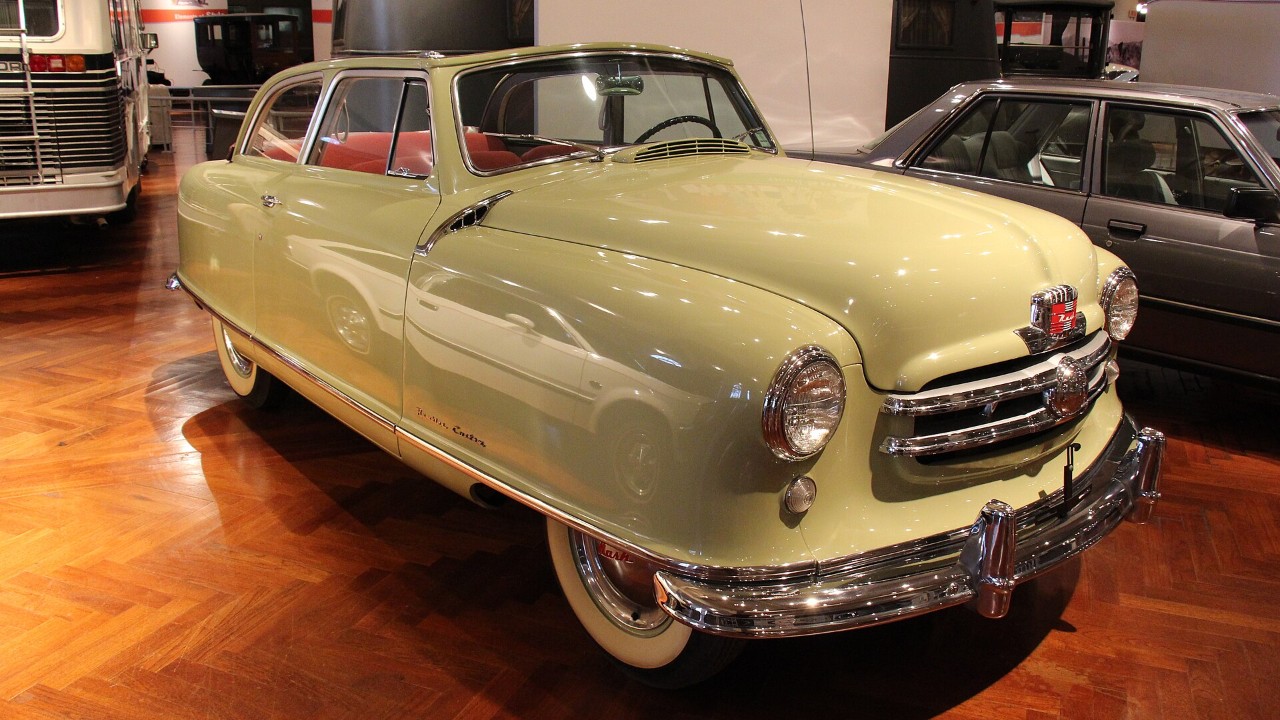
For its first year, the Rambler came in only one body style: this two-door convertible. Its door and rear-window frames stayed fixed while the canvas top rolled back. As a result, that design let Nash keep its unibody construction without extra bracing. The price was $1,808, which made it the cheapest convertible in America. Yet a radio, an electric clock, whitewalls and full wheel covers came standard. Power came from an 82 hp L-head six. Even so, Nash sold 9,330 in the short first year. That’s why we’d keep one forever.
2. Nash Rambler Deliveryman

Nash built a working Rambler, too. The Deliveryman was a two-door utility wagon, priced at $1,892. Better still, it used the same compact unibody as the passenger Ramblers, with Nash’s Airflex coil-spring front suspension. As a result, in our view, a small business got a delivery car with a car-like ride. It’s also the Rambler that rarely gets talked about. To us, that’s the reason to hang on to one.
3. 1953 Nash Rambler Custom station wagon

For 1953, Pinin Farina gave the Rambler its first restyle. Because it took cues from the bigger Nash Airflyte cars, it got a lower hood line, while skirts continued to cover the front wheels. Buyers could also pick a 184-cubic-inch six with 85 hp, or a 195.6 with 90 hp when they ordered GM’s Hydra-Matic. That’s a lot of style for a small family wagon. In fact, we think the Italian touch makes the 1953 Custom wagon one of the best-looking Ramblers of all.
4. 1954 Nash Rambler Custom Country Club

Nash added the Country Club hardtop in 1951, the year the Rambler bet on compact thinking. It was a pillarless two-door, so it gave a small car a big-car look. By 1954, Custom models wore a Continental spare tire as standard. Nash also offered its integrated air conditioning that year for $345. Then, on May 1, 1954, Nash and Hudson announced the merger that created American Motors. That makes 1954 the last model year Nash started as an independent company. We wouldn’t let a Country Club from that year go.
5. 1955 Nash Rambler Cross Country

The four-door Cross Country wagon joined the line in 1954, on a longer 108-inch wheelbase for bigger families. For 1955, Nash removed the front fender skirts, which tightened the turning radius. Helene Rother also designed the interior that year. Meanwhile, an automatic Rambler four-door set a Mobil Economy Run record of 27.47 mpg. However, 1955 was also the final year for the original compact Rambler. In our view, a last-year Cross Country is the family hauler to keep.
6. 1956 Nash Rambler four-door hardtop

The 1956 Rambler was all new, and every body style had four doors. Buyers could choose a sedan, a wagon or this four-door hardtop sedan. AMC also introduced the industry’s first four-door hardtop station wagon that year. Under the hood, meanwhile, sat a new overhead-valve 195.6-cubic-inch Typhoon six with 120 bhp. Two- and three-tone paint schemes were optional, too. Sales totaled 66,573 in 1956, including 20,496 Hudsons. Finally, a tri-tone hardtop is the one we’d never sell.
More from Fast Lane Only