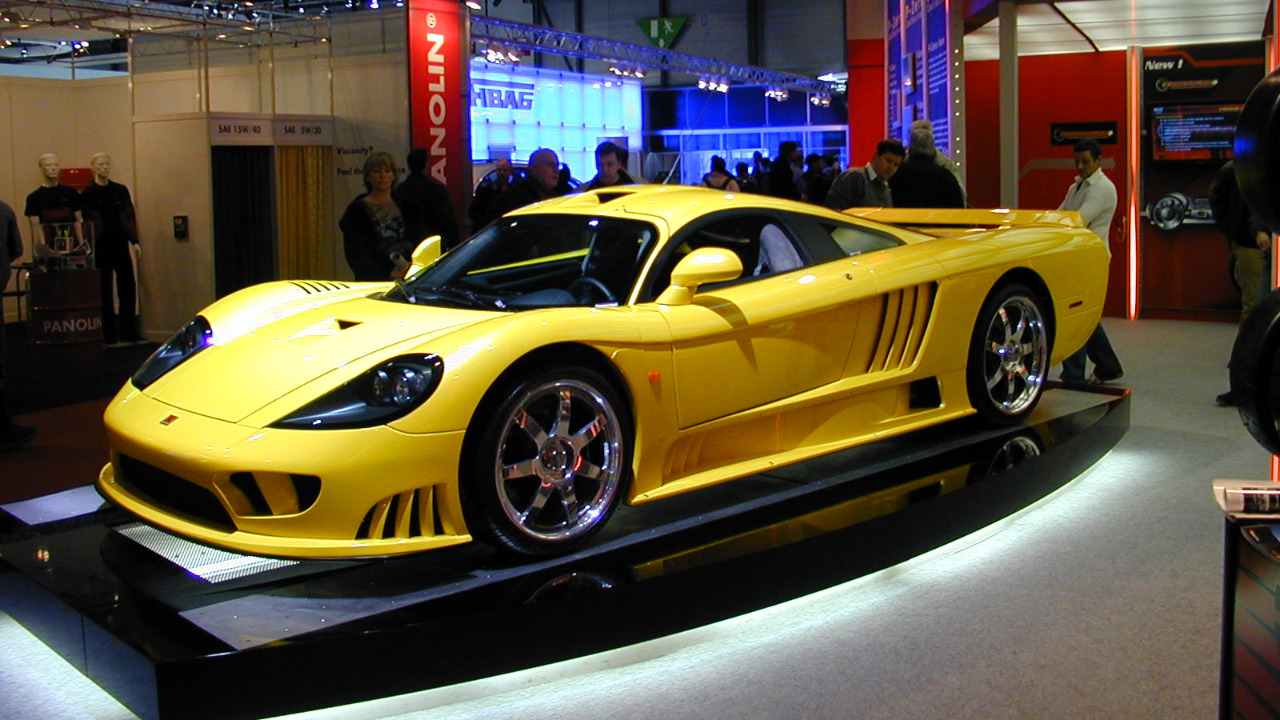
The Saleen S7 arrived in the early 2000s as a hand-built American exotic that could run with the quickest European machinery of the era. Two decades later, the 2004 model year in particular stands out as proof that a low-volume California constructor could engineer a true global supercar, not just a curious footnote in muscle car history.
With its carbon-fiber body, mid-mounted V8 and racing pedigree, the S7 did more than chase top speed bragging rights. It showed that an American company could design, build and sell a road car that felt at home on international circuits and concours lawns, while also competing on paper with the likes of Ferrari and Porsche.
From California concept to global statement
Saleen had already built a reputation modifying Ford Mustangs before turning to a clean-sheet supercar project. The S7 emerged as a mid-engine, rear-wheel-drive coupe with a bespoke carbon-fiber body and a chassis developed with track performance in mind. The naturally aspirated version used a 7.0‑liter aluminum V8 that produced around 550 horsepower, enough to push the car past 200 mph and into conversation with established European brands.
By 2004, the S7 had evolved from an ambitious idea into a fully realized production car that owners could register, drive to a track day and then park alongside Lamborghinis and McLarens at high-end events. The limited production and hand-built nature of the car meant that each example carried a level of rarity that even some Italian exotics could not match.
The S7 was never intended as a volume product. It served instead as a rolling manifesto for what Saleen believed an American supercar should be: lightweight, brutally fast and unapologetically dramatic in its styling. The scissor doors, long rear overhang and deep side intakes were not simply visual theater. They reflected aerodynamic and cooling requirements that came from serious performance targets rather than styling exercises.
The leap to twin-turbo power
The most striking evolution of the S7 arrived with the twin-turbo variant. Saleen replaced the naturally aspirated setup with twin turbochargers that lifted output to around 750 horsepower, transforming an already quick car into something that could run with the most extreme machines of its time. A later competition package pushed that figure even higher, highlighting how much headroom the original engineering left in the platform.
For 2004 buyers, this evolution mattered because it showed that the S7 was not a one-and-done halo car. It was a base for continuous performance development, with power levels and chassis tuning that could respond to what was happening in Europe. When Ferrari and Porsche raised their game, Saleen had a credible answer waiting in the form of turbocharged upgrades and track-focused packages.
Why the 2004 S7 still turns heads
Even in a world filled with hybrid hypercars and electric torque monsters, the 2004 Saleen S7 retains a distinct appeal. Part of that comes from its analog character. The car pairs a big-displacement V8 with a traditional manual gearbox and rear-wheel drive, without traction control layers or complex hybrid systems. Drivers interact directly with the hardware, which gives the S7 a raw personality that modern supercars often smooth over.
Rarity is another factor. Production numbers were extremely low, which means that each surviving 2004 example represents a sizable share of the entire S7 population. Collectors value that scarcity, especially when combined with documented histories and low mileage. Auction appearances are infrequent, and when an S7 surfaces, it tends to draw attention from both American muscle fans and European exotic collectors.
Styling also plays a role in the car’s enduring presence. The S7’s proportions are extreme even by supercar standards, with a long wheelbase, wide stance and an exaggerated rear section that looks like it belongs on a race car rather than a street machine. The design has aged differently from contemporary Ferraris and Lamborghinis, but it has not faded into anonymity. Parked next to modern exotics, an S7 still looks like something that escaped from a GT racing paddock.
Built with racing in mind
The S7 was not just styled like a racecar. It was engineered with motorsport in mind from the start, with a rigid spaceframe, integrated roll structure, and suspension geometry that could be adapted for endurance racing. That approach gave the road car a sense of purpose that many boutique exotics lack. Owners could believe that underneath the leather and carpeting sat a chassis capable of serious lap times.
In the period, Saleen pursued racing programs that used the S7 as a base, which helped validate the car’s capabilities in front of global audiences. While the exact results and series varied, the presence of an American-built GT car on international grids reinforced the idea that the S7 was more than a styling exercise. It was a machine that could be tuned, serviced, and pushed in competition environments where reliability and consistency matter as much as raw speed.
American power, international reach
One of the defining traits of the S7 is how clearly American its powertrain feels, even as the rest of the package leans toward European-style engineering. The big V8 delivers torque in a broad, muscular wave, which suits highway pulls and long straights as much as tight technical circuits. Yet the car’s gearing and aerodynamics were designed to keep it stable at very high speeds, which made it a viable option for owners in regions with unrestricted or high-speed roads.
That combination of American power and global usability helped the S7 carve out a niche in markets beyond the United States. Collectors in Europe and the Middle East, who were accustomed to Ferraris and Porsches, could see the appeal of a car that felt different without sacrificing performance benchmarks. The S7’s top speed figures, acceleration times, and braking performance put it firmly in supercar territory, which helped overcome any skepticism about its origin.
At the same time, the car’s hand-built nature and low production volume meant that each export example carried a sense of exclusivity. Owning an S7 in London, Dubai, or Tokyo signaled a willingness to look beyond the usual European brands and embrace a more individualistic choice. That global spread reinforced the notion that the S7 was not just an American curiosity, but a supercar that could stand on equal footing with its international peers.
How it stacked up against rivals
In the early to mid-2000s, the S7 found itself lined up against heavy hitters like the Ferrari Enzo, Porsche Carrera GT and later the Mercedes-Benz SLR McLaren. On paper, the Saleen compared favorably in several key metrics. Its power output, especially in twin-turbo form, matched or exceeded many of its rivals. Its top speed figures pushed into the same territory as European flagships, and its acceleration numbers were competitive.
Where the S7 diverged was in philosophy. The European cars leaned heavily on advanced materials, electronic aids and, in some cases, semi-automatic transmissions. The Saleen stuck with a more straightforward mechanical approach. That made it less polished in daily use but more engaging for drivers who valued a direct connection to the car. For certain enthusiasts, that trade-off was not a compromise at all. It was the entire point.
Collector market and intellectual property intrigue
Two decades on, the S7 occupies a fascinating place in the collector market. Values have reflected both its rarity and its reputation as a serious performance machine. When an S7 appears at auction, especially one with desirable specifications or competition-focused upgrades, it tends to attract bidders who already own European exotics and want something different in their garages.
Recent sales of twin-turbo cars equipped with the most aggressive packages show how strong that demand can be. A particularly rare example fitted with a high-output competition package drew attention not just for its performance numbers but for its status as one of a tiny group of S7s built to that specification, illustrating how the market differentiates between standard and upgraded cars.
Beyond individual cars, the S7 has also become the subject of interest at the intellectual property level. A recent listing offered buyers the opportunity to acquire the rights associated with the S7 supercar, including design and engineering assets. The chance to own the S7 rights underscored how the car has moved from being just a collectible object to a potential platform for future projects or continuation builds.
Why IP ownership matters
The sale of rights tied to a car like the S7 carries implications beyond branding. Intellectual property can include body designs, chassis layouts, engineering drawings and even homologation data. A buyer who secures those assets might explore limited continuation runs, restomod-style reinterpretations or licensing deals for digital recreations in games and simulations.
For the S7, such a transaction suggests that its story is not finished. Even if no new cars are built, the ability to control how the design and name appear in media, merchandise or virtual environments keeps the model in circulation. That ongoing presence helps sustain interest in original 2004 cars and can influence how future generations of enthusiasts perceive the S7’s place in supercar history.
Engineering details that made the difference
Part of the S7’s credibility came from its engineering depth. The carbon-fiber body panels helped keep weight in check, while the mid-engine layout optimized weight distribution. Suspension geometry was set up for both road comfort and track performance, with adjustable components that allowed owners to fine-tune handling characteristics.
The braking system used large ventilated discs and multi-piston calipers, which were essential given the car’s power and top speed potential. Aerodynamic elements, from the integrated rear wing to the sculpted underbody, were designed to generate downforce at speed. These details were not just marketing language. They translated into stability and grip that drivers could feel on fast circuits and open highways.
Inside, the S7 blended race-inspired elements with enough comfort to make long drives possible. Bucket seats, a compact steering wheel and clear instrumentation kept the focus on driving, while leather trim and bespoke touches reminded owners that they were in a hand-crafted machine. The cabin did not chase the luxury feel of a grand tourer, but it delivered an experience that matched the car’s performance intent.
Analog charm in a digital age
Modern supercars rely heavily on electronic stability systems, active suspension, and complex drive modes. By contrast, the 2004 S7 feels almost old-school. Drivers manage the clutch, gearbox and throttle themselves, and the car responds without layers of software smoothing every input. That analog character has become a selling point as more enthusiasts seek out experiences that modern cars no longer provide.
This analog nature also means that the S7 rewards skill and punishes carelessness. Owners who take the time to learn the car’s behavior, especially near the limit, often describe it as demanding but deeply rewarding. In a market where many high-end cars can make average drivers feel like heroes, the S7 stands apart as a machine that expects its driver to rise to its level.
More from Fast Lane Only
- Unboxing the WWII Jeep in a Crate
- 15 rare Chevys collectors are quietly buying
- 10 underrated V8s still worth hunting down
- Police notice this before you even roll window down
*Research for this article included AI assistance, with all final content reviewed by human editors.