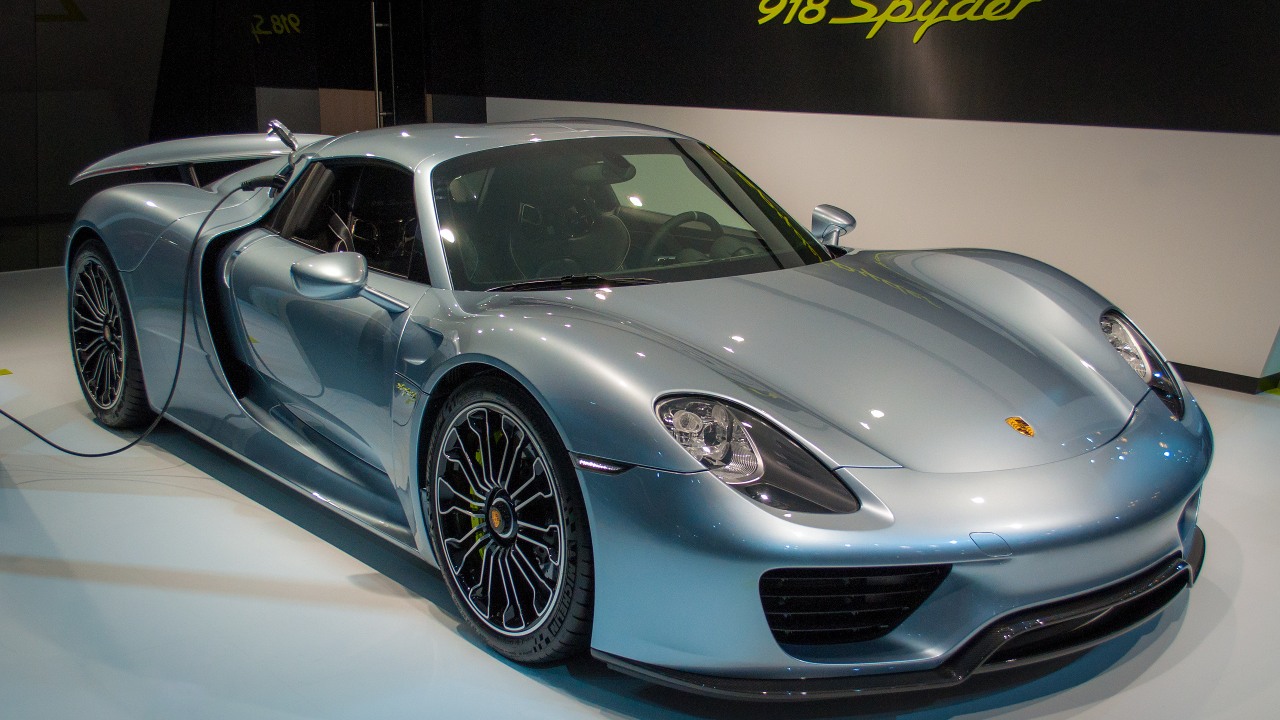
The 2014 Porsche 918 Spyder arrived at a moment when hybrid badges still suggested thrift rather than thrill. Instead of softening its flagship, Porsche used batteries and motors to turn a limited-run supercar into rolling proof that electrification could sharpen a brand’s identity rather than dilute it. The result was a plug-in hybrid that felt every inch a Porsche first and an efficiency experiment second, even as it previewed the technology now shaping the company’s mainstream models.
A laboratory on slick tires
The 918 Spyder was never just another halo car. It was conceived as a technical showcase, a low-volume project that let Porsche test high-voltage hardware, complex control software, and new driving modes at the outer edge of performance. Engineers paired a naturally aspirated V8 with two electric motors, one on each axle, and a sizable battery pack that could be charged from the grid. The hybrid system was not an afterthought grafted onto an existing platform; it sat at the heart of the car’s carbon-fiber chassis and dictated its packaging, aerodynamics, and weight distribution.
That approach meant the 918 did more than post big power numbers. With the electric front axle, it gained all-wheel drive and torque available from zero rpm, while the rear motor worked with the V8 to fill gaps in the powerband and smooth gear changes. Multiple drive modes let the car glide in near silence or attack a circuit with everything deployed at once. This architecture, tested in extreme conditions and refined through track development, was later fed directly into Porsche’s broader hybrid strategy, including its high-performance plug-in sedans and SUVs.
From racetrack experiment to road-going template
Porsche did not treat the 918 Spyder as an isolated curiosity. The company used the car as a reference point when it invited journalists to experience its wider electrified lineup, including the Panamera Turbo S E-Hybrid Sport Turismo, at events such as dedicated hybrid track days at Portimão. At those gatherings, the 918 sat alongside production plug-in models to illustrate how lessons from its powertrain control, brake energy recuperation, and thermal management had migrated into more practical cars. The message was clear: hybrid hardware was being tuned for lap times and driver engagement, not just fuel economy.
On track, the 918’s electric assistance changed the character of a lap. Instant torque out of slow corners, compressed braking zones, and exit phases into a single, fluid motion. Regenerative braking blended with friction brakes to stabilize the car on entry, while careful calibration kept pedal feel consistent even as the system harvested energy. That same logic later informed the way road-focused hybrids manage their transitions between regeneration and mechanical braking, a detail that matters as much in city traffic as it does on a circuit.
Hybrid power without hybrid timidity
The 918 Spyder’s defining achievement was philosophical as much as technical. Hybrids had long been associated with cautious driving and muted responses. The 918 inverted that assumption by treating its electrical components as performance multipliers. Electric torque filled in where the combustion engine could not, and the battery became a strategic resource to be deployed for maximum speed rather than conserved for maximum range.
That mindset shaped the car’s driving modes. In pure electric operation, the 918 could slip through urban streets with little noise, yet the chassis and steering still felt keyed in, as if waiting for the driver to wake the V8. Switch to the most aggressive setting and the hybrid system emptied its energy reserves in short, intense bursts, trading long-distance efficiency for immediate acceleration and repeated high-speed runs. The car did not pretend to be something it was not; it was a supercar that happened to carry a plug, not a commuter that occasionally played at being fast.
Carrying Porsche’s character into the battery era
The 918 Spyder mattered because it bridged a cultural gap inside performance car circles. Enthusiasts who worried that electrification would erase the traits they loved in a Porsche could see, hear, and feel that the essential ingredients were still there. The steering remained precise, the brake pedal communicative, and the chassis balance adjustable on throttle. The additional hardware added complexity, but it also opened new dimensions in how the car could be driven.
Engineers used the 918 to refine how different power sources talk to each other. The V8’s sound and response were carefully staged so that the handoff to electric torque felt natural, not like a digital intervention. Calibration teams worked to preserve the sense of mechanical connection that defined earlier Porsches, even as software took on a larger role in managing traction, stability, and energy flow. That philosophy later influenced how the brand tuned its other hybrids, where drivers still expect a clear, predictable link between inputs and outputs despite the layers of control logic in the background.
Technology transfer into everyday models
The 918 Spyder’s influence is most visible in how Porsche now treats electrification across its range. The company’s plug-in hybrids use powertrain layouts and control strategies that echo the supercar’s template, albeit scaled for comfort and practicality. In cars like the Panamera Turbo S E-Hybrid Sport Turismo, electric motors provide both low-speed refinement and high-speed thrust, with software deciding in real time how to blend combustion and battery power for the best result.
During hybrid-focused events such as the E-Performance trackdays at Portimão, Porsche positioned the 918 as a reference point for this strategy. The supercar’s role was to show that the same principles guiding its layout and driving modes now underpin vehicles that can carry families and luggage. Regenerative braking maps, thermal strategies for keeping batteries in the right temperature window, and algorithms that decide when to prioritize electric or combustion power all trace their lineage back to the 918’s development program.
Balancing weight, complexity, and feel
Hybrid hardware adds mass, and the 918 Spyder had to confront that reality. Batteries, electric motors, inverters, and cooling systems all increase curb weight, which can blunt feedback and agility if not carefully managed. Porsche responded with extensive use of lightweight materials, including a carbon-fiber reinforced plastic monocoque and magnesium components, to offset the hybrid system’s bulk. The result was a car that still felt lithe and responsive, with weight placed low and centrally to keep handling crisp.
Complexity was another challenge. Multiple power sources, two driven axles, and sophisticated electronic controls could have produced a disconnected driving experience. Instead, the 918’s engineering team treated that complexity as an opportunity to fine-tune behavior in ways that purely mechanical systems could not. Torque vectoring on the front axle, for instance, allowed the car to pivot into corners with unusual precision, while the hybrid system’s ability to shuffle power between front and rear gave it traction advantages in varied conditions. These traits helped prove that digital control, when tuned with a driver-first mindset, could enhance rather than dilute the Porsche feel.
Shaping expectations for future performance cars
The 918 Spyder also influenced how the wider industry thinks about performance benchmarks. Its combination of combustion and electric power set new standards for acceleration and lap times, but it did so while offering a usable electric driving mode and plug-in capability. That dual personality has since become a template for high-end sports cars and super sedans that aim to satisfy both regulatory demands and enthusiast expectations.
By treating the battery pack as a performance component, not just an emissions tool, Porsche reframed the conversation around hybrid tech. Competitors began to explore similar layouts, pairing high-revving engines with electric torque to achieve numbers that would have been difficult with combustion alone. The 918’s success suggested that customers at the top of the market were willing to accept, and even value, hybridization when it delivered tangible benefits on road and track.
Customer perception and brand identity
For a brand that built its reputation on air-cooled flat-sixes and lightweight sports cars, the move into complex plug-in systems carried reputational risk. The 918 Spyder helped mitigate that risk by anchoring new technology in familiar values. Owners and enthusiasts could see that the car still prioritized driver involvement, precision, and durability. The hybrid components were not there to chase marketing buzzwords; they were integrated in the service of performance and control.
This alignment between technology and identity mattered as Porsche expanded its electrified lineup. When customers considered plug-in versions of the Cayenne or Panamera, they did so with the 918’s example in mind. The supercar had already shown that a Porsche with a charging port could still deliver the brand’s signature dynamics. That halo effect smoothed the path for broader adoption of hybrid and, eventually, fully electric models within the portfolio.
Lessons for the next generation of sports cars
The 918 Spyder’s legacy extends beyond its production run. It demonstrated that performance car makers can use hybrid systems to add character rather than subtract it, provided they treat electric components as integral to the driving experience. The car’s development program generated a library of data on how drivers use power, how batteries behave under repeated high-load cycles, and how to keep complex systems reliable in demanding conditions.
Those lessons continue to inform how Porsche approaches future projects that mix combustion and electrification. Calibration teams now have a reference for how quickly powertrains should respond, how brake feel should evolve as regeneration ramps up or down, and how driving modes can shape a car’s personality without confusing the driver. The 918 set expectations for transparency: even as software makes thousands of decisions per second, the driver should feel in control, not managed.
What comes after a hybrid icon
Looking ahead from the 918 Spyder’s example, the key question for Porsche is not whether electrification fits the brand, but how far that integration should go. The supercar showed that plug-in technology can coexist with a high-revving engine and traditional driving cues. As regulatory pressure tightens and battery technology improves, the balance between combustion and electric assistance will continue to shift. Yet the 918’s core lesson remains relevant: performance gains and emotional engagement must move in step.
For enthusiasts, the car stands as a reminder that technical progress does not have to erase familiar pleasures. The 918 Spyder delivered world-class hybrid performance while preserving the feedback, timing, and sense of connection that define a Porsche. That achievement set a high bar for every electrified sports car that follows, both within the company’s lineup and across the industry.
More from Fast Lane Only
- Unboxing the WWII Jeep in a Crate
- 15 rare Chevys collectors are quietly buying
- 10 underrated V8s still worth hunting down
- Police notice this before you even roll window down
*Research for this article included AI assistance, with all final content reviewed by human editors.