

Saab built the 96 for two decades, from 1960 until the last car left a Finnish factory in January 1980. It started with a three-cylinder two-stroke and finished as the Saab 96 V4, with a Ford-built engine under the same rounded body. Through all of it, the recipe barely changed: front-wheel drive, a tough shell and very few parts to go wrong.
That simplicity won rallies. It also made the 96 a car that owners could understand and fix. In a world of sealed engine covers and software updates, that idea has fresh appeal.
These are our picks for the versions of the 96 that make the point best, and the verdict is our opinion. However, every year, engine and power figure comes from published records.
1. 1960 Saab 96

The 96 replaced the Saab 93 in 1960, and the first cars kept things wonderfully basic. Power came from an 841 cc three-cylinder two-stroke rated at 38 PS. Hagerty’s Saab 96 buyer’s guide credits Sixten Sason, who designed Saab’s first cars, with the 92 and 96 shapes.
Early cars also used drum brakes all around. Then there was the freewheel. A two-stroke that runs on premixed fuel gets little lubrication when you lift off the throttle at high revs. So Saab fitted a one-way clutch that let the engine drop to idle while the car coasted. Hagerty advises changing the three-speed gearbox oil every 6,000 miles, and a whirring noise often means a failing freewheel.
The drawback was a loss of engine braking. Still, the freewheel became a Saab trademark and stayed in the 96 until production ended. For the car that came right before this one, see our look at the 1958 Saab 93.
In our view, the 1960 car is the purest 96. It has the original body, the original engine and almost nothing extra. If you want one, Hagerty puts a clean, usable early two-stroke at about £6,000 in the U.K.
2. Saab 96 841 cc two-stroke three-cylinder

The engine is the reason the early 96 feels so unusual. Hagerty notes that the Saab two-stroke has just seven moving parts. That is about as simple as a car engine gets.
Saab kept improving it, too. Output rose to 40 PS by 1965, then to 42 PS for 1966 with a three-throat Solex carburetor. We looked at that model year in our piece on the 1966 Saab 96. At first, standard engines used oil premixed with the fuel. Later, higher-performance and late two-strokes got direct oil injection from a separate tank, so owners no longer had to mix oil at the pump.
American rules shaped it as well. The U.S. version was called the Shrike, and for 1968 Saab cut displacement to 795 cc. As a result, it stayed under the 50-cubic-inch limit for an emissions exemption.
Our take: the two-stroke is simplicity you can hear, with a buzzing exhaust note all its own. However, it needs the correct fuel and oil mix and careful storage. Parts are harder to find, according to Hagerty, so line up a specialist before you buy.
3. 1962 Saab 96 of Erik Carlsson

Erik Carlsson turned a small Swedish sedan into a giant-killer. He won the RAC Rally in 1960, 1961 and 1962, and he took the Monte Carlo Rally in 1962 and 1963, all in a Saab 96. He also won the 1961 Acropolis Rally in one. In addition, he finished second in the 1964 East African Safari Rally.
Fans called him “Carlsson på taket,” or “Carlsson on the roof,” borrowing the name of an Astrid Lindgren character. Later, Saab used him for public relations work, and people simply called him “Mr. Saab.”
His personal life ran through rallying, too. In July 1963, he married Pat Moss in London. She was a rally driver herself and the sister of Stirling Moss.
In our view, Carlsson’s 1962 season is the clearest proof that a simple car can beat complicated ones. A light body, front-wheel drive and a driver who understood momentum were enough. To us, few small cars have made a stronger case for themselves on a rally stage. Carlsson died in May 2015, aged 86, but his wins with the 96 remain the heart of Saab’s rally story.
4. Saab 96 Sport
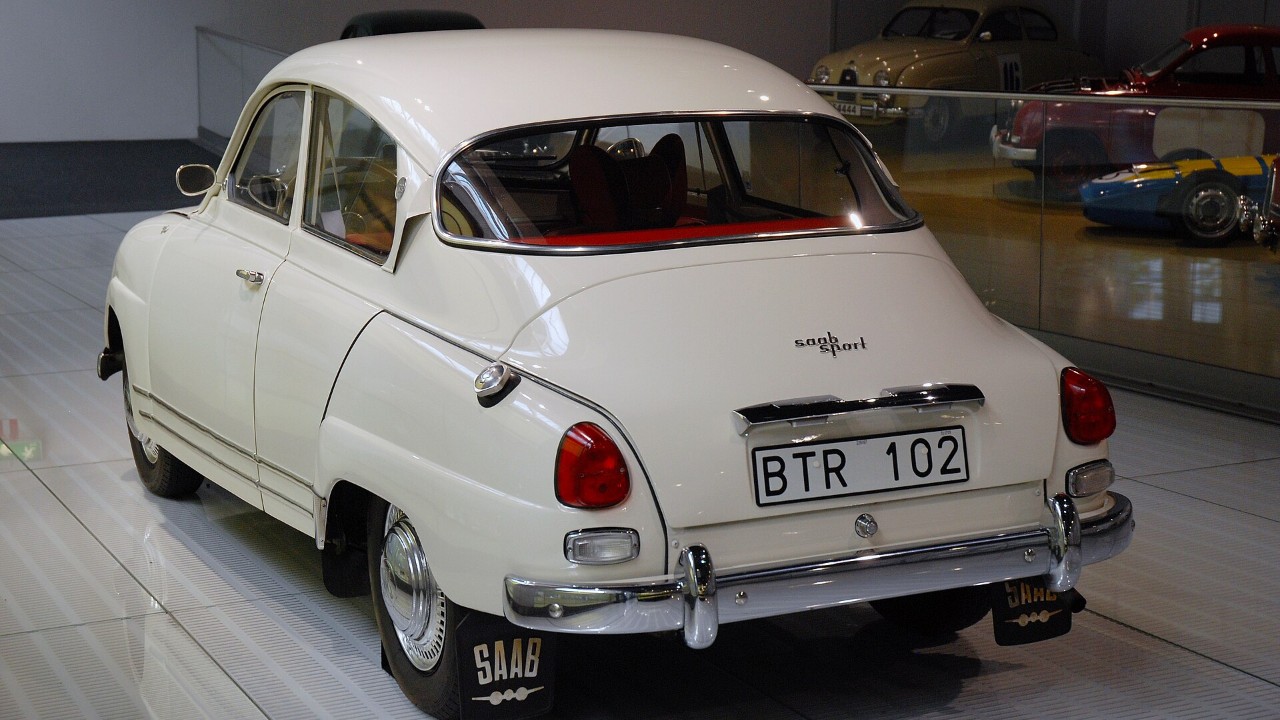
The Sport arrived in 1962 as the 96 for drivers who wanted more. It replaced the earlier Granturismo, and Saab built it until 1968. It used the same 841 cc two-stroke, but with one Solex carburetor per cylinder. A separate oil tank fed an injection system, so there was no premixing at all. It also had front disc brakes, which were uncommon on small cars at the time.
At first, Saab rated the Sport at 57 hp at launch and 60 hp for 1965. From the 1966 model year, every market version took the name Monte Carlo 850. Carlsson also won the 1964 San Remo Rally in a 96 Sport.
The Sport kept the formula honest. It added carburetors, oil injection and better brakes, then stopped. There were no gimmicks, just a more serious version of the same car.
Our take: the Sport is the collector’s two-stroke, and Hagerty notes that rare Sport and Monte Carlo versions cost more than standard cars. If you shop one, confirm the carburetors, oil injection and disc brakes are original. Those parts are what you are paying for.
5. 1967 Saab 96

Saab’s 1967 model year was a turning point. The V4 version took over in September 1966, according to Saab Planet. Instead of the two-stroke, it used a 1,498 cc V4 built by Ford in Cologne, rated at 65 PS. At first, Saab advertised it as an additional model, partly to clear the remaining two-stroke stock.
The difference was big. A 1967 Autocar road test recorded a 92 mph top speed and 0-60 mph in 16.5 seconds. The same year, front disc brakes arrived on the V4. A 1965 nose change had already made room, lengthening the front end and moving the radiator ahead of the engine.
Many buyers in 1967 could choose between old and new. Moreover, the V4 was at least 50% more powerful than the original 96, Saab Planet notes. That was a strong argument for the new engine.
In our view, the 1967 car is the most interesting year to own, because it sits right on the line between two eras. If you look at one, check the engine first, since a 1967 96 could carry either the two-stroke or the V4.
6. 1972 Saab 96 V4

By 1972, the Saab 96 V4 had settled into a long, steady career. Saab Planet reports that the factory built 34,120 V4 saloons and 9,367 estates in 1970 alone. The 1969 update had swapped the round headlights for rectangular ones.
Then came a small luxury. Hagerty says 1972 brought the first 96 with factory-fitted electrically heated seats. For a car sold in Sweden, that was a practical feature, not a gimmick.
The U.S. version changed, too. First, the engine grew to 1,700 cc with lower compression for 1971. For 1972, its stated output fell to 65 hp, because SAE net ratings replaced gross figures. Saab sold the 96 in America through 1973. The same year, bigger bumpers arrived on the 96, according to Hagerty.
Our take: the 1972 car is the sweet spot for a usable classic. It has the V4, front discs and heated seats, yet it is still a plain, honest shape. Also, Hagerty puts a V4 ready for regular use at about £6,500. Check the screen frames, floors and rear inner wheel arches for rust.
7. Saab 96 V4 rally engine

The Ford V4 did more than power family cars. In Group 2 rally tune, it could make over 100 bhp, according to Saab Planet. That was well beyond the 65 bhp of the road version. By comparison, Hagerty’s guide clocks a road-going V4 at 0-60 mph in 16 seconds.
Carlsson proved it right away. For example, he won the 1967 Czech Rally in a Saab 96 V4. Two years later, he finished third in the 1969 Baja 1000 in a V4, which took the little Swedish car into the Mexican desert.
Road cars can be tuned as well. Hagerty notes that the V4 responds to work, and that owners often swap the original Ford carburetor for a Weber.
In our view, the rally V4 shows the 96 at its most capable. It is the same basic car and the same basic engine, just tuned harder. So if a stock V4 feels gentle today, remember what the same engine could do with rally tuning. If you are buying a V4, listen for bottom-end rumble that points to worn main bearings, and check the fiber balance-shaft gear.
8. 1977 Saab 96 V4

Saab kept improving the 96 well into the 1970s. For example, in August 1975, the “1975B” update brought impact-absorbing bumpers. A revised floor also let the rear seat move 5 cm further back.
From 1977, the V4 got a power bump to 68 PS, and the cars wore “V4 super” badges. That came after 1976 Swedish models had dropped to 62 PS for emissions reasons. A stronger transmission had also arrived for 1974, according to Hagerty. The same V4 also powered the 95 estate, which could seat up to seven with an optional rear-facing seat.
Sales were winding down by then. Saab Planet reports 22,762 saloons and 5,559 estates sold in 1974, and the totals fell through the decade. Even so, to us the late cars were the most refined 96s Saab built.
Our take: a 1977 car gives you the best power and safety updates in the same simple package. For a different take on Saab’s V4 years, read our story on the Saab Sonett V4. Check the radiator and cooling system, since Hagerty warns the radiator can block.
9. 1978 Saab 96 L V4

By 1978, the 96 was nearly two decades old, and that was part of its charm. It also had the 1975B floor, which gave rear passengers 5 cm more room. The L trim also kept the 68-PS V4 of the late cars. It also kept the freewheel, a feature Saab never dropped from the 96.
Finally, Valmet Automotive built the last cars in Uusikaupunki, Finland. The last production car rolled out on January 11, 1980, ending a run that began in 1960.
Looking back, the late 96 shows how little Saab needed to change. The body shape and the front-wheel-drive layout both date back to the first car. Meanwhile, the V4 and its updates simply kept it legal and useful.
In our view, the 1978 L is the 96 for someone who wants to drive a classic often. It is the most developed version of a very simple car. Before you buy one, check the front bulkhead drain holes and the suspension mounts, two rust spots Hagerty flags. Hagerty puts an immaculate V4 at about £12,000 in the U.K.
More from Fast Lane Only


