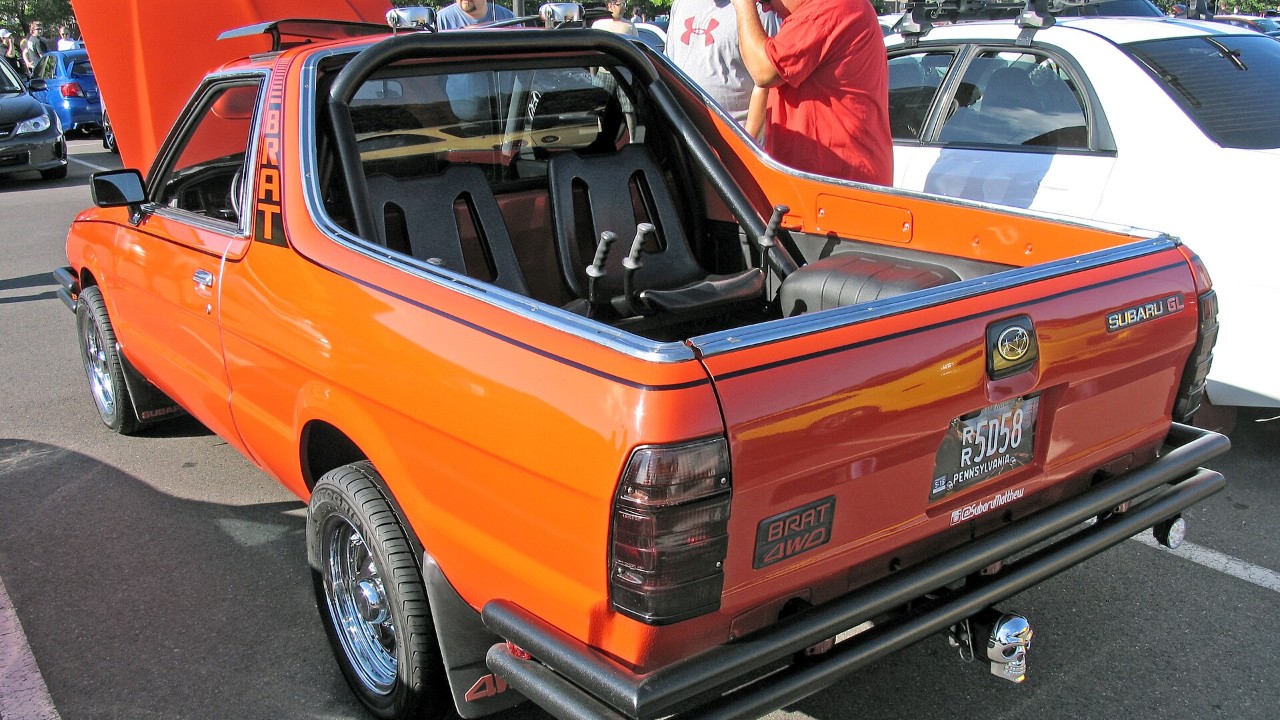
The Subaru BRAT jump seats are the strangest thing about a small four-wheel-drive pickup that Subaru sold in North America from 1978 to 1987. Two rear-facing seats sat in the cargo bed, along with carpeting. They were not there for comfort. Instead, they helped Subaru argue that the BRAT was a passenger car, which mattered a great deal at the border.
American import rules taxed light trucks far more heavily than cars. So a pair of seats in the back could change what Subaru paid on every BRAT it shipped from Japan.
Here is how the idea worked, what the BRAT was underneath and what happened to those seats.
The tariff behind the seats
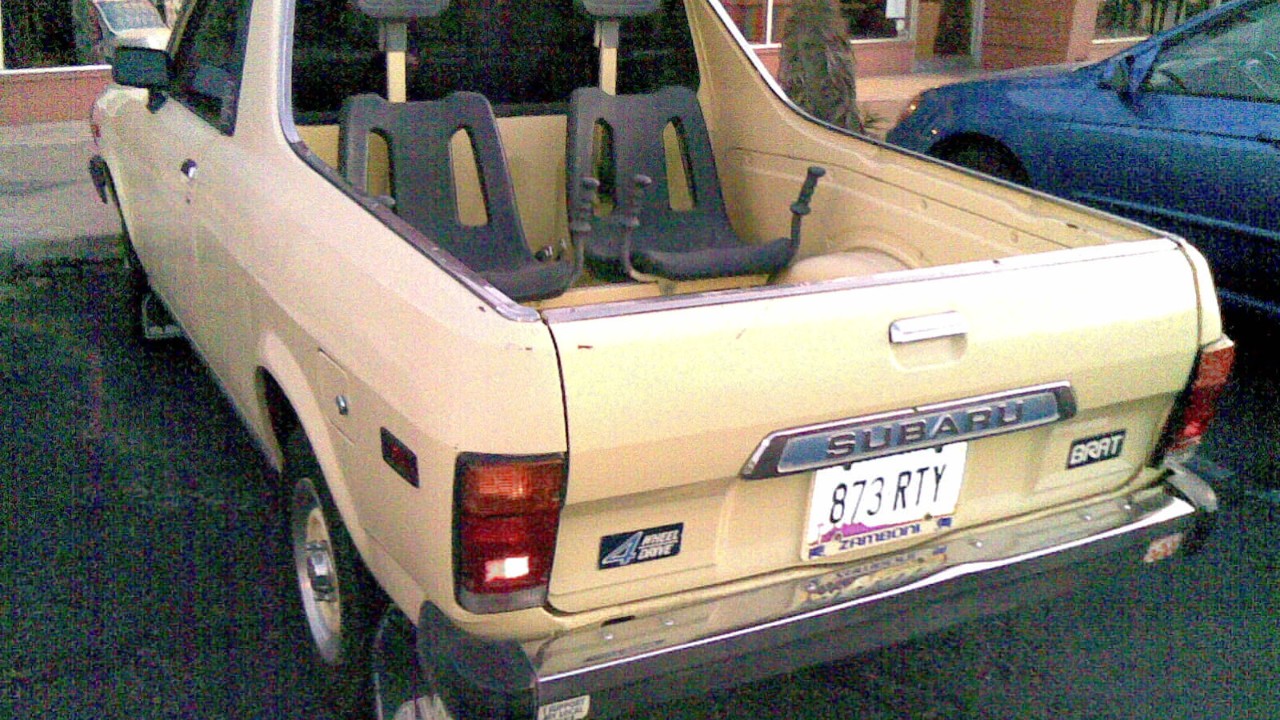
The truck rate goes back to a trade fight over poultry. According to SlashGear’s explainer on the BRAT’s bed seats, President Lyndon B. Johnson imposed the so-called Chicken Tax in 1963. He did it in response to European taxes on American poultry, and it put a 25 percent tariff on foreign-built pickup trucks.
Passenger cars, by contrast, paid much less. Hagerty’s BRAT buyer’s guide says passenger cars were “taxed at under 3 percent,” while light trucks were “taxed at 25 percent.” That gap gave Subaru a clear reason to call its little pickup a car.
How the Subaru BRAT jump seats made it a “car”
The solution was simple. Subaru fitted the BRAT with rear-facing jump seats and carpeting in the cargo area, as Hagerty describes it. SlashGear adds that the seats came with seatbelts, and that Subaru marketed the BRAT as a “passenger car.” With seats for two more riders, the bed now counted as passenger space.
The Wikipedia entry on the BRAT, which cites period press reports, describes the seats as plastic. It also says they went on North American and Canadian models. Riders sat facing backward, out in the open, behind the cab.
The setup also explains the name. According to Hagerty, BRAT stands for “Bi-drive Recreational All-terrain Transporter.” Hagerty adds that Subaru’s first choice, “Four-wheel-drive All-terrain Recreational Transporter,” got rejected, for reasons its initials make obvious.
What the BRAT was underneath
Mechanically, the BRAT was a small pickup built from Subaru’s Leone wagon, per Wikipedia. Hagerty puts its weight at 2,200 pounds. From 1978 to 1980, it used a 1.6-liter EA-71 boxer four with 67 horsepower. Then, for 1981, Subaru switched to a 1.8-liter EA-81 with 73 horsepower, and torque rose from 81 to 94 lb-ft.
Every BRAT had four-wheel drive, yet the hardware changed over time. Hagerty says cars built for 1980 or earlier had a single-range transfer case, while later trucks got a dual-range unit. Even so, Hagerty calls it not a very capable off-roader. In fact, its staff found that out while testing a 1984 model in the California desert.
The BRAT was built for export from the start. Wikipedia’s entry says Subaru developed it in Japan in 1977 for the North American small-truck market. Hagerty adds that Japanese buyers preferred station wagons, so the BRAT stayed an export-only model.
A few other quirks stood out. The spare tire rode under the hood, behind the engine. Subaru also offered an optional T-top, which it marketed as a “halo-twin roof,” according to Hagerty.
Prices stayed modest. SlashGear lists a base price of $7,613 for a 1982 BRAT GL. Hagerty, meanwhile, says Subaru sold about 100,000 BRATs in North America.
When the seats went away
The seats did not last for the whole run. Hagerty says Subaru removed the jump seats after the 1985 model year. Sales in North America then ended with the 1987 models. However, the BRAT kept going in Europe and Australia until 1994, per Hagerty.
Many owners did not wait that long. According to Hagerty, most of them pulled out the bed carpet, because it could hold water and cause rust. Many also cut out the jump seats, since the seats got in the way of hauling anything.
As a result, a BRAT with its seats in place has become a collector detail. It is the one feature that tells the story of the tariff at a glance.
What the seats are worth today
The seats now carry a price premium. When Hagerty wrote its BRAT guide, it valued a 1985 BRAT with jump seats in excellent, #2 condition at $15,800. By comparison, a 1986 model without them came in at $14,600, a 7.6 percent difference.
Values had climbed overall, too. In the same guide, Hagerty said a 1985 BRAT GL in excellent condition rose 48 percent in a year, from $10,700 to $15,800. That was also up 126 percent from an average of $7,000 in May 2017, and Hagerty said all model years had followed the same trend.
More from Fast Lane Only
- Unboxing the WWII Jeep in a Crate
- 15 rare Chevys collectors are quietly buying
- 10 underrated V8s still worth hunting down
- Police notice this before you even roll window down
This article was created with the help of AI and was reviewed and edited by Fast Lane Only editors before publication.