Tesla’s third-quarter profit came to $787 million in 2026, down from $1.373 billion a year earlier. That is a drop of 43%, even though revenue barely moved. The company reported the results on October 21, and the same report said Optimus robots and the Tesla Semi had both entered production.
So the quarter tells two stories at once. On one side, the car business sold slightly fewer vehicles and earned far less per dollar of sales. On the other, Tesla spent heavily on robots, trucks and self-driving, and it now has hardware rolling off lines to show for it.
First, here is what the numbers say. After that, here is what Tesla says it actually started building.
Tesla third-quarter profit: the headline numbers

Total revenue was $28.046 billion, compared with $28.095 billion in the third quarter of 2025, according to Tesla’s Q3 2026 Update, filed with the SEC. In other words, sales were flat. Net income attributable to common stockholders fell to $787 million from $1.373 billion.
By comparison, income from operations dropped harder, to $718 million from $1.624 billion. Tesla put the decline in operating margin at 322 basis points. By Electrek’s math, that left a margin of 2.6%, down from 5.8% a year ago.
On a per-share basis, GAAP earnings were 22 cents, Electrek reported. Adjusted earnings came to 48 cents, against 50 cents a year earlier.
Oddly, gross margin improved even as operating profit fell. Electrek put total gross margin at 19.6%, up from 18.0% a year ago. Similarly, automotive gross margin excluding regulatory credits rose to 18.1% from 15.4%, which Tesla credited to better mix and more FSD revenue. Meanwhile, free cash flow fell to $1.531 billion from $3.990 billion, while cash and investments rose to $45.4 billion.
Where the money went
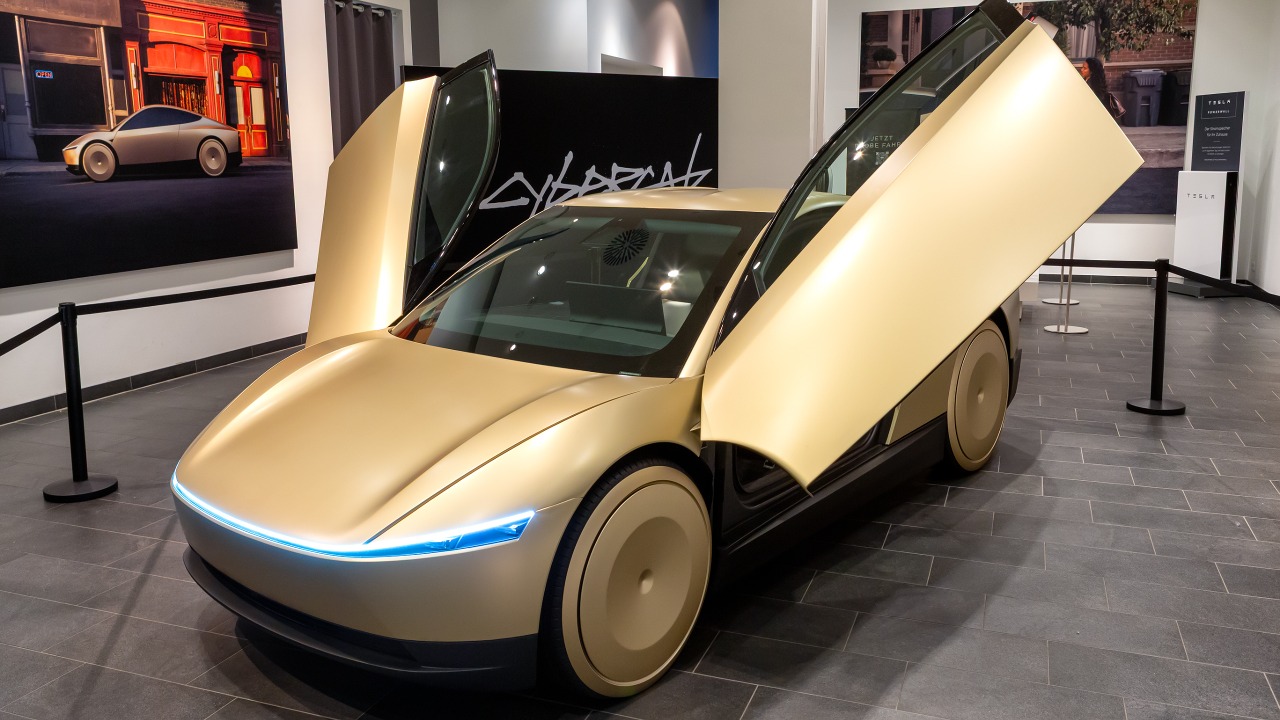
That’s why spending explains much of the gap. According to Electrek’s report on the results, research and development rose 69% to $2.76 billion. The outlet tied that jump to Tesla’s “Super Intelligence” work, Optimus and Cybercab.
Capital spending also climbed. Tesla’s filing shows $4.732 billion in the quarter, up from $2.248 billion a year before. Electrek noted that nine-month capex stands at about $13 billion, roughly half of Tesla’s guidance of more than $25 billion for the year.
Finally, two investments moved net income. Electrek said net income included a $288 million unrealized gain on bitcoin. At the same time, it carried a $142 million unrealized loss on Tesla’s SpaceX stake.
Fewer deliveries, more cars built
Tesla delivered 486,532 vehicles in the quarter, down 2% from 497,099. However, it built more than it did a year ago: production rose 4% to 464,391 from 447,450. Model 3 and Model Y deliveries alone came to 478,237, against 481,166 a year earlier.
Notably, the company named batteries as the bottleneck. “Battery availability continued to be the limiting factor in increasing auto volumes in the quarter,” the update says. Even so, Tesla reported record deliveries in Canada, Australia, Japan and Taiwan. In addition, Electrek noted that Tesla called its passenger vehicle backlog the largest in four years.
Meanwhile, the rest of the lineup shrank. Electrek reported that “other models” fell 48%, a group that covers Cybertruck, Semi and the Model S and X. Regulatory credit revenue also slid to $113 million from $417 million.
Optimus robots leave the line in Fremont
For many readers, the update’s biggest product line concerns the humanoid robot. “Optimus production began in Fremont on our high-volume lines,” Tesla wrote. It added that these are “the first production-quality bots that we have manufactured.”
Tesla also said the work proves its manufacturing process for Optimus “is suitable for a commercial product.” For now, though, the capacity table lists the California line only as “Early Ramp.” A second Optimus line in Texas is shown as under construction.
Tesla Semi reaches volume production
The Semi is Tesla’s Class 8 heavy-duty truck. This quarter, the company said, “We began volume production of Tesla Semi.” Production happens on a high-volume line in Nevada, and the capacity table lists 25,000 Semis a year there.
According to the filing, the top Semi variant can cover 500 miles at a full 82,000-pound gross combination weight. Tesla also said it is raising output of its 4680 battery cells to support both the Semi and Cybercab ramps.
Cybercab, Robotaxi and FSD
On the self-driving side, the update is specific about dates. “We started providing Robotaxi rides using Cybercabs on September 3 in Austin,” Tesla wrote. By the end of the quarter, its Robotaxi service had logged nearly two million cumulative unsupervised miles.
Tesla lists more than 125,000 units of Cybercab capacity in Texas, marked as in production. Meanwhile, active FSD (Supervised) subscriptions rose to 1.74 million from 1.04 million. Tesla notes that FSD (Supervised) requires active driver supervision and does not make a car autonomous.
The same report also mentions the Next Gen Roadster, which Tesla unveiled on October 15. At this stage, the capacity table lists the Roadster in Nevada as “Design development,” with no volume given.
Energy storage keeps growing
In the third quarter, Tesla’s battery business deployed 13.7 gigawatt-hours of storage, up from 12.5 a year earlier. The company also said Megafactory Texas has begun production, with planned capacity of 50 GWh a year.
Even so, revenue from that segment fell. Electrek put energy generation and storage revenue at $2.88 billion, down 16%, and said Tesla blamed part of the drop on tariff-related customer refunds.
Next on Tesla’s own calendar is the Austin Fab, which remains under construction. The company says it plans to start commissioning equipment there in 2027.
More from Fast Lane Only