The 1969 Dodge Charger Daytona occupies a singular place in American performance history, a road‑legal oddity created for one purpose: to win on high‑speed ovals. Its towering rear wing and needle‑nose front end were not styling excesses but the visible evidence of a factory racing program pushed to extremes. Understanding how these “wing cars” came to be, and why they vanished so quickly, reveals a story of engineering brinkmanship, rulebook politics, and a collector market that now treats them as sacred artifacts.
Behind every surviving Charger Daytona is a backstory that runs from Dodge’s frustration on the NASCAR circuit to a brief production run built only to satisfy homologation rules. The car’s radical shape, its specific engines, and its later status as a record‑setting auction star all trace back to that short window when Detroit treated stock‑car racing as a laboratory for speed at any cost.
From NASCAR disappointment to radical experiment
The Charger Daytona was born out of failure, not success. After Dodge’s disappointing 1968 NASCAR season, the company’s leadership and engineers recognized that the standard Dodge Charger, even in the limited Charger 500 configuration, could not keep pace on the fastest superspeedways. The blunt nose and recessed grille created lift and drag at the very speeds that decided races, and the brand’s factory teams watched rivals pull away on the straights. In response, Dodge authorized a far more extreme solution, a car that would sacrifice showroom subtlety in favor of outright aerodynamic advantage.
That decision produced the 1969 Dodge Charger Daytona, a one‑year‑only model explicitly developed so Dodge could run a transformed Charger in NASCAR competition. The production cars existed primarily to satisfy homologation rules that required a roadgoing version of any body raced on Sunday. Dodge produced these cars as modified Dodge Chargers, with the Daytona name applied to a package that was visibly and mechanically distinct from the standard model. The company’s intent was clear: build just enough of these radical machines for the sanctioning body, then let the race teams exploit the design on the track.
Aerodynamics in sheet metal and steel
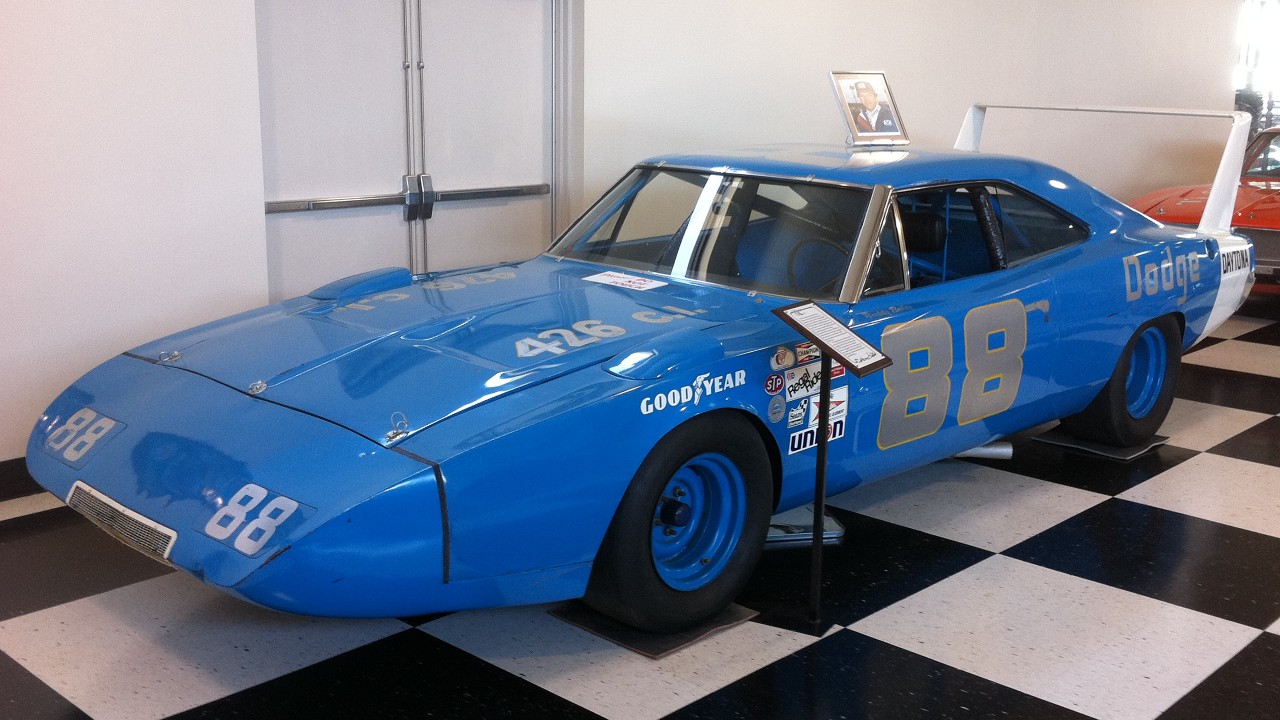
What set the Charger Daytona apart visually was the way its bodywork turned aerodynamics into sculpture. The car wore a pointed nose cone that extended the front of the Dodge Charger into a sharp wedge, reducing drag and helping the car slice through the air at racing speeds. At the rear, a massive 23‑inch stabilizer wing rose above the decklid, towering over the roofline in a way no production car had attempted. Unlike a standard 1969 Charger, the Daytona’s entire profile was reshaped to keep the car planted at the kinds of velocities that defined NASCAR’s superspeedways.
The tall rear wing was not a styling gimmick but a carefully considered piece of engineering. By mounting the Spoiler so Tall above the trunk line, Dodge’s designers ensured it operated in cleaner airflow, generating meaningful downforce without being disrupted by turbulence off the roof. The supports were anchored to the rear frame rails rather than the sheet metal, so the load transferred into the structure of the car instead of flexing the body panels. Paired with the extended nose and reworked rear window area, these changes turned the Dodge Charger Daytona into a true “Aero Car,” a machine that could remain stable at speeds that would unsettle more conventional muscle cars.
Engines, platforms, and the mechanics of speed
Beneath the wild bodywork, the Charger Daytona relied on familiar but potent hardware. Built on Chrysler’s proven B‑body platform, the car shared its basic underpinnings with other Dodge Chargers of the era, which simplified production and ensured durability on the track. Most examples came equipped with the 440 M Magnum V8 rated at 375 horsepower, a big‑block engine that delivered the torque and reliability teams needed for long NASCAR events. This combination of a known chassis and a powerful engine allowed Dodge to focus its experimental energy on aerodynamics rather than reinventing the entire car.
For those seeking even more performance, the Charger Daytona also debuted with the 426 Hemi V8, a racing‑bred engine that had already earned a fearsome reputation in American competition. In NASCAR trim, this powertrain, combined with the Daytona’s slippery shape, allowed the car to reach speeds that pushed the limits of both tires and courage. On the road, the same basic package gave the 1969 Dodge Charger Daytona an aggressive look and high performance that turned heads, even if its true purpose remained rooted in the demands of the oval track rather than boulevard cruising.
Homologation, debut, and domination on the high banks
The only reason the public could buy a Charger Daytona at all was because NASCAR required manufacturers to sell a minimum number of cars that matched their race entries. Dodge responded by producing a limited run of these modified Dodge Chargers, then sending the competition versions to the track late in the 1969 season. The car made its debut in that campaign and quickly proved its worth, validating the company’s gamble that radical aerodynamics could overcome the shortcomings of the previous Charger 500 effort.
The turning point came when the Charger Daytona appeared at the inaugural Talladega 500, where its stability and speed on the high banks signaled a new era. The car was named after the Daytona 500, one of NASCAR’s crown‑jewel events, and its performance on superspeedways showed that the name was more than marketing. Together with its corporate sibling from Plymouth, the Daytona became part of a small group of Aero Cars that regularly topped 200 m per hour in competition. Its massive nose cone and towering rear wing were aerodynamically functional, allowing it to become the first car in NASCAR history to break through that symbolic barrier and forcing rivals like Ford and Mercury to respond with their own wind‑cheating designs.
From outlawed race car to blue‑chip collectible
The Charger Daytona’s very success helped bring about its demise in top‑level stock‑car racing. As the Aero Cars pushed speeds higher, concerns grew about safety and competitive balance. NASCAR eventually changed its rules to rein in these specialized machines, effectively ending the brief era in which a car like the Dodge Charger Daytona could dominate through extreme aerodynamics. With the homologation requirement satisfied and the rulebook moving on, production of the original Daytona ceased, leaving a small population of road cars that had been built for a purpose now largely closed off to them.
That scarcity, combined with the car’s outsized role in racing history, has turned the 1969 Dodge Charger Daytona into one of the rarest and most coveted American muscle cars. On the road, the Daytona turned heads with its aggressive look and high performance, and its rarity has made it a holy grail for Mopar fans and collectors. The model’s status as a one‑year‑only Dodge Charger Daytona, developed specifically to change the outcome of NASCAR races, has helped examples command record prices at auction and cemented its reputation as a legend of the automotive golden age.
More from Fast Lane Only