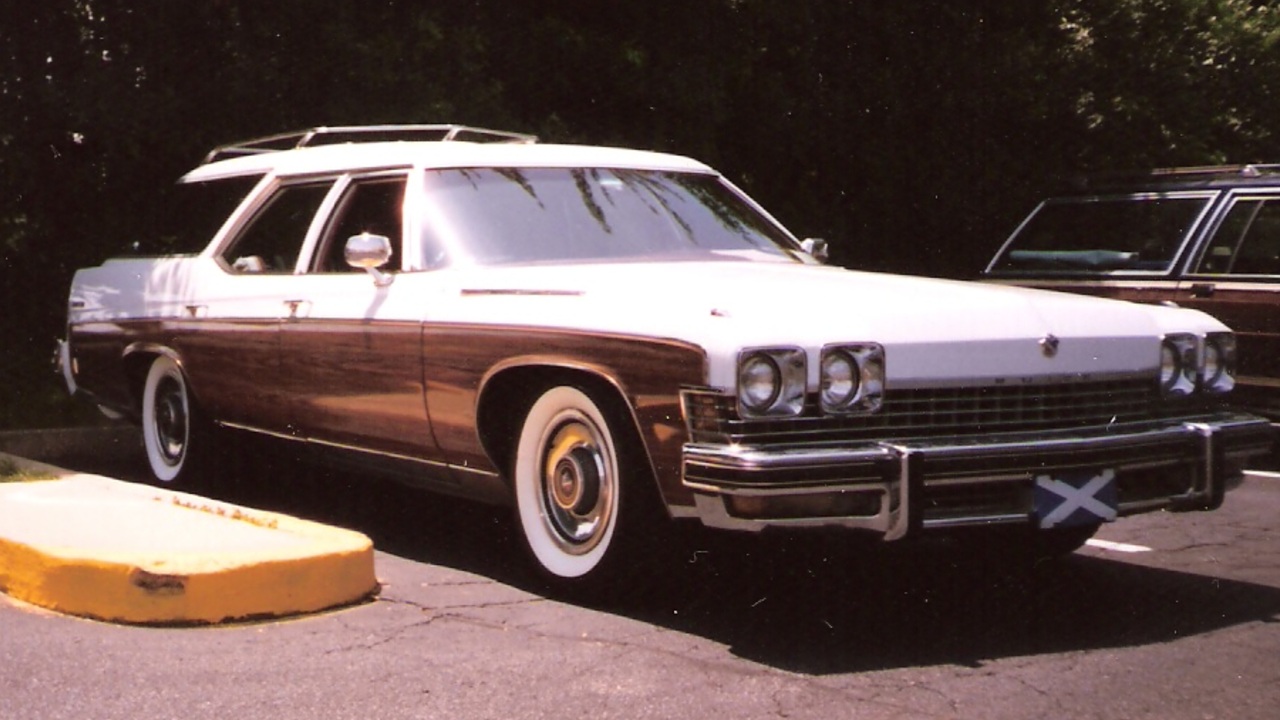
Among American “land yachts,” one Buick still stands apart for its sheer mass. The Buick Estate Wagon of the early 1970s was not only the heaviest Buick ever built, it remains widely cited as the heaviest American passenger car ever sold to the public. In an era when weight and size were badges of honor, this long-roof giant pushed the limits of what a family wagon could be.
Today, when even large SUVs are carefully engineered to trim pounds, the Estate Wagon’s curb weight reads like a relic from another age. Its status as the ultimate heavyweight is more than a trivia note, it is a window into how Detroit once thought about comfort, prestige, and safety, and how far the industry has moved since the land yacht era faded.
The land yacht era and Buick’s heavyweight champion
American automakers spent the postwar decades escalating a quiet arms race in size, with full-size sedans and wagons stretching longer, wider, and heavier with each redesign. Enthusiasts later dubbed these cars “land yachts,” a term that captured both their ocean-liner proportions and their relaxed, floaty ride. Within that culture of excess, the Buick Estate Wagon of the 1971 to 1976 period emerged as a singular achievement in mass, identified in enthusiast accounts as the heaviest Buick ever built and the largest production station wagon the brand ever offered.
That distinction is not simply internal to Buick. The same reporting that credits the 1971 to 1976 Buick Estate Wagon with those records also places it at the top of the American passenger car weight charts, describing it as the heaviest American car ever sold. In the broader context of the land yacht era, where full-size, body-on-frame designs from General Motors and Ford dominated suburban driveways, the Estate Wagon’s combination of length, width, and heavy-duty hardware pushed it beyond even many contemporary luxury sedans in curb weight.
How the Estate Wagon outgrew even Cadillac’s giants
To understand how remarkable that is, it helps to compare the Buick to the most imposing sedans of its time. The Cadillac Fleetwood 75, produced in the mid 1970s, is often cited as the longest mass-produced American car, with sources specifying that The Cadillac Fleetwood 75 measured 252.2 inches in overall length. That figure underscores just how far General Motors was willing to go in pursuit of prestige, yet the Fleetwood’s record in length did not automatically translate into the greatest mass.
While the Fleetwood 75 stretched to 252.2 inches, the Buick Estate Wagon’s claim to fame rests on weight rather than wheelbase or bumper-to-bumper measurement. Accounts that single out the Estate Wagon as the heaviest Buick and the largest production wagon also emphasize that, for sheer mass, it eclipsed other American passenger cars of the period. In other words, Cadillac may have built the longest sedan, and even commissioned wagon conversions of the Cadillac Fleetwood through coachbuilders such as ASC and Traditional Coachworks of Chatsworth, California the Cadillac Fleetwood, but Buick’s own factory wagon carried more curb weight in standard form than any of them.
Engineering a family wagon like a freight car
The Estate Wagon’s extraordinary heft was not an accident, it was the product of engineering choices that treated a family hauler almost like a light-duty commercial vehicle. Built on a full-size, body-on-frame platform, the wagon used heavy-gauge steel for both its frame rails and body panels, a practice that was common at the time but particularly pronounced on long-roof models designed to carry large families and their luggage. The extended roof, reinforced rear cargo area, and third-row seating hardware all added material, and therefore weight, on top of an already substantial full-size chassis.
For much of its production life, the Buick Estate was positioned as the top station wagon in the brand’s lineup, and that status encouraged generous standard equipment. Power-operated accessories, thick sound insulation, and large-displacement engines all contributed to the curb weight. Historical overviews of the Buick Estate note that the nameplate spent much of its existence at the upper end of Buick’s range, and that by the 1970s it sat on the same basic underpinnings as the company’s biggest sedans. When combined with the wagon-specific structure, that platform produced a vehicle that weighed significantly more than the typical family car of its day.
From land yachts to lighter platforms
The Buick Estate Wagon’s reign as the heaviest American car is also a marker of the end of an era. By the early 1990s, General Motors and Ford had introduced what would be their last major redesigns of traditional full-size, body-on-frame passenger cars, a shift that signaled the gradual retreat of the classic land yacht formula. Industry histories of the “land yacht” period point out that these redesigns were effectively the final chapter for the old-school big car, as automakers began to prioritize fuel economy, emissions compliance, and more agile handling.
As those priorities took hold, the idea of a family wagon or sedan approaching the mass of the 1970s Estate Wagon became untenable. Later Buick wagons, and eventually crossovers, moved to lighter unibody platforms, and the Estate name itself disappeared from the lineup. The same sources that celebrate the 1971 to 1976 Buick Estate Wagon as the heaviest Buick ever built implicitly underscore how unique it was, because no subsequent Buick, wagon or otherwise, has approached its combination of size and curb weight.
How the heaviest Buick compares to today’s cars
Placed against modern vehicles, the Estate Wagon’s reputation as a heavyweight becomes even clearer. Contemporary sports cars that feel substantial on the road, such as The Porsche Boxster and Cayman, are described as clocking in at just over 3,000 pounds. Larger performance models, including the Ford Mustang and Toyota Supra, add mass for power and safety, yet still operate within a range that would have seemed modest in the heyday of the land yacht.
Even as modern SUVs and electric vehicles can exceed 5,000 pounds, they do so with very different packaging and materials, and often with three rows of seating and complex battery systems. By contrast, the Buick Estate Wagon achieved its record-setting heft with conventional steel construction, a gasoline engine, and the expectations of a 1970s family car. When enthusiasts and historians describe the 1971 to 1976 Buick Estate Wagon as both the heaviest Buick ever built and the largest production wagon the brand offered, they are recognizing a vehicle that pushed the traditional American car template as far as it could go, in a way that modern engineering is unlikely to repeat.
More from Fast Lane Only