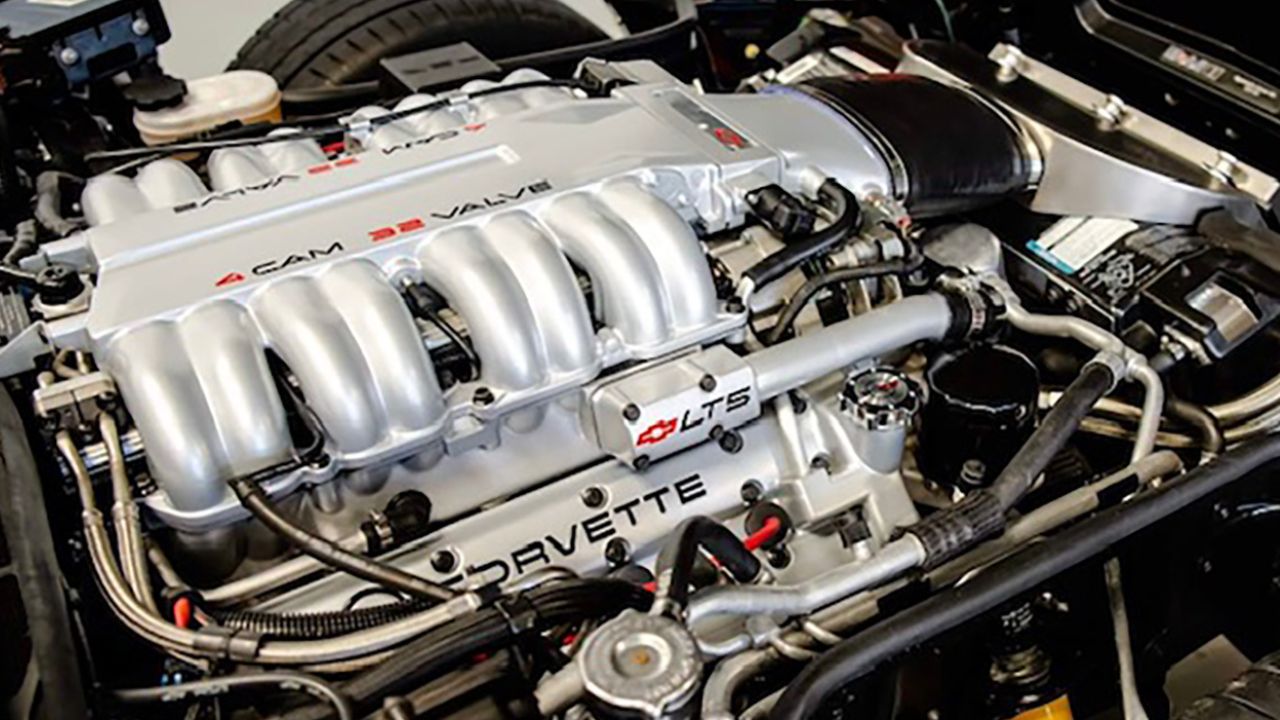
The Chevrolet LT5 engine marked one of the most ambitious engineering leaps in Corvette history, arriving at a time when American performance was shifting toward precision rather than pure displacement. Developed with extreme attention to airflow and high-RPM capability, it delivered a level of sophistication that surprised even the engineers who built it.
GM and Lotus created a high-revving V8 that redefined Corvette performance
When General Motors partnered with Lotus Engineering, the goal was to create a new generation of Corvette power that could compete with advanced European performance cars. The result was the Chevrolet Corvette LT5 engine, a dual overhead cam, 32-valve V8 that broke away from traditional pushrod Corvette design.
Unlike earlier small-block and big-block engines, the LT5 emphasized high-RPM efficiency and airflow precision. It used four camshafts and multi-valve technology to dramatically improve breathing at higher engine speeds, allowing it to produce strong horsepower figures while maintaining refinement. This was a major departure from the brute-force philosophy that had defined earlier Corvette generations.
The LT5 gave the Corvette ZR-1 supercar-level credibility
The Chevrolet Corvette LT5 engine powered the C4-generation ZR-1, a model designed to elevate the Corvette into true global performance territory. With Lotus tuning and engineering input, the engine delivered smooth, linear power delivery that felt closer to exotic European sports cars than traditional American muscle.
At the time, many engineers at General Motors reportedly viewed the engine as a bold and risky departure from established Corvette engineering. Its complexity, cost, and advanced design made it unlike anything GM had previously placed in a production sports car, yet it proved that the Corvette could evolve beyond its muscle car roots.
Advanced DOHC design pushed American V8 engineering forward
The Chevrolet Corvette LT5 engine used a dual overhead camshaft layout that allowed for improved valve control at high RPM. This design enabled the engine to breathe more efficiently than traditional pushrod V8s, contributing to its strong top-end performance and racing-inspired character.
This level of engineering complexity was rare for American production V8s at the time, making the LT5 a technological milestone. It demonstrated that American manufacturers could successfully adopt advanced multi-valve architectures without sacrificing reliability, even if it came at significantly higher production cost and development effort.
The LT5 remains a turning point in Corvette performance history
Today, the Chevrolet Corvette LT5 engine is remembered as a defining moment in Corvette evolution, representing the shift from traditional muscle car engineering to modern high-performance design. It proved that the Corvette could compete with the world’s best sports cars not just through power, but through advanced engineering.
Although later generations would move in different directions, the LT5’s influence remains significant. It stands as a symbol of innovation within General Motors, showing what was possible when American engineering embraced cutting-edge technology in pursuit of supercar performance.
More from Fast Lane Only