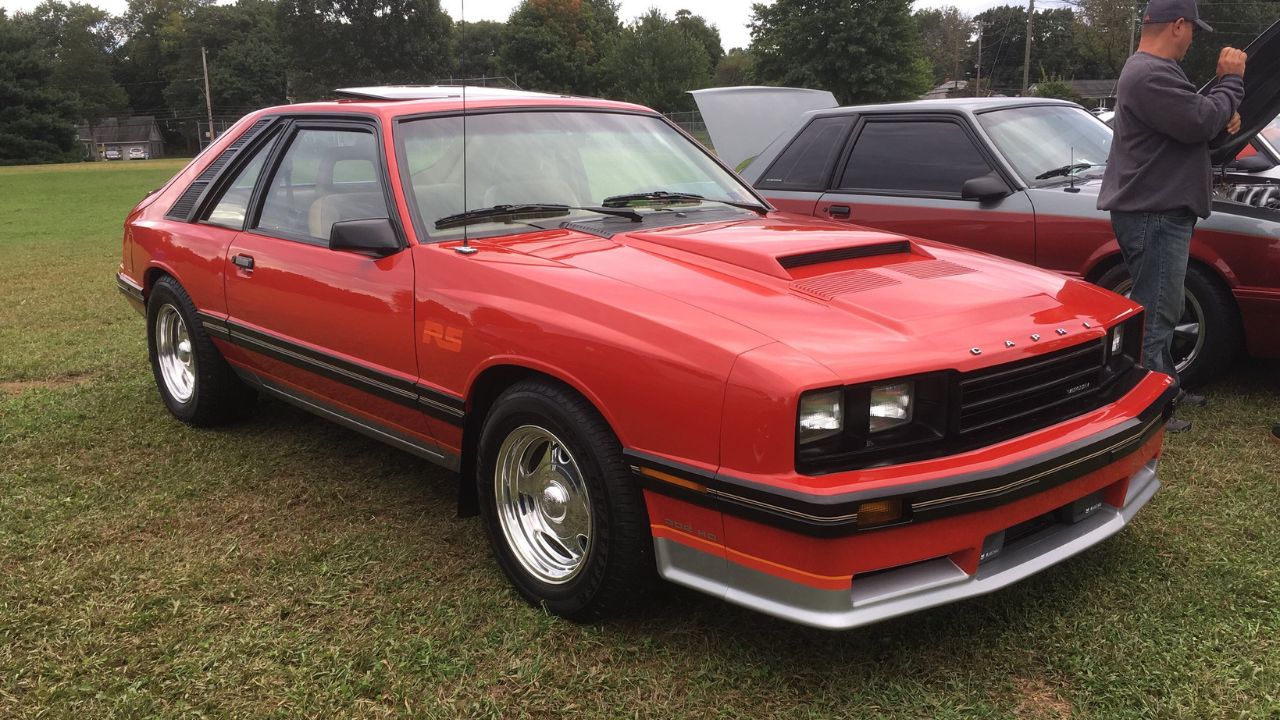
The Capri RS 5.0 arrived as Ford’s more European flavored answer to the Fox body Mustang, pairing the same V-8 punch with sharper styling and a rarer badge. When Ford and Mercury shifted the Capri RS into full 5.0 territory in the mid Eighties, they created a short run of cars that now sit in a curious place in the collector market, more obscure than Mustangs yet increasingly appreciated by enthusiasts who know what they are looking at.
Looking back at when the Capri RS 5.0 was introduced, and how it evolved through the final 1986 model year, helps explain why values today can swing from bargain territory to serious money for the best examples. I want to trace that arc from launch to legacy, then connect it to what recent sales and specialist coverage suggest about where prices are heading.
From European import to Fox platform twin
The Capri story in North America started long before the RS 5.0 badge appeared on a hatchback. From 1970, the Capri was sold as a sport compact in North America by the Lincoln and Mercury division, marketed without any Ford or Mer branding on the car itself, which gave it a quasi European mystique even though it was part of the broader Ford family. That first wave of Capri imports set the tone for a car that was always positioned as a slightly more continental alternative to mainstream American coupes, a positioning that Ford Lincoln carried into the Fox era.
When Ford Lincoln-Mercury launched the second generation Capri on the Fox platform, it effectively became Mercury’s Second Pony Car, a sibling to the Mustang with shared underpinnings but distinct styling and trim. Reporting on the 1979 to 1986 Mercury Capri History describes this car as Ford Lincoln-Mercury’s second pony car, underscoring that it was conceived from the start as a performance oriented companion rather than a simple badge job. That context matters, because the RS 5.0 would later lean heavily on this pony car identity while still trading on the Capri’s earlier European reputation.
The rise of the Capri RS and the move to 5.0 power
By the mid Eighties, the RS badge had become the Capri’s performance calling card, and Ford used it to signal when the car stepped up to serious V-8 power. Coverage of the 1986 Mercury Capri 5.0 notes that by 1985, the Capri RS had become the 5.0 variant, picking up a big air dam, driving lamps, and 15 x 7 inch aluminum wheels to visually separate it from lesser models. That shift, reported in a Sep 24, 2018 buyer’s guide that looks back to By 1985, effectively turned the RS into shorthand for the 5.0 liter V-8, aligning the Capri more closely with the Mustang GT in both performance and image.
The RS 5.0 cars also benefited from the broader Fox platform performance push that Ford Motor Company was making at the time. A later enthusiast account of how Ford Motor Company made special performance versions of the Fox platform Mustang points to the way the company used shared architecture to spin off multiple enthusiast focused variants, and the Capri RS 5.0 fits squarely into that strategy. Within the Capri lineup, the RS 5.0 sat above more modest four and six cylinder models, and even above some V-8 cars that lacked the full RS appearance and suspension package, which is why collectors today tend to zero in on RS 5.0 build sheets when they are hunting for the most desirable examples.
Bubble back styling, special editions and the final 1986 evolution
Styling is a big part of why the Capri RS 5.0 still sparks debate among enthusiasts, and the so called bubble back hatch is at the center of that conversation. A period discussion of the 1984 to 1986 Mercury Capri RS 5.0 bubble back notes that, as one commenter put it, Not after the bubble back was grafted on for 1983 they didn’t, capturing how polarizing that rear glass treatment was even when the cars were relatively new. The bubble back gave the Capri a more dramatic, almost concept car profile compared with the Mustang, and it remains one of the quickest visual tells that you are looking at a Fox Capri rather than its more common sibling.
Alongside the regular RS 5.0 models, Mercury and its partners also created a handful of special editions that have become cult favorites. Reporting on Mercury Capri History highlights that Just 50 of these 1985 Mercury Capri Motorsport Pace Cars were built as part of a factory special order Memo Ford Show program, a tiny production run that has made surviving examples particularly sought after. In the mid Eighties, ASC’s collaboration with McLaren Engines produced further Capri based specials, including a 1986 ASC Coupe that combined unique bodywork, specific style wheels, and orange stripes, as detailed in a Jan 28, 2024 feature on Mercury Capri special editions. These low volume variants sit at the top of the Capri value hierarchy today, often commanding a premium over even very clean standard RS 5.0 cars.
The final model year, 1986, brought an important mechanical change that affects how collectors view these cars. A technical overview of the 1986 Capri notes that the 1986 Capri’s 5.0 V-8 was the first with port EFI, making 10 hp less but 20 lbs.ft. more than the ’85 4V version, and that this setup foreshadowed the improvements enjoyed by Mustang for 1987. That move to EFI (described explicitly as Capri EFI in the source) gave the last year RS 5.0 a different driving character and a more modern fueling system, which some buyers prefer for reliability and tuning, even if the headline horsepower figure dipped slightly compared with the carbureted 1985 cars.

Production rarity, enthusiast knowledge and how values are set
One reason Capri RS 5.0 values can be hard to pin down is that production numbers were always lower than the Mustang’s, and documentation is patchy. The broader Mercury Capri History coverage makes clear that the Fox Capri was a niche player even when new, positioned as Mercury’s Second Pony Car rather than a mass market performance leader. That relative scarcity means that when a well preserved RS 5.0 surfaces, especially one with documentation confirming its original Liter and Speed configuration, it can attract outsized attention from a small but motivated pool of buyers.
Enthusiast communities have stepped in to fill some of the gaps left by official records, and their discussions help shape what the market considers correct or desirable. A Feb 6, 2020 thread titled 1986 5.0 Capri RS designation shows owners debating how Mercury Capri badging and option codes were applied in the final years, with posters referencing specific 1985 Mercury Capri 5.0 Liter 5-Speed cars and sharing photos to verify details. That kind of grassroots research, often led by owners like Michael Lamoureux in regional groups such as North East Fox Frenzy, has helped clarify which cars are genuine RS 5.0 examples and which are later clones, and that clarity directly influences pricing when cars cross the block or appear in online listings.
Market signals and what buyers are paying today
To understand current values, I look at how specialist buyer’s guides and auction listings frame the Capri 5.0 compared with other Eighties performance cars. A Sep 24, 2018 buyer’s guide on the 1986 Mercury Capri 5.0, filed under Home, Buyer, Guides, Collector Cars, Mercury Capri, positions the car as a credible alternative to the Mustang for collectors who want something a bit more European in flavor. The same coverage notes that by 1985, the Capri RS had become the 5.0 variant with its distinctive aero pieces and wheels, which helps explain why clean RS 5.0 cars tend to command a premium over base Capris with similar mileage and condition.
Actual transaction data is thinner than for Mustangs, but auction platforms and dealer sites provide useful signals. Listings on large collector marketplaces such as Mecum show that when a low mileage, well documented Capri RS 5.0 or a rare special edition like the Mercury Capri Motorsport Pace Cars or an ASC Coupe appears, bidding can climb into territory that would have seemed optimistic a decade ago. At the same time, driver quality cars with needs still trade for relatively modest sums, reflecting the fact that the Capri remains a connoisseur’s choice rather than a mainstream blue chip collectible.
Recent coverage of Mercury Capri special editions published on Jan 28, 2024 reinforces that dynamic by highlighting how In the mid Eighties, ASC’s collaboration with McLaren Engines created cars that appeal to a specific slice of the market willing to pay for rarity and provenance. For buyers today, that means the spread between an average Capri 5.0 and a top tier RS 5.0 or special edition can be wide, and careful attention to documentation, originality, and mechanical specification (including whether the car uses the earlier carbureted setup or the later Capri EFI system) is essential before assigning a value. Unverified based on available sources are any precise price ranges or appreciation percentages, but the direction of travel in specialist coverage suggests that the best Capri RS 5.0 examples are finally starting to be valued in line with their significance in Ford’s Fox era performance story.