The question of what truly counts as the “first muscle car” has sparked arguments for decades among enthusiasts, historians, and even engineers. Unlike many automotive milestones with clear beginnings, the muscle car era has no universally agreed starting point. Instead, it sits in a gray zone where performance sedans, factory hot rods, and mid-size coupes slowly blended into a new category that no one initially named.
What makes the debate so strange is that the cars involved were not designed to start a new class at all. The label “muscle car” came later, retroactively applied as people tried to make sense of a sudden explosion of factory-built street performance in the 1960s.
Before “muscle cars” had a name
In the early 1950s and early 1960s, American automakers were already experimenting with high-performance packages. Large V8 engines were being installed into relatively lightweight bodies, but these combinations were not yet part of a defined category.
Cars like the Chrysler 300 letter series and early performance Pontiacs offered impressive speed, but they were still viewed as upscale performance cruisers rather than something distinct. The idea of a factory-built street machine aimed at younger buyers had not fully formed.
At this stage, performance was an option—not an identity.
The turning point: mid-size cars meet big engines
The real shift began when manufacturers started placing large-displacement V8 engines into mid-size platforms. This created a new balance of weight, cost, and performance that changed everything.
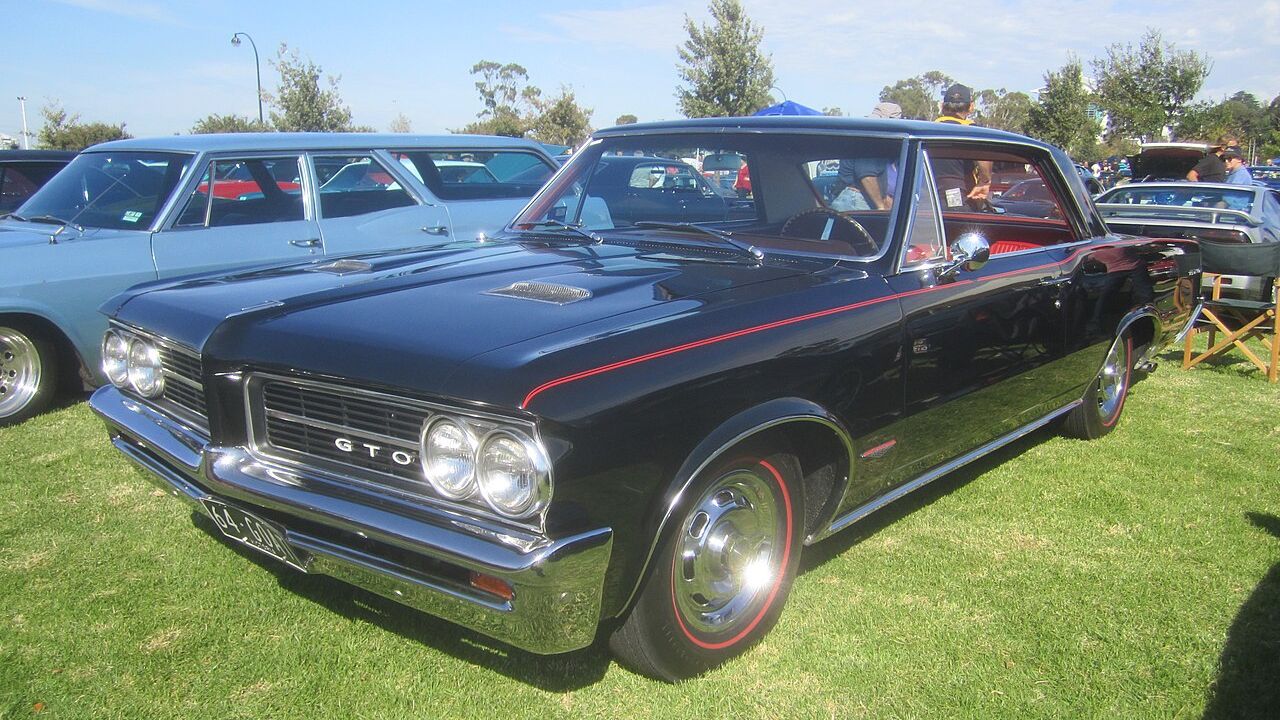
A key example often discussed in the debate is the Pontiac Tempest LeMans GTO 1964, commonly referred to as the GTO. It combined a relatively light mid-size body with a powerful 389 cubic-inch V8, creating acceleration that felt dramatically different from typical family sedans of the time.
For many enthusiasts, this moment represents the first time a mainstream production car clearly prioritized straight-line performance over luxury or touring comfort.
Why Pontiac’s move caused controversy
The reason the GTO sparked debate was not just its performance, but how it was offered. Initially, General Motors had an unofficial policy limiting large engines in mid-size cars, known informally as the “corporate racing ban.”
To bypass this, engineers and marketing teams packaged the high-performance option as an upgrade rather than a separate model. This allowed it to be sold within existing product rules while still delivering far more power than typical vehicles in its class.
The success of this strategy caught the entire industry off guard.
The competition reacts immediately
Once the concept proved popular, other manufacturers quickly followed. Chevrolet, Dodge, Plymouth, and Ford began introducing their own mid-size performance packages, each trying to outperform the others in horsepower and acceleration.
This rapid escalation created a unique situation: instead of one defining “first,” multiple cars emerged almost simultaneously as contenders for the title.
Within just a few years, the market was filled with factory-built performance machines that blurred the line between regular transportation and street performance icons.
Why the definition problem exists
The core issue in the muscle car debate is that the category itself was never officially defined by manufacturers at the time.
Some enthusiasts define a muscle car as a mid-size American car with a large V8 engine. Others require specific traits such as affordability, straight-line performance focus, or mass-market availability.
Depending on which definition is used, the “first” muscle car changes completely.
Marketing created the category after the fact
The term “muscle car” did not exist during the earliest phase of this performance boom. It was popularized later as journalists and enthusiasts tried to categorize what had already happened.
By the late 1960s and early 1970s, the industry had fully embraced the concept, but by then the foundational cars were already in circulation. The label was applied retroactively, which is why historical disagreement persists.
What started as marketing competition eventually became automotive history classification.
The role of insurance and regulation pressure
As performance increased, so did external pressures. Insurance companies began raising premiums on high-horsepower vehicles, and regulatory changes started limiting compression ratios and emissions output.
This shift had an unexpected effect: it helped define the muscle car era as a specific historical window rather than an ongoing category.
The early pioneers of the movement were no longer just competitors—they became reference points for a brief but intense performance period.
Why enthusiasts still argue today
The debate continues because it is not just about a single vehicle—it is about identity.
Calling a car the “first muscle car” assigns it symbolic importance as the origin of a cultural movement. Different brands, regions, and enthusiast groups naturally emphasize different vehicles based on loyalty and interpretation.
As a result, the conversation remains open-ended rather than resolved.
Engineering convergence created the illusion of a beginning
One reason the debate feels so complicated is that multiple engineering trends converged at once: lighter bodies, more powerful V8s, improved transmissions, and growing demand for affordable performance.
No single manufacturer invented the muscle car concept. Instead, the industry collectively arrived at it through competition and experimentation.
What looks like a clear starting point in hindsight was actually a gradual convergence of ideas.
The GTO’s role as a symbolic benchmark
Even with ongoing debate, the Pontiac Tempest LeMans GTO 1964 remains a central reference point in discussions. It represents the moment when performance, pricing, and mass-market appeal aligned in a way that defined everything that followed.
Whether or not it was truly “first” depends on definition—but its influence is difficult to ignore.
A category born from competition, not design
Unlike sports cars or luxury sedans, the muscle car was not originally a planned category. It was a reaction to competition between manufacturers trying to outperform each other within existing platforms.
This reactive origin is the reason the debate still exists. There was no single blueprint, no official launch, and no agreed definition at the start.
When a category is defined by memory, not documents
The first muscle car debate continues because it is rooted in interpretation rather than documentation. Enthusiasts are not just comparing specifications—they are reconstructing a moment when the automotive industry changed direction without realizing it.
In the end, the answer depends on what someone chooses to value most: engineering innovation, marketing strategy, or cultural impact.
That uncertainty is exactly what keeps the debate alive decades later.
More from Fast Lane Only
- Unboxing the WWII Jeep in a Crate
- 15 rare Chevys collectors are quietly buying
- 10 underrated V8s still worth hunting down
- Police notice this before you even roll window down
*Research for this article included AI assistance, with all final content reviewed by human editors