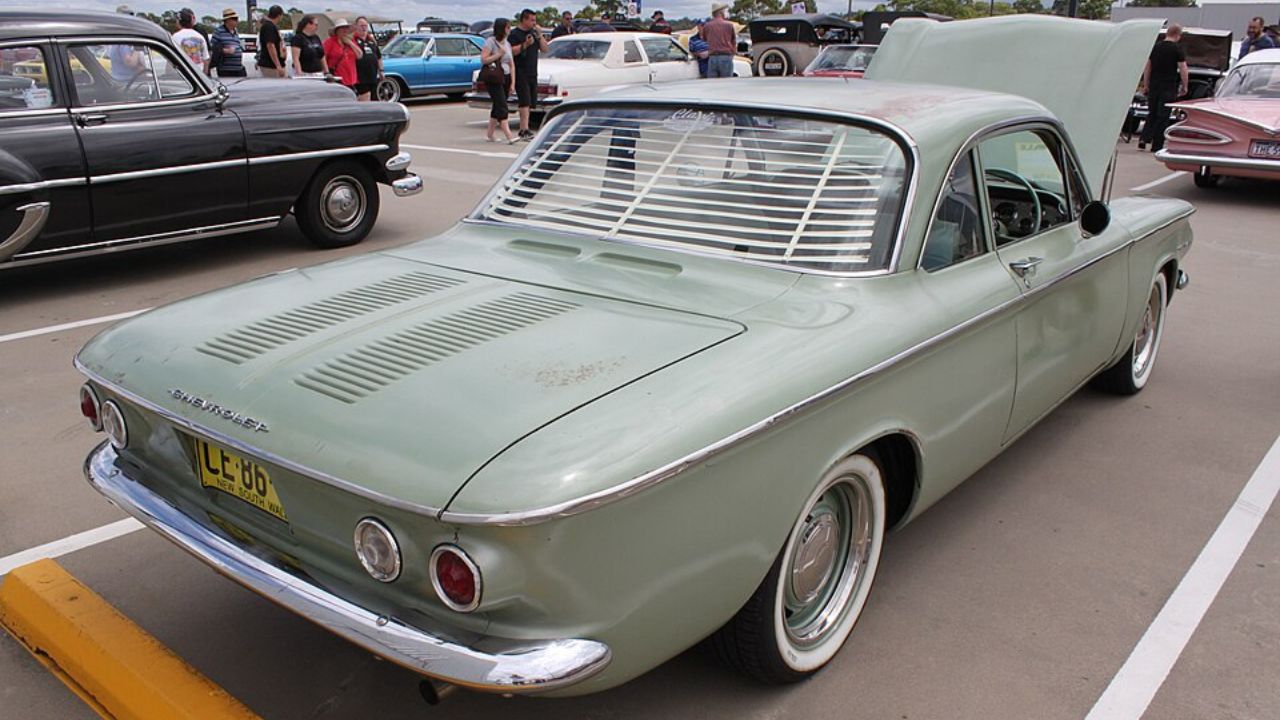
The 1960 Chevrolet Corvair was unlike almost anything else coming from Detroit. With its rear-mounted air-cooled engine, compact dimensions, and European-inspired design, it challenged traditional American automotive thinking. Yet the very engineering choices that made the Corvair innovative eventually made it one of Chevrolet’s most controversial cars, especially after safety concerns attracted national attention.
Chevrolet Took a Radical Direction
When Chevrolet introduced the Corvair for 1960, American automakers were producing increasingly large cars with front-mounted engines and traditional body-on-frame layouts. Chevrolet decided to take a completely different approach by creating a compact car with a rear-mounted, air-cooled flat-six engine.
The decision was influenced partly by the growing popularity of small European cars and the success of the Volkswagen Beetle. Chevrolet wanted a compact vehicle that could appeal to buyers who valued efficiency and maneuverability without giving up American styling.
The Corvair’s independent suspension and compact dimensions also gave it a distinctive driving character. It was not simply a smaller Chevrolet; it was an entirely different engineering concept.
That unconventional design became both its greatest strength and, eventually, its biggest source of controversy.
The Rear Engine Changed Everything
The Corvair’s rear-engine layout gave Chevrolet engineers several advantages. Without a conventional engine occupying the front of the vehicle, the designers could create a spacious passenger compartment while maintaining a relatively compact exterior.
The air-cooled flat-six also eliminated the need for a traditional radiator and coolant system. This simplified certain aspects of the design and gave the Corvair a unique mechanical identity.
However, the rear-engine configuration affected the car’s weight distribution and handling characteristics. Early Corvair models used a swing-axle rear suspension, and under certain circumstances, changes in suspension geometry could produce challenging handling behavior.
For most ordinary driving, the Corvair could be operated normally, but its unusual design meant that proper tire pressures and suspension condition were particularly important.
What made the Corvair controversial was therefore closely connected to what made it innovative.
Safety Criticism Changed Its Reputation
The Corvair’s reputation changed dramatically after journalist Ralph Nader published Unsafe at Any Speed in 1965. The book criticized safety practices across the American automobile industry, with particular attention given to the first-generation Corvair’s rear suspension.
Nader argued that the Corvair’s design could contribute to dangerous handling in certain situations. His criticism attracted enormous public attention and helped make the Corvair a symbol of America’s growing concern over automobile safety.
The controversy eventually contributed to congressional investigations and helped increase pressure for stronger federal vehicle-safety standards.
Chevrolet disputed some of the criticisms surrounding the Corvair, and later investigations and engineering studies complicated the story. The issue was not simply that every Corvair was inherently unsafe; rather, the car became associated with a broader debate about how automobiles should be designed and regulated.
Its unusual engineering had suddenly become a national conversation.
Chevrolet Eventually Changed the Corvair
Chevrolet responded to criticism by improving the Corvair’s suspension design. For 1965, the company introduced a redesigned rear suspension that replaced the earlier swing-axle arrangement with a fully independent system.
The updated Corvair was widely regarded as a significant engineering improvement. Its handling became more predictable, while the car retained the rear-mounted flat-six engine that made it distinctive.
Ironically, the later Corvair demonstrated how much potential the original concept had. The redesigned model offered refined handling and remained an interesting alternative to conventional American cars.
But by then, the damage to its reputation had already been done. Chevrolet discontinued the Corvair after the 1969 model year as consumer preferences and the compact-car market continued changing.
The controversy had become inseparable from the car’s identity.
A Controversial Legacy That Still Matters
Today, the Chevrolet Corvair is increasingly appreciated for the engineering ambition behind it. Its rear-mounted flat-six, independent suspension, compact proportions, and unconventional layout made it one of the most technically interesting American cars of its era.
The Corvair also played an important role in the history of automotive safety. The controversy surrounding it helped fuel public discussion about vehicle design, crash protection, and government safety standards.
Collectors now recognize the Corvair as more than the controversial car described in headlines. It was an ambitious attempt by Chevrolet to challenge conventional thinking and create something genuinely different.
The unusual reason the 1960 Corvair became so controversial was ultimately the same reason it remains fascinating today: Chevrolet dared to build an American car that broke almost every traditional Detroit formula.
More from Fast Lane Only
- Unboxing the WWII Jeep in a Crate
- 15 rare Chevys collectors are quietly buying
- 10 underrated V8s still worth hunting down
- Police notice this before you even roll window down
*Research for this article included AI assistance, with all final content reviewed by human editors