Ken Block’s Hoonicorn was never supposed to be replicable. Built with roughly two million dollars of direct backing from Ford Performance and more than two years of development time, the all-wheel drive, 900-horsepower 1965 Mustang became one of the defining machines of modern gymkhana. It was a car that existed because a major manufacturer decided to write the check. For almost anyone else, building something in that league was never realistic.
Westen Champlin has spent years thinking about it anyway. He first saw the Hoonicorn unveiled as a teenager, and the idea of an all-wheel drive muscle car with nine hundred horsepower stuck with him long enough that he eventually had renderings made of his own version, sketched out more than two years before any metal got cut. The shop behind those renderings, Horsepower Labs, has built plenty of ambitious projects before, from engine-swapped Rolls-Royces to an LS-swapped couch. None of those, by his own admission, compare to what he is attempting now.
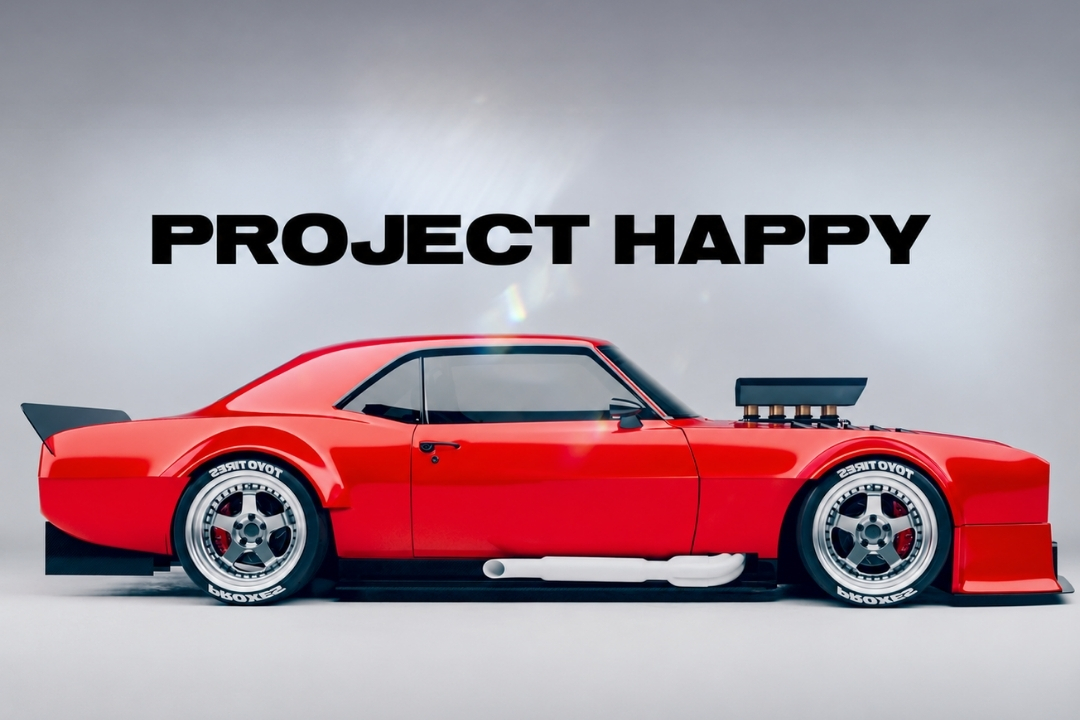
The car is called Project Happy, and the premise is simple to say and brutal to execute: take a 1967 Camaro shell with nothing left inside it, and turn it into an all-wheel drive drift car aiming for 1,000 to 1,500 horsepower, without the Ford Performance budget or the two years Ken Block’s team had to figure it out.
Starting from nothing, literally
The Camaro that anchors this build came off Facebook Marketplace, and it arrived with no floor, no windshield, no trunk, and no rear glass. It was, in practical terms, a shape rather than a car. Once the team finished trimming away the metal that would not survive the build, the only pieces expected to remain from the original 1967 Chevrolet were the roof, the quarter panels, and part of the rear structure. Everything else, from the floor to the firewall to the subframes, has to be fabricated or sourced from somewhere else entirely.
That is where the junkyard part of the equation comes in. The plan calls for a rear subframe, control arms, spindles, and brakes pulled from a C6 Corvette, chosen because that platform has already proven itself durable on other builds the shop has done. The rear differential is a Ford 8.8 out of an S550 Mustang, grafted into the Corvette suspension to solve a packaging problem the Corvette’s own differential couldn’t handle. It is a combination that has no factory precedent. Nothing about a Camaro body wearing Corvette suspension and Mustang gears was ever meant to bolt together, which means the team is essentially inventing the fitment as they go.
The parts that actually cost real money
Not everything on this build came from a bargain bin. The engine is a 427 cubic inch LS built by Texas Speed, paired with a 3-liter Whipple supercharger and an internal intercooler brick, a combination rated at 1,500 horsepower on its own. Behind it sits a fully billet 6XD sequential transmission rated to handle 2,000 horsepower, a component expensive enough that Champlin joked it was worth more than his own house. A billet transfer case, built to the same standard as units used in 2,000-horsepower monster trucks, completes the drivetrain’s high end.
That contrast is the real character of this build. A six-figure transmission sits a few feet away from a front differential the team is hoping to find for around $150 out of a junkyard. The expensive components are there because there is no substitute for a transmission and transfer case that can survive fifteen hundred horsepower running through all four wheels. The cheap components are there because that is simply what the budget allows once the drivetrain has eaten most of it.
The problem nobody has solved yet
Most factory all-wheel drive trucks route their front differential with a driver-side drop, which works fine when the vehicle sits high off the ground. A 1967 Camaro built for drifting does not have that luxury. The team needs the ride height low enough that the car handles like a performance car rather than a truck, which means the transfer case has to feed the front axle from the passenger side instead, the opposite of how almost every donor differential on the used market is built.
That single packaging requirement has turned into the build’s most stubborn holdup. The front differential needs to mount on the passenger side, handle the power the drivetrain is capable of producing, fit in the limited space left under the engine and steering rack, and still be affordable enough to make sense next to a $150 target. Finding a part that checks all four boxes has proven difficult enough that Champlin has resorted to asking his own audience for suggestions rather than solving it in isolation.
Why the junkyard approach still adds up
The team is running the same category of hardware, and in some cases the identical style of components, that a two-million-dollar factory-backed build would use. The difference is where the rest of the car comes from. A subframe out of a Corvette, a differential out of a Mustang, and a shell bought secondhand online are not the ingredients of a factory concept car, but stacked correctly they can produce the same fundamental outcome: an all-wheel drive muscle car with the kind of power figures that used to require a manufacturer’s checkbook to reach.
Champlin has already gotten the engine, transmission, transfer case, and rear subframe test-fitted together inside the chassis, an early sign that a Camaro-Corvette-Mustang combination that has no business existing might actually share the same footprint. What is left is the part that cannot be solved with fabrication skill alone, a single differential that satisfies four conflicting requirements at once. Once that piece falls into place, the rest of Project Happy is mostly a matter of connecting the tubes already jigged into position, and turning a car with no floor and no glass into something that can put fifteen hundred horsepower down through all four corners.
More from Fast Lane Only
- Unboxing the WWII Jeep in a Crate
- 15 rare Chevys collectors are quietly buying
- 10 underrated V8s still worth hunting down
- Police notice this before you even roll window down
*Research for this article included AI assistance, with all final content reviewed by human editors.