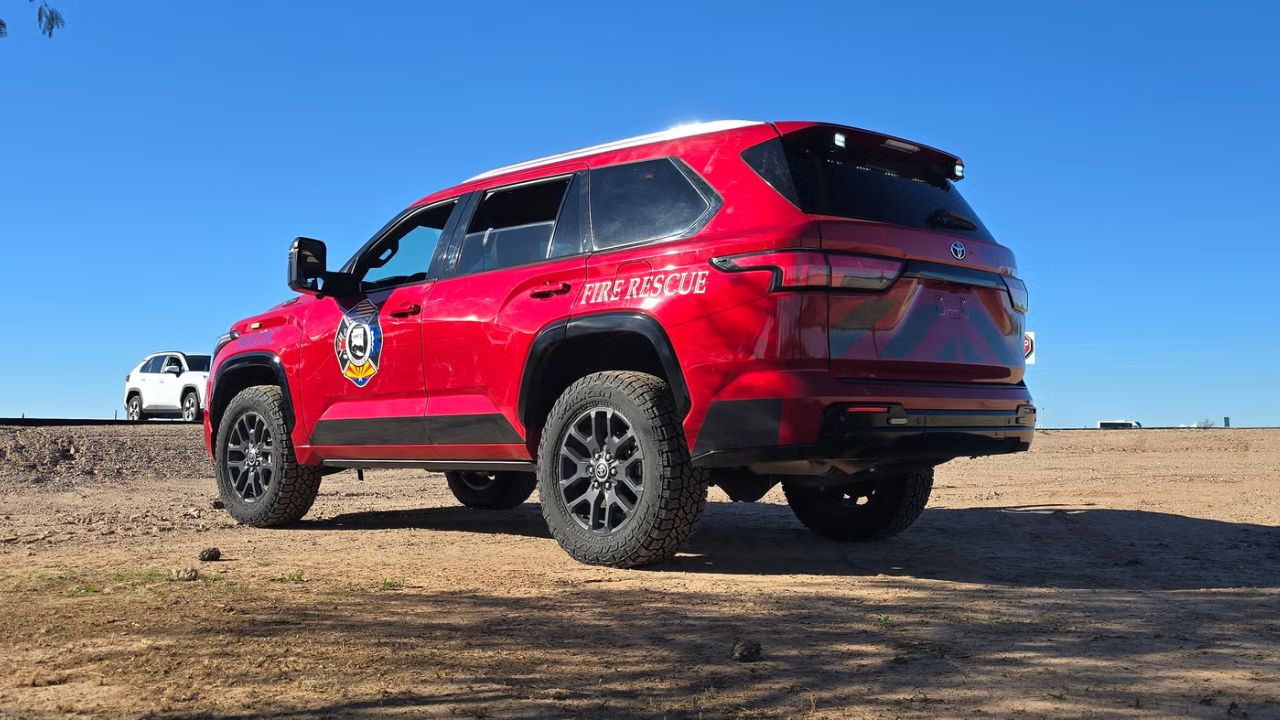
You think you know what a full-size SUV can be, right up until you meet the Toyota Sequoia EMT. It looks like a lifted family hauler that got lost on the way to a fire station, but under the light bar and decals sits a purpose-built rescue tool that you were never supposed to park in your driveway. Instead of chasing suburban errands, this one-off truck exists to chase the worst days of other people’s lives.
The familiar Sequoia shape is still there, yet every meaningful change nudges it away from consumer product and toward rolling medical gear. From the stripped-out rear cabin to the custom electronics and emergency lighting, the Sequoia EMT shows you what happens when Toyota stops thinking about cupholders and starts thinking about seconds and survival.
From showroom SUV to off-road EMT rig
The build starts with a regular Sequoia, then you watch Toyota quietly turn it into something that has no place on a dealer lot. The company began with a Platinum-spec body-on-frame SUV, then converted it into an off-road EMT rig that now wears a prominent Star of Life badge and has already covered a documented 14,600 mile of duty. You still see the luxury trim in the front cabin, but once you move past the B-pillars, the priorities change from comfort to access, storage, and medical response.
From there, it was stripped of its third-row seats and most of its family-friendly fittings, then rebuilt so the rear half functions as a mobile work bay for emergency crews. Reporting on the project describes how the rear interior was gutted so only the front cabin remains largely stock, which lets you imagine the contrast between plush leather up front and hard-wearing, wipe-clean surfaces in back that are ready for gear and blood rather than groceries. That transformation is laid out in detail when you follow the Sequoia from showroom form to dedicated emergency vehicle in coverage of Toyota’s tool choices.
Why Toyota built a Sequoia you cannot buy
A lifted, light-drenched Sequoia like this might look like a marketing play, but Toyota treats the EMT rig as a working instrument, not a brochure prop. The company uses it at its proving grounds, where high-speed tests and durability trials create real risk for engineers, test drivers, and guests. When you read how As Toyota hosted a group of media at its largest proving grounds and let them see the truck up close, you understand that this Sequoia exists first to serve that dangerous environment, with publicity coming a distant second.
Toyota’s broader safety mindset also shapes this one-off. The same manufacturer that controls access to The EDR in its production vehicles, requiring that any downloads and reports be generated by Toyota or NHTSA, is not casual about who handles a medical-response Sequoia either. That tight grip on critical tools appears again in the way the Sequoia EMT is described as for emergency use only, a phrase that tells you this SUV is not just another accessory package but part of a controlled safety system rather than something you can option on a lease.
Lifted stance, hidden tech
You notice the Sequoia EMT before you even clock the decals, because the stance is all wrong for a mall parking lot and just right for a washed-out proving-ground trail. Toyota added a suspension lift and off-road hardware so the Sequoia EMT could reach crash scenes and remote corners of its test facility, a setup enthusiast pages have highlighted when they describe Toyota’s off road ready Sequoia EMT as built for emergency use only. In that context, the extra ground clearance is not cosmetic, it is a way to keep paramedics moving when the surface turns to mud or gravel.
Once you get close, the lighting and electronics tell you how much custom work went into this truck. Technician Tanner Yost explains that “All the mounts for the lights inside and out were designed in CAD and 3-D printed,” which means every beacon, floodlight, and interior fixture sits on a bracket tailored to this exact body. That level of detail, captured in coverage of how All the mounting points were modeled in CAD by Tanner Yost, gives you a sense of how far Toyota went beyond bolt-on parts, turning the Sequoia EMT into a prototype lab for rapid, precise emergency hardware.
Inside Don Donka’s rolling office
The Sequoia EMT really comes into focus once you follow Meet Don Donka into the cabin. As Toyota hosted a group of media at its largest proving grounds, Don Donka ate lunch in the ventilated front seat of his Sequoia while the emergency rig sat nearby, ready to roll at the first radio call. That small detail, shared in a profile that invites you to Meet Don Donka and his Sequoia, shows how the truck doubles as a daily workspace and a standby ambulance, with the same front comfort features you expect from a Platinum model.
Behind that calm driver’s seat, the vibe shifts. The rear of the Sequoia EMT is packed with organized storage for medical bags, extraction tools, and communications gear, arranged so one person can reach what they need without climbing over a patient or another responder. When you read how As Toyota opened the doors for a closer look during that media visit, you get the sense that every drawer and bracket was laid out to match real emergency workflows rather than to impress onlookers. The Sequoia EMT is less a show car and more a rolling protocol, built around how Don Donka and his colleagues actually move when someone is hurt.
Why you are not getting an EMT package on your next Sequoia
It is easy to imagine an options list where you tick a box for “EMT package” on your next family SUV, but Toyota’s language makes it clear that this rig is for Emergency Use Only. That phrase appears again in coverage of another project, where For Emergency Use Only is used to describe specialized equipment that will never appear in consumer catalogs, and it fits the Sequoia EMT perfectly. The truck is part of an internal safety ecosystem, not a lifestyle trim, and Toyota treats it the same way it treats restricted diagnostic tools and crash data readers.
The pattern becomes clearer when you look at how The EDR in Toyota vehicles is handled. This equipment is not available to the public, and the documentation spells out that The EDR must be downloaded and any reports must be generated by Toyota or NHTSA, which mirrors the control you see around the Sequoia EMT. Just as you cannot casually plug into crash data, you are not going to order a Star of Life badge, custom CAD mounts, and emergency lighting on a weekend build sheet. The company clearly separates what protects you as a consumer from what it uses behind the scenes to protect its own people and guests.
More from Fast Lane Only