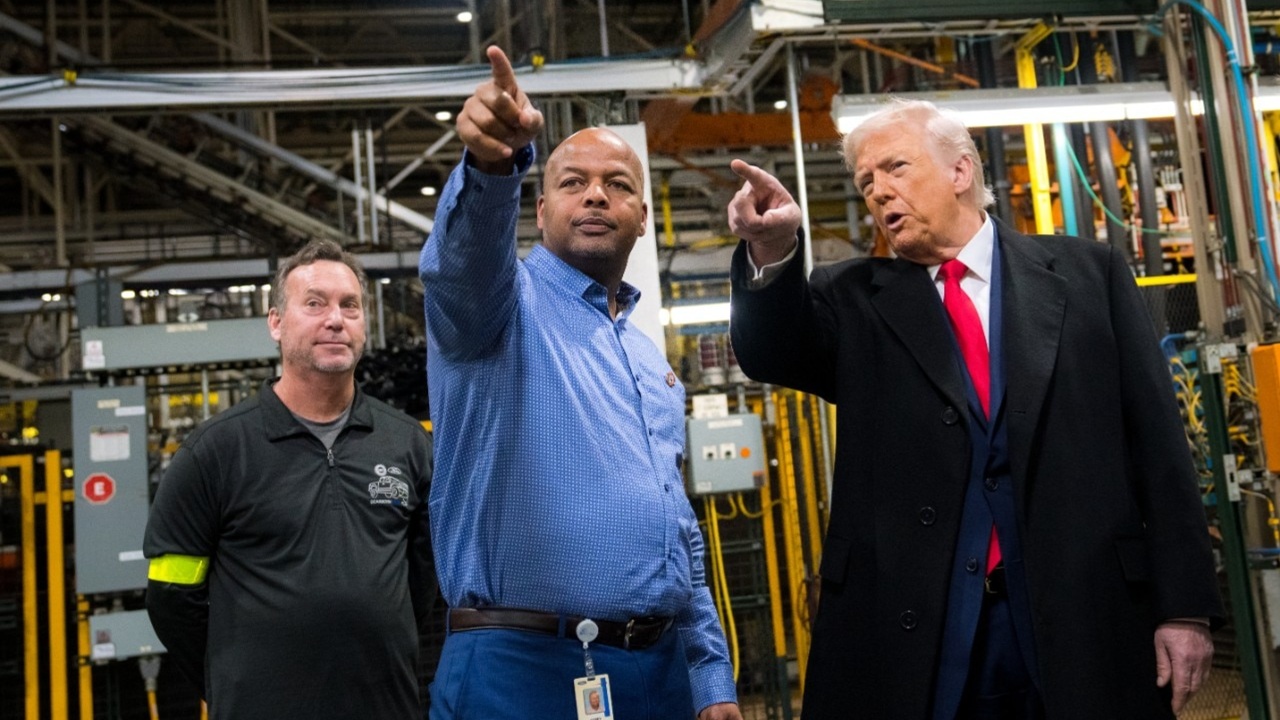
The viral moment on a Dearborn factory floor captured a flash of anger, a raised middle finger and a worker who suddenly found his livelihood in question. Yet as the clip of President Donald Trump flipping off a Ford employee ricocheted across social media, the balance of power around that worker began to shift in unexpected ways. What started as a confrontation that turned his face red with risk may now leave him, quite literally, laughing all the way to the bank.
I see in this episode a compressed story about class, politics and the economics of modern autowork. A single shouted insult, a presidential gesture and a corporate suspension have opened a window into how workers are punished, how unions respond and how online outrage can be converted into hard cash.
The three seconds that exposed a factory floor power struggle
The confrontation unfolded in a Ford Motor Co plant in Dearborn, where a line worker broke the carefully staged choreography of a presidential tour. As President Donald Trump walked past, cell phone video captured the worker shouting “pedophile protector” at him, a phrase that cut through the background noise of machinery and security chatter. In those three seconds, the usual deference that surrounds a presidential visit gave way to a raw exchange between a head of state and a man in safety glasses.
According to Video obtained by TMZ, the worker’s outburst drew an immediate and unmistakable response. Trump turned, raised his hand and extended his middle finger, reportedly telling the worker “F you” as he moved on. Multiple accounts describe the same sequence, with Cell phone footage from the Dearborn plant showing President Donald Trump reacting to the heckle with the gesture while Ford representatives and staff looked on. For a moment, the hierarchy of the factory floor was inverted, the president engaging directly with a single employee rather than the executives and union leaders usually arrayed around him.
From suspension to support: how a worker became a cause
The corporate response came quickly. The Ford worker who shouted at Trump and was flipped off in return was suspended by Ford, a move the company framed as a workplace discipline decision rather than a political statement. Reporting on the suspension notes that the employee was removed from the plant after the incident and placed under investigation, a step that immediately raised the stakes for his family’s income and health benefits. What might have been a fleeting viral clip suddenly carried the weight of a potential job loss.
Yet the suspension did not leave the worker isolated. A major union forcefully backed him, with union officials publicly criticizing Ford’s decision and arguing that workers should not be punished for speaking their minds during this time of uncertainty. One account describes how a powerful union stepped in on behalf of the Ford employee who had been flipped off by Trump, framing his treatment as part of a broader pattern in which workers feel their voices are constrained on the job. In Dearborn, that support turned a disciplinary case into a test of whether a rank and file autoworker could challenge both corporate management and the President of the United States without being crushed.
Online outrage, real money: the GoFundMe windfall
While Ford weighed its options and the union rallied, the internet did something it has learned to do with startling efficiency: it turned outrage into money. Donations began pouring in for the suspended Ford worker who heckled Trump, with a crowdfunding campaign quickly attracting contributions from people who saw him as a symbol of defiance. One report describes Donations surging in as supporters reacted to the viral clip and to a Trump spokesperson’s description of the worker as “a lunatic” who was “wildly screaming expletives in a complete fit of rage.” That language, intended to discredit him, instead helped galvanize donors who felt the punishment did not fit the supposed offense.
The sums involved are not trivial. Coverage of the fallout notes that the viral video and subsequent suspension have already cost the autoworker thousands of dollars in lost pay, but that the GoFundMe campaign has more than offset that hit. One account characterizes him as a Rich autoworker, with the phrase “Autoworker Who Goaded Trump Into Flashing His Naughty Finger Gets Rich” capturing the sense that the online fundraiser has transformed his financial outlook. The campaign’s success has been striking enough that images of TJ Sabula, identified as the worker at the center of the storm, are now paired with references to his newfound resources rather than just his suspension.
Tariffs, bonuses and the long shadow over Detroit paychecks
To understand why so many people were willing to open their wallets for a single Ford worker, it helps to place his story in the broader economic context of Detroit’s factory floors. Did Pres Trump’s tariffs destroy Detroit factory workers’ bonuses, or did they simply squeeze an already fragile system of profit sharing and overtime? Reporting on the “Detroit Three” automakers has emphasized that When the Detroit Three do well, their factory workers share in the upside through bonuses that can make the difference between getting ahead and just keeping the lights on. Tariff policy, supply chain disruptions and shifting consumer demand have all put pressure on those payouts.
In that light, the Dearborn incident is not just about a rude gesture. It is about a workforce that has seen its economic security tied to decisions made far above the plant floor, from trade policy to product strategy. The same presidency that brought the motorcade to Ford’s doors also brought tariffs that, according to some analyses, have weighed on Detroit’s margins and, by extension, on workers’ bonuses. For a line worker whose annual income may hinge on a few thousand dollars in variable pay, the idea that a GoFundMe could suddenly deliver a windfall feels like a sharp commentary on how precarious traditional compensation has become.
What this clash reveals about power, speech and risk
As I weigh the details, I see the Dearborn episode as a collision of three power centers: the presidency, corporate management and organized labor, with one worker caught in the middle. President Trump’s decision to respond to a shouted insult with a middle finger, captured in The Brief that circulated widely, signaled a willingness to meet a factory worker on the same emotional plane rather than maintaining the distance of office. Ford’s choice to suspend the employee underscored how quickly a moment of speech on the job can be recast as a disciplinary matter. The union’s intervention, and the public’s financial backing, pushed back against that framing and suggested that the worker’s outburst resonated far beyond the plant gates.
The irony is that the same incident that threatened his paycheck may ultimately leave the Ford worker more financially secure than before. Experts who have weighed in on the suspension note that the viral video has already cost him thousands of dollars in lost wages, yet the crowdfunding response appears to have more than compensated for that loss and may continue to grow. In a political climate where a single clip can define a news cycle, this autoworker’s three seconds of defiance have turned into a referendum on who gets to speak, who gets punished and who ends up with the last laugh. If the current trajectory holds, the man Trump turned red with a raised finger could indeed be the one quietly counting his gains while the rest of the country argues about what it all meant.
More from Fast Lane Only