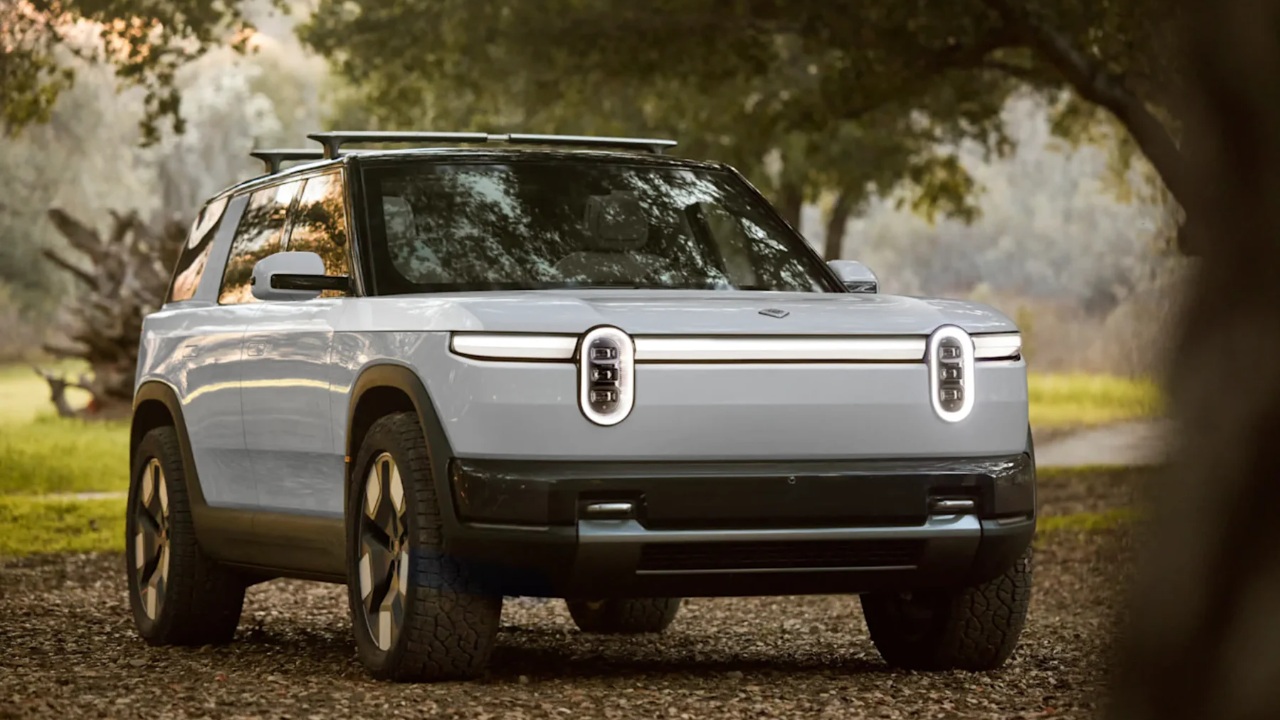
Rivian has moved its long promised R2 from PowerPoint to production tooling, with the first validation rigs now emerging from its reworked factory and early buyers being told that customer vehicles are not far behind. The shift from design studio to physical metal marks a pivotal moment for the company’s more affordable SUV, and it raises fresh questions about timing, technology choices, and how quickly Rivian can scale. I see the new test builds as a stress test not only of the R2 platform, but of Rivian’s broader claim that it can bring a $45,000 electric SUV to market without losing the premium edge that made its first trucks stand out.
Validation rigs signal a real production ramp
The most important development is that R2 bodies are no longer theoretical. Rivian has begun building manufacturing validation units at its plant in The Normal, Illinois, using new assembly lines dedicated to the R2 platform. These rigs are not saleable vehicles, but they are built on production intent tooling and processes, which means engineers can finally test how the compact SUV behaves when it is assembled at speed rather than in a prototype shop. The company has described these as the last major step before customer builds, and it has paired that message with assurances to reservation holders that deliveries will follow “soon,” a word that carries more weight now that the line is actually moving.
Behind the scenes, the factory itself has been reshaped to accommodate the R2, with new equipment and an “automated hang-on line” that Rivian CEO RJ Scaringe has highlighted as central to the midsize SUV’s build process. That approach, which suspends bodies and brings doors, closures, and other components to the vehicle rather than the other way around, is designed to cut labor time and improve quality consistency. When I look at the combination of fresh tooling in The Normal, Illinois, and the company’s own description of “hundreds” of production intent R2 units rolling out, it is clear that Rivian is treating this as a full dress rehearsal for volume manufacturing rather than a small pilot run.
What “soon” really means for early customers
For the thousands of people who put down deposits, the obvious question is how to translate corporate optimism into a delivery window. Rivian has repeatedly framed R2 as a 2026 product, and Scaringe has said that saleable production would begin in Early 2026, with deliveries later that year. More recently, the company has told customers that the gap between the current validation builds and the first handovers will be short, which is consistent with its claim that it is already rolling out “hundreds” of production intent units. In practical terms, I read that as a sign that the remaining work is about software tuning, supplier validation, and regulatory sign off rather than fundamental engineering changes.
The reservation process itself underscores how close Rivian believes it is. Customers can configure an R2 on Rivian’s site and secure a place in line with a refundable $100 deposit, a relatively low barrier that has helped the company build a large backlog. The official language around those reservations stresses that R2’s package is meant to deliver “the best of Rivian” at a significantly lower price point, which raises expectations that the driving experience and build quality will match the more expensive R1T and R1S. When I weigh that promise against the current stage of validation, I expect the first wave of owners to see their vehicles in the latter part of 2026, even if the company continues to use softer language like “soon” in its public messaging.
Pricing, positioning, and the first R2 variants
Rivian is not shy about the role R2 is meant to play in its lineup. The company has pegged the starting price at $45,000 before incentives, a figure it has repeated in investor materials and product briefings. That number matters because it pulls Rivian into direct competition with mass market electric crossovers while still promising the design flair and off road capability that defined its earlier models. The R2 is described as a compact or midsize SUV that seats five, with proportions aimed at urban and suburban buyers who found the R1T and R1S too large or too expensive. In my view, that price point is aggressive but not unrealistic if Rivian can leverage its new battery and manufacturing strategies.
The initial configuration strategy is equally deliberate. Scaringe has confirmed that Rivian will Start Production With Dual Motor Variant, positioning a dual motor all wheel drive model as the launch configuration rather than a stripped down single motor base. Separate briefings have described a Launch Edition that combines that dual motor setup with roughly 300 miles of range and a richer feature set, again starting at $45,000 before incentives. By leading with a well equipped dual motor SUV instead of a bare bones entry model, Rivian is signaling that it would rather protect its brand and margins in the early months of production, even if that means some price sensitive buyers wait for later trims.
Battery tech, charging, and autonomy trade offs
Under the skin, R2 is not simply a scaled down R1. Rivian has designed a new battery pack that uses larger round cells, identified as a 4695 format, which the company says improves energy density and simplifies manufacturing. That pack is paired with a clean sheet platform that is meant to be cheaper to build while still supporting the performance and off road hardware that Rivian buyers expect. The company has also confirmed that R2 will offer bidirectional charging, allowing owners to power tools, campsites, or even parts of a home, a feature that aligns with the brand’s outdoors oriented image and helps justify the SUV’s positioning against rivals that still treat vehicle to load as an optional extra.
On the software side, Rivian has made a more conservative choice. Enthusiasts on Reddit and dedicated Rivian tracking sites have clarified that R2 will not launch with the company’s next generation autonomy processor or its Gen 3 hardware. Instead, the compact SUV will ship with the current generation driver assistance stack, with plans to introduce the new silicon and LiDAR based system later in 2026. There has been some confusion around this timeline, which is why I pay close attention to detailed breakdowns that state Rivian will launch R2 in early 2026 without the next generation hardware at launch. For buyers, the trade off is clear: they can get into an R2 sooner, but those who care deeply about future proof autonomy features may prefer to wait for the hardware refresh.
Factory strategy, test sightings, and what comes next
Rivian’s manufacturing strategy for R2 extends beyond the current validation rigs. The company has emphasized that The Normal, Illinois plant is being used as the launchpad for R2, with new lines and processes that will later inform additional capacity. That decision allows Rivian to lean on an existing workforce and infrastructure while it refines the automated hang on line and other innovations. At the same time, executives have talked about a broader rollout that includes new facilities once the initial production kinks are worked out, a phased approach that I see as a hedge against the financial and operational risks of opening a greenfield plant for an unproven model.
More from Fast Lane Only