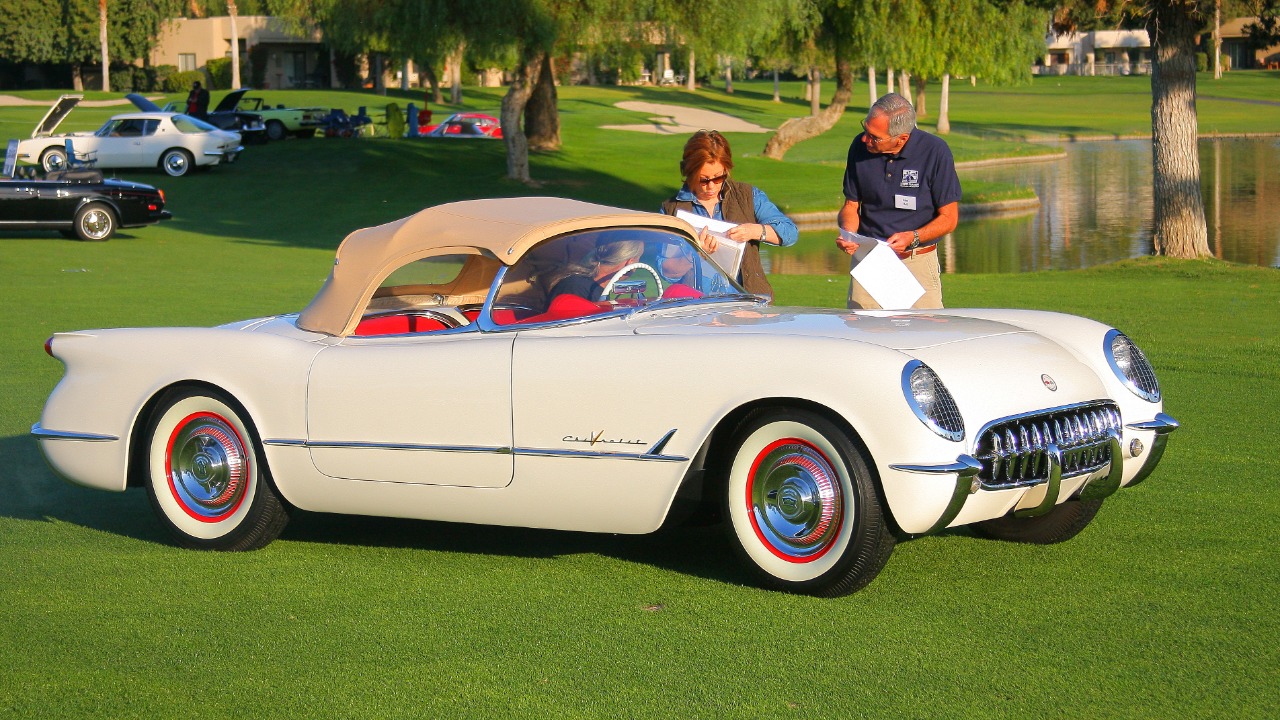
The 1955 model year is where the Corvette stopped being a pretty experiment and started becoming a serious sports car. When Chevrolet finally slipped a compact V8 under that fiberglass hood, the car’s character, reputation, and future all changed at once. The Original C1 suddenly had the muscle to match its looks, and the Corvette’s long run as America’s sports car really began.
From stylish experiment to performance crossroads
When I look back at the early C1 years, I see a car that had the right shape but not yet the right heart. The Original Corvette arrived in the early 1950s with a six‑cylinder engine and an automatic transmission, a combination that made sense for a cautious company but left enthusiasts underwhelmed. Fiberglass bodywork and a sleek profile turned heads, yet the car’s straight‑line pace and handling feel did not live up to the promise of its warship‑inspired name.
By the time the Corvette reached its third model year, the stakes were clear: either the car evolved into a true performance machine or it risked fading away as a styling exercise. Internal discussions inside Chevrolet focused on how to transform the existing platform rather than abandon it, and engineers zeroed in on the need for a compact, modern V8 that could fit the Corvette’s tight engine bay without adding excessive weight. That pressure set the stage for the 1955 pivot that would define the car’s evolution.
The small‑block that changed everything

The breakthrough came with a new small‑block V8 that was as compact as it was potent. Chevrolet introduced a 265 cubic inch engine, listed as 265 cubic inches, displacing 4.3 liters and rated at 195 horsepower, or 145 kW. That output might sound modest next to modern numbers, but in the mid‑1950s it turned the Corvette from a cruiser into a genuine performance car. The engine’s compact dimensions and relatively light weight meant the car did not lose its agility while gaining a serious bump in acceleration and top speed.
This V8 was not just a Corvette story, it was a Chevrolet story. The same Chevrolet small‑block, again at 265 cubic inches and 4.3 liters, also powered the Corvette and Bel Air, signaling a new generation of V8 performance across the lineup. Inside the sports car, the engine was marketed as a New 195-hp Chevrolet Corvette V8, described as a “cyclone of power” for America’s sports car, and that language captured how transformative the engine felt to drivers stepping out of the earlier six‑cylinder cars.
Inside the 1955 Corvette’s upgraded package
Once the V8 arrived, the rest of the 1955 package had to live up to it. I see that year as a careful blend of continuity and quiet revolution: the fiberglass body and basic C1 proportions carried over, but the drivetrain and feel behind the wheel were dramatically different. The 1955 Chevrolet Corvette C1 combined the new engine with a more focused chassis setup, and period specifications highlight how the car’s performance envelope widened while still retaining the distinctive styling that had defined the first two years. Contemporary overviews of the 1955 Chevrolet Corvette emphasize its Specifications, History, and Key Facts as a turning point in the model’s story.
Production figures underline how pivotal, and yet how rare, these early V8 cars were. Detailed Production Numbers for the 1955 Corvette show that the model year was not a runaway sales success, but it was a crucial engineering milestone that set the template for everything that followed. Under the skin, the V8 installation, revised cooling, and drivetrain changes created a blueprint that later C1s would refine rather than reinvent, which is why collectors and historians treat the 1955 configuration as a bridge between the experimental early cars and the more confident late‑1950s machines.
The people who pushed for a V8
Hardware alone never tells the full story, and the 1955 Corvette’s V8 owes a lot to determined individuals inside Chevrolet. One of the most influential was Zora Arkus‑Duntov, widely known simply as Zora, who saw the Corvette’s potential long before the sales numbers justified the effort. He wrote directly to Ed Cole, the Chief Engineer for Chevrolet, outlining ways the Corvette could be improved, and that advocacy helped secure him a role shaping the car’s future. Zora’s belief that the Corvette needed a strong V8 and a more competition‑ready setup aligned with the broader engineering push behind the 265 small‑block.
Corporate history often smooths out the tension in these decisions, but I read the 1955 shift as a moment when performance advocates inside Chevrolet finally gained the upper hand. The arrival of the V8 in the Corvette coincided with the broader rollout of the 1955 Chevrolet lineup, where the 265 engine was the first V8 available in a Chevrolet since the earlier Model D. That context matters, because it shows the Corvette was not an isolated experiment but part of a company‑wide embrace of modern V8 power, with engineers like Zora and executives like Ed Cole pushing the brand toward a more performance‑oriented identity.
How the 1955 V8 legacy lives on today
Seven decades later, the 1955 V8 cars still resonate with owners who drive and preserve them. When I read about enthusiasts like Ron Ensweiler, who is the proud owner of a 3‑speed 55 Vette, I am reminded that these cars are more than museum pieces. Owners talk about how the manual gearbox, the compact V8, and the light fiberglass body create a driving experience that feels raw and mechanical compared with later generations. Here, the red hot Chevy is not just a collectible, it is a living link to the moment when the Corvette found its voice.
That is why the 1955 V8 milestone still anchors so much Corvette lore. The car’s combination of compact small‑block power, distinctive styling, and low production has made it a touchstone for how enthusiasts define an authentic early Corvette. When I trace the line from that first V8 C1 to today’s high‑output models, I see a continuous thread that runs straight through the 1955 decision to give the Corvette the engine it always deserved, turning a stylish experiment into a sports car icon.
More from Fast Lane Only: