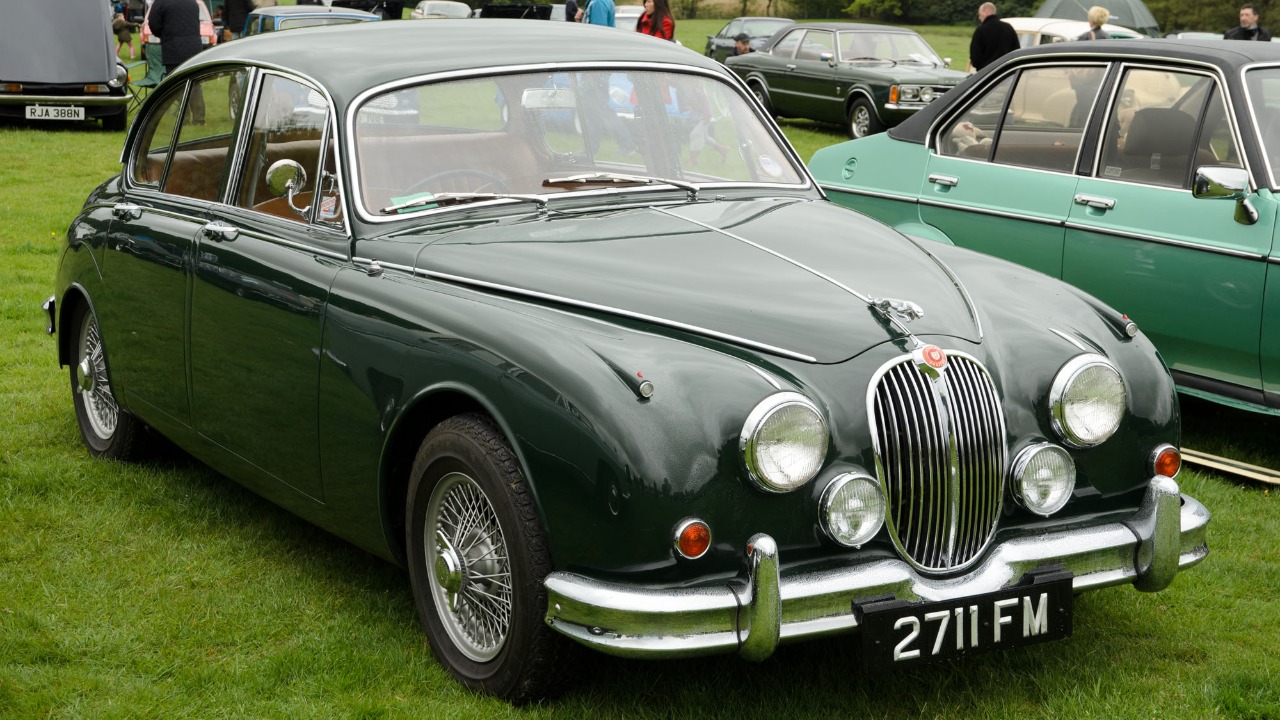
The Jaguar Mark 2 arrived at a moment when family cars were supposed to be sensible and sports cars were supposed to be selfish, and then calmly ignored that rule. By 1963, the Mk 2 had matured into a saloon that could carry children, luggage, and serious speed, wrapping it all in walnut veneer and deep leather. I want to look at how that single model year crystallised Jaguar’s ambition to build a car that was as happy on a fast A‑road as it was outside a theatre.
Grace, space, pace: the brief behind the Mk 2
The starting point for understanding the 1963 Jaguar Mk 2 is its identity as a mid‑sized luxury sports saloon, a car that deliberately blurred categories. The official description of The Jaguar Mark 2 makes clear that this was not a stripped‑out racer with seats added later, but a fully fledged four‑door that still promised serious performance. Jaguar’s own slogan captured that ambition with three simple words, “Grace, Space, Pace”, a line that enthusiasts still repeat when they talk about the Mk II today. One detailed restoration account notes how that motto, launched first time with As the Jaguars MKII, summed up the blend of luxury and speed that made the car so distinctive.
That balance was not accidental, it was baked into the engineering and the way the car was marketed. The Mk 2’s slogan is recalled again in a social‑media post that describes how The Jaguar 3.8 M saloon still stops people in their tracks when they encounter one at places like Cool Classic and Trim Tastic and similar workshops. Another enthusiast history describes the 1960 Jaguar Mark 2 Saloon British as a classic British sports sedan that “beautifully blended elegance, performance, and practicality”, underlining how the Jaguar Mark Saloon British formula was always about more than straight‑line numbers. By 1963, that philosophy had been refined into a car that could credibly serve as both a family saloon and a driver’s indulgence.
Engines that made a saloon feel like a sports car
Under the bonnet, the Mk 2’s engine range is where the sport in “sports saloon” really came alive. The Mark 2 came with a choice of inline‑six engines, and a later evolution introduced the 240 and 340 models, which were effectively updated versions of the earlier 2.4 and 3.4. In that update, Output of the 240 engine was increased from 120 bh to keep the entry‑level car competitive, while the 340 offered more power again, all for a price of £1364, only £20 more than the first 2.4 in 1956, details that are laid out in the 240 and 340 section of the model’s history. That careful tuning of output and pricing shows how Jaguar tried to keep the Mk 2 accessible while still delivering performance that felt special.
For drivers who wanted more, the 3.4-Litre and 3.8‑litre versions turned the Mk 2 into something that could embarrass dedicated sports cars. A detailed enthusiast breakdown of the 1963 Jaguar MK II 3.4-Litre Manual/Overdrive lists the 3.4-Litre engine alongside smaller 2.4 units and notes how the Litre Manual gearbox with Overdrive helped the car dominate early 1960s circuits, a reminder that this was not just a boulevard cruiser but a machine that could be raced in anger, as described in the Jaguar MK II Litre Manual notes. Another enthusiast piece on classic car features asks What made this Jaguar such a driver’s favorite and answers that Under the hood, the Mark II offered a range of strong inline‑six engines that combined power and sophistication, a point reinforced in the What Jaguar Mark II discussion.
From fastest saloon to family car
Performance figures from period tests help explain why the Mk 2 earned such a reputation. A video analysis of how Jag turned a humble saloon into something quicker than most sports cars cites a 0 to 60 time of 8.5 seconds and a 125 m ph top speed for the 3.8‑litre version, and notes that when this Jag arrived it was regarded as the fastest saloon car in the world, a claim that shows just how far the company pushed the concept of a family four‑door, as highlighted in the Apr Jag review. That kind of pace, combined with disc brakes and a sophisticated suspension layout, meant the Mk 2 could be driven very hard without feeling wayward, something that appealed to both enthusiasts and less law‑abiding owners.
Yet the Mk 2 was never only about speed, it was also about how that speed was delivered in everyday life. A detailed technical breakdown of the Jaguar Mk. II notes that Years of Manufacture ran from 1961 to 1975 for later derivatives and that the Number Built reached 83,980, figures that underline how many buyers were drawn to this mix of qualities, as set out in the Jaguar Mk Technical Specifications. That same source lists the fuel system as Twin SU HD6 carburettors and the braking system as bolt on disc units, technical choices that helped the car feel responsive and secure in daily use. When I look at those numbers, I see a car that was built in serious volume because it worked as transport, not just as a weekend toy.
Luxury that did not apologise for performance
Inside, the Mk 2 made its case as a luxury car the moment you opened the door. Period descriptions talk about deep leather seats, polished wood, and generous glass area, and a detailed profile of a 1963 example notes that From the exterior subtle details distinguished the Mk II from its predecessor, such as an increased 18% glass area in the cabin that made the interior feel lighter and more spacious, a change that is highlighted in the From the Mk II description. That extra light worked with the rich materials to create a cabin that felt more like a club lounge than a conventional family car.
Contemporary and modern enthusiasts alike keep returning to that sense of occasion. A social‑media history of the 1960 Jaguar Mark 2 Saloon British notes that criminals and police forces both appreciated the car’s combination of speed and comfort, and describes the model as a classic British icon of automotive excellence and timeless design, a sentiment captured in the The 1960 Jaguar Mark 2 Saloon British overview. Another passage from the same source calls the car renowned for its timeless design, luxury, and timeless style, reinforcing how the Mk 2’s interior and exterior finish were central to its appeal, as set out in the Renowned for summary. When I picture a 1963 car in this context, I see a saloon that did not ask drivers to choose between a fast engine and a refined cabin, it simply offered both.
Why 1963 still matters to enthusiasts
Today, the 1963 Mk 2 sits at a sweet spot for collectors and drivers who want the classic shape with mature engineering. A detailed auction listing for a 1963 Jaguar Mark 2 Saloon custom build describes how the car, later upgraded to a 3.8‑liter engine, was tuned for improved performance, handling, and braking while still being handy on a racing circuit and an ideal family companion for drivers who enjoy spirited motoring, a balance that is spelled out in the Later upgraded description. Another section of the same listing notes that the model is handy on a racing circuit yet still practical, a modern echo of the original design brief that treated track days and school runs as equally valid uses for the same car, as seen in the 1963 Jaguar Mark 2 Saloon custom profile.
More from Fast Lane Only: