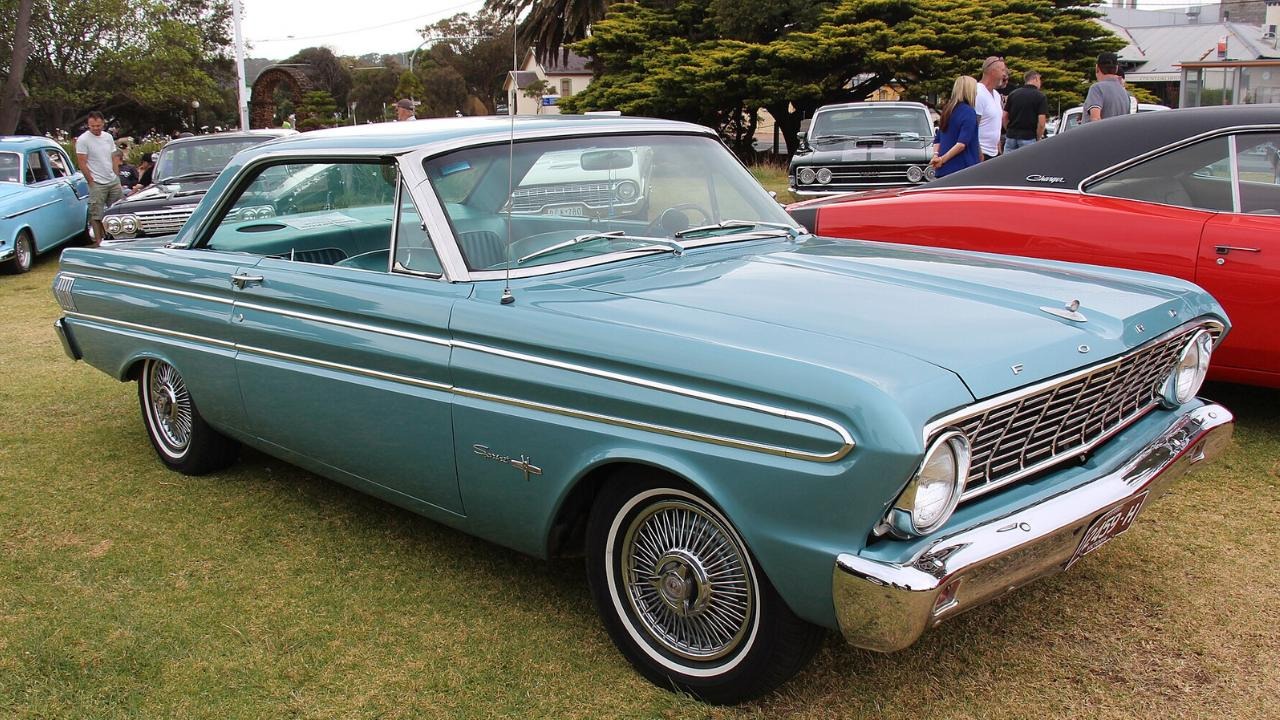
The 1967 Ford Falcon Sprint arrived at an awkward moment, caught between the compact economy car it had been and the muscle era that was roaring around it. Yet in that in‑between space, it managed to surprise drivers who expected little more than a basic commuter. By the time the Sprint badge appeared on the 1967 Falcon, the name already carried a small but stubborn reputation for turning skeptics into believers.
The skeptical roots of a “Sprint” Falcon
When I look back at how the Sprint idea evolved, I see a pattern of internal doubt followed by reluctant respect. In Australia, designer Mar set out to give the local Falcon a harder edge, and he later recalled that his proposal was met with deep skepticism in Dearborn, where Ford executives remembered how a previous attempt to turn a family car into something sporty had fizzled. That resistance only makes it more striking that his vision eventually led to a Falcon that enthusiasts embraced, and that path, from a doubtful boardroom in Dearborn to a celebrated performance model, set the tone for how the Sprint name would be received on both sides of the world, as later shown when the Australian car evolved into the first Falcon GT linked to Bourke.
In North America, the Sprint story started earlier in the decade, when Ford tried to inject some Fairlane muscle into its compact. For the 1964 year, the company created a Sprint Package that gave the Falcon the Fairlane’s 260 V8, a stiffer suspension, and a louder exhaust, a combination that looked promising on paper but never quite broke through in the showroom. Even so, that early experiment with the 260 engine and firmer underpinnings planted the idea that a Falcon could be more than basic transportation, and it set expectations that would quietly shape how enthusiasts approached the later 1967 Sprint, as the compact’s performance image grew out of that first Sprint Package.
How Australia kept the Falcon flame alive
While the American Falcon’s star was fading by the mid‑sixties, I find it telling that the car’s most passionate evolution was happening far from Dearborn. Ford Australia did not treat the Falcon as a dead end, instead it treated the platform as raw material and did a LOT of evolution on them, reworking engines, suspensions, and body styles to suit local tastes and punishing conditions. That willingness to keep refining the formula meant that, even as the U.S. market shifted its attention to other nameplates, the Falcon badge remained a living, changing thing in Australia, with each revision building on the last in a way that kept the car relevant for local buyers who wanted both toughness and speed from Ford Australia.
That commitment was backed by serious infrastructure, not just marketing slogans. Today, Ford marked 50 years YYPG operations by celebrating the arrival of the first global Mustang, and that same proving ground has long been the place where Australian Falcons were engineered and tested. When I think about the 1967 Falcon Sprint, I see it as part of this broader story, where the compact’s reputation was being quietly reinforced by engineers running cars hard at YYPG while the company also showcased icons like the Ford Mustang. The fact that the proving ground has been central to local development for 50 years shows how much effort went into making the Falcon more than a budget car, and that engineering backbone helped give later performance variants a credibility that surprised drivers who assumed the badge still meant bare‑bones transport from YYPG.
The 1967 Falcon Sprint steps into the spotlight
By 1967, the Falcon in the United States had been reshaped into a more mature compact, and the Sprint version slotted into that new identity with a mix of subtlety and intent. This revised Falcon package was carried forward for 1967 in three body styles, including a two‑door‑post Club Coupe and a four‑door Sedan, which meant the same basic hardware could serve as either a family car or a low‑key performance machine. I like how that range of bodies let the Sprint hide in plain sight, since a Club Coupe with the right drivetrain could feel far more eager than its upright lines suggested, while a similarly equipped Sedan could play the role of an unassuming commuter that just happened to pull hard when the road opened up, all within the broader 1967 Falcon lineup.
Under the hood, the Falcon continued in this form through early 1970, and in 1967, its last year before emissions controls, the 289 packed 225 horsepower in a compact shell that still carried the reputation of an economy car. I am always struck by how that 289 figure, paired with 225 horsepower, gave the Sprint real pace without the visual drama of bigger muscle machines, which made it easy for skeptics to underestimate it until they felt the car pull through the midrange. The same basic architecture would later underpin the pillared Futura Sport Coupe, but in 1967 the Sprint already showed how much performance Ford could squeeze into a modest package, and that quiet potency is a big part of why the car ended up catching out drivers who expected the old, slow Falcon.
Racing, rally tricks, and the Sprint mystique
On the other side of the world, the Falcon name was proving itself in competition, which fed back into how enthusiasts viewed every performance‑leaning version, including the Sprint. Having a V8 platform opened up a whole new world of possibilities, particularly if you were eyeing off the all‑important Bathurst endurance race, where the XR Falcon’s victory in the Gallaher 500 in 1967 showed that a car with family roots could dominate a brutal track. When I connect that Bathurst success to the Sprint story, I see a shared theme: a supposedly ordinary Falcon, once given the right V8 and chassis tuning, could punch far above its weight, and that racing credibility made it easier for buyers to believe that a compact Ford with a sporty badge might actually deliver on its promise at Bathurst.
The Falcon’s underdog streak also showed up in rallying, where clever engineering sometimes mattered more than raw power. I am fascinated by the story of a mechanic who used a “simple” gearbox tweak to help a 4,700-lb American muscle car beat purpose‑built rally machines through the Welsh mountains, because it captures how a heavy, unfashionable car could still win with the right setup. That tale, involving a 4,700-lb brute surprising specialists on Welsh stages, echoes the way the Sprint confounded expectations on the road, and it reinforces the idea that the Falcon family, in the right hands, could be far more agile and effective than its spec sheet suggested in the world of American rallying.
From obscure compact to cult favorite
Even as the Falcon’s original run wound down, the Sprint name kept finding new ways to attract attention, especially in Europe. In the late sixties, the Falcon went up market with a new model called the Sprint, which had a sporty fastback roof and packed a 260 cubic inch small block that gave it real highway legs. I like how that European Sprint, with its 260 engine and sleeker profile, turned a once‑humble compact into something closer to a grand tourer, and it showed that the basic Falcon platform could be dressed up to meet very different expectations without losing the straightforward character that made it appealing in the first place, as seen in that fastback Sprint.
More from Fast Lane Only: