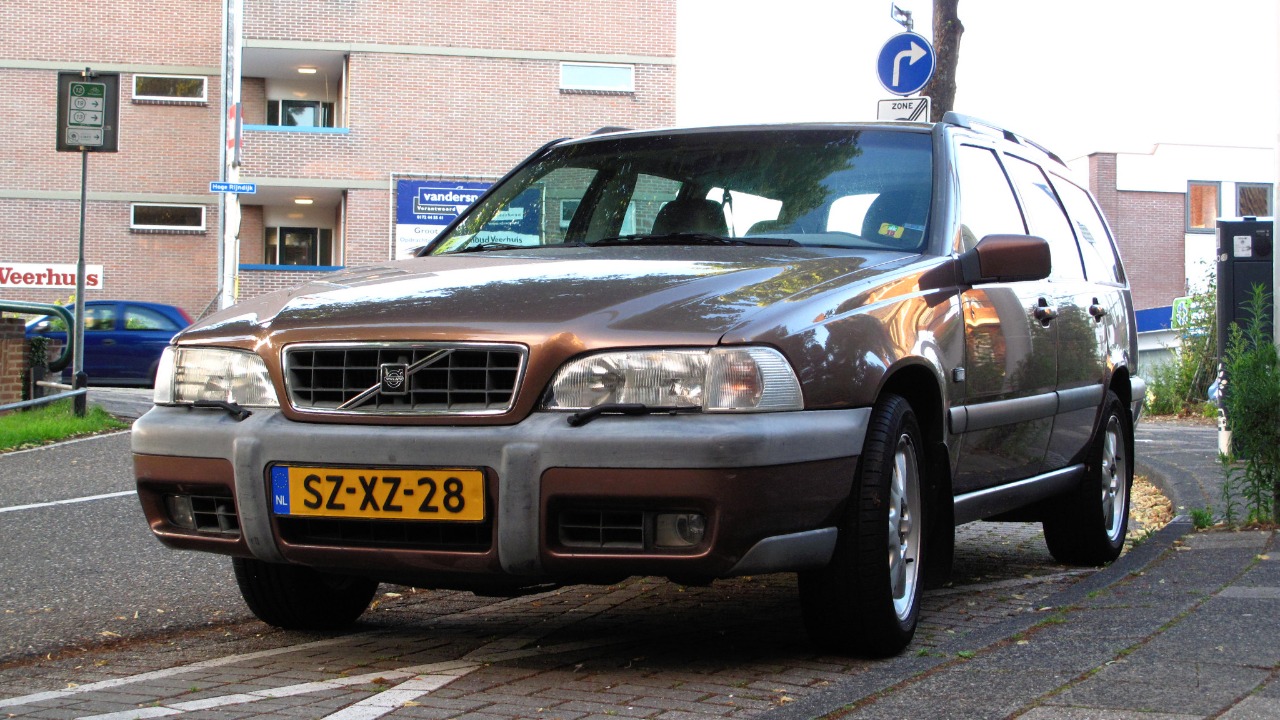
The late 1990s were full of loud spoilers and louder exhausts, yet one of the era’s most intriguing performance cars wore a sensible wagon body and a Volvo badge. The 1998 Volvo V70 R took the brand’s reputation for caution and quietly grafted on serious pace, creating a family hauler that could keep up with contemporary sports sedans while still feeling like a rolling safety blanket. I see it as the moment Volvo proved that responsibility and speed did not have to live in separate garages.
From sober estate to “R” rebel
To understand why the 1998 V70 R mattered, I start with the car it evolved from. The standard V70 was introduced as the successor to the 850, carrying over the boxy practicality and a wide mix of engines, gearboxes, and trim levels that made it a staple family wagon in Europe and North America. As the model range broadened, the V70 effectively became the brand’s mid-size backbone, offered with everything from modest five‑cylinder units to more powerful turbocharged versions and a raised‑ride‑height XC variant, all configured to balance comfort, space, and everyday usability in a way that felt very typically Volvo.
The V70 R arrived as the spiritual heir to the 850 T‑5R and 850 R, models that had already shown how far the company was willing to push its staid image. In official material the R is explicitly framed as the follow‑up to those earlier hot estates, a car that built on their formula while adding more refinement and all‑weather capability. That lineage is underscored again in the broader Volvo R performance family, which positions the first‑generation V70 R as the next step in a line of fast wagons that were sold in relatively small numbers but had an outsized influence on how enthusiasts saw the brand.
Power, pace, and the numbers that mattered
Under the hood, the 1998 V70 R was not just a trim package, it was a serious mechanical upgrade. The core specification centered on a 2.3 L Inline 5 Turbo engine, a configuration that gave the car its distinctive warble and a broad spread of torque that made overtakes feel effortless. In period performance data, that engine is credited with 247 hp, a top speed of 155 m, and a 0 to 60 sprint in 6.8 seconds, figures that put the wagon squarely in sports‑sedan territory while still returning about 20.7 mpg and seating 5 Seats with a flexible 14.8‑55.8 ft3 of cargo space, according to a detailed Tech Specs Summary.
The automatic version gave up a little outright speed but kept the same dual‑personality character. Data for the self‑shifting car lists a Top Speed of 146 m, with 0‑62 m in 7.4 seconds and a 0‑60 m run in 7.2 seconds, backed up by 237 hp and 243 lb·ft of Torque, numbers that still look respectable for a tall‑roof family hauler. Those figures, drawn from a separate automatic specification sheet, underline how Volvo offered two flavors of the same idea, both quick enough to surprise drivers used to seeing wagons as the slow lane.
All‑weather grip and everyday comfort
Raw numbers only tell part of the story, because what made the V70 R compelling was how it deployed that power in real life. The car’s all‑wheel drive system ran full time, but it was tuned for superior traction rather than rock‑crawling antics, a setup that made it feel planted in rain and snow without pretending to be an SUV. Contemporary commentary notes that Volvo paired this drivetrain with its TRACS traction control, turning the wagon into an enthusiast’s alternative to an SUV that still behaved predictably when the weather turned ugly, as described in a detailed AWD review.
Inside, the V70 R leaned hard into comfort, which is where its safety‑first roots really showed. Period road tests of the broader V70 line describe the front seats as “as comfortable as lounge chairs,” and highlight side airbags built into those front seats along with a three‑piece rear seat that folded to expand cargo space. One such evaluation also notes a CURB WEIGHT of 3,768 lbs for a comparable V70 and praises the way the wagon combined the maneuverability of a car with the space of a small van, while quoting a base price of $35,595 and an MPG RATING of 18 city, 24 hwy for a well‑equipped example, details captured in a comprehensive road test.
Safety first, even when it was fast
For me, the most striking thing about the V70 R is how little Volvo compromised on its core values while chasing performance. The company’s broader messaging around the car emphasizes that it came loaded with Safety features, including side‑impact airbags and traction aids that were still relatively advanced for a family wagon at the time. One retrospective on the model line notes that, like other products from the brand, the V70 R was engineered so that parents could enjoy brisk acceleration without feeling they were gambling with the security of their loved ones, a point echoed in a social post that explicitly ties the car’s appeal to people who cared deeply about Safety.
That balance between pace and protection helped cement the car’s reputation among enthusiasts who might otherwise have dismissed a wagon. A later reflection on the broader V70 range describes how the Volvo V70R AWD developed a cultural impact that went beyond its sales numbers, presenting itself as a car for drivers who wanted to enjoy strong performance without abandoning the sense of responsibility that came with a Volvo badge. In that account, the model is singled out as a touchstone for people who built their automotive identity around both speed and the security of their loved ones, a sentiment captured in a widely shared reflection on the car’s legacy.
Colors, character, and the way it drove
Visually, the 1998 V70 R walked a fine line between subtle and special. The car was offered in a tightly curated palette of six colours, each of which has since taken on near‑mythic status among fans: Black Stone, Nautic Blue, Silver Metallic, Coral Red, Regency Red, and Saffron. All of these were paired with specific interior trims and wheel designs that distinguished the R from lesser V70s without shouting about it, a combination that is documented in detail in the official V70 listing that tracks the first‑generation model’s evolution.
On the road, contemporary reviewers were often surprised by how cohesive the package felt. In one video Review, Ginny Buckley calls the 1998 Volvo V70R “The Ultimate Performance Estate” while highlighting a 0‑60 time of just 7 seconds, a figure that aligns closely with the published acceleration data and underscores how brisk the car felt in real‑world use, as seen in the archived YouTube clip. A separate Dailymotion video, again fronted by Ginny Buckley, reinforces that impression by focusing on the way the Volvo combined strong performance and handling with the ability to swallow family luggage, while repeating that 0‑60 time of 7 seconds as a shorthand for its pace, as captured in the performance review.
More from Fast Lane Only: