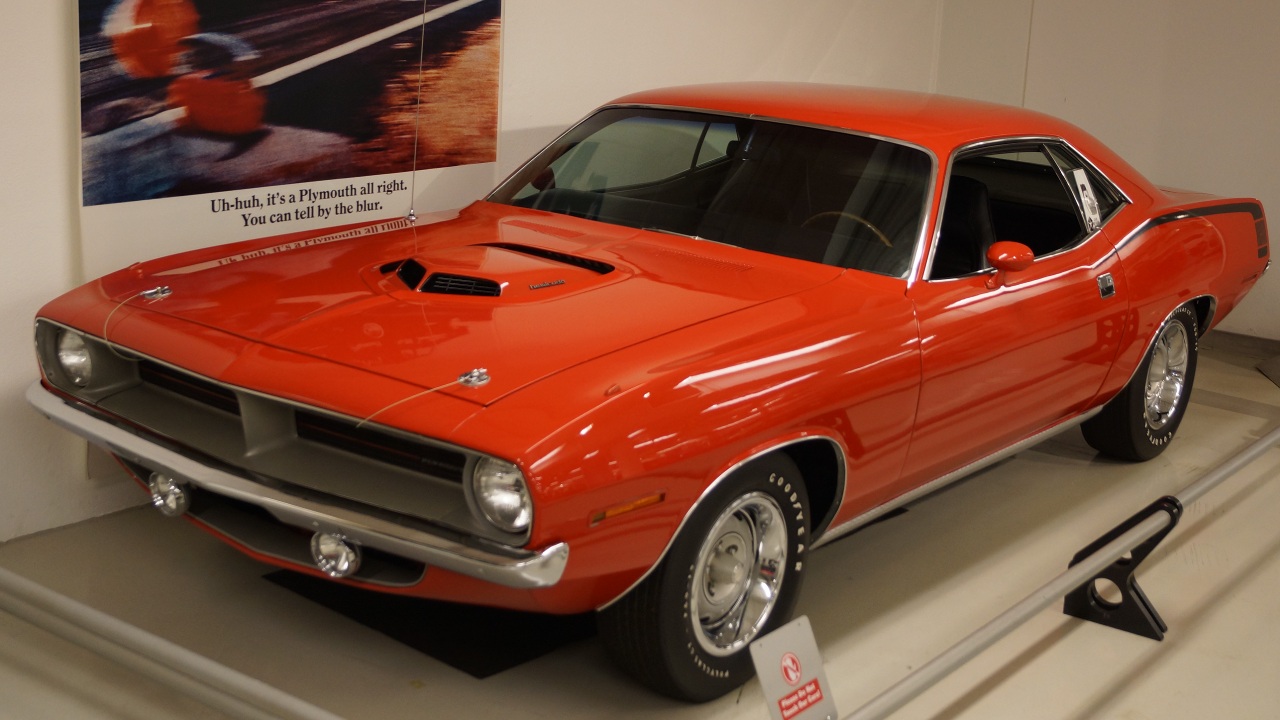
The Plymouth Hemi ’Cuda did not simply raise the volume of the muscle car era, it rendered understatement irrelevant. By combining a race-bred Hemi engine with a compact pony-car shell and unapologetically aggressive styling, it turned a once-modest fastback into one of the loudest statements Detroit ever put on four wheels. More than half a century later, its blend of brute force, rarity, and cultural impact has made it a benchmark for how a single model can redefine an entire brand.
From quiet Barracuda to loud ’Cuda
The story of the Hemi ’Cuda begins with a car that was, at first, almost polite. The Plymouth Barracuda entered the pony car fray ahead of The Ford Mustang, giving Plymouth an early claim on the segment even if the Mustang ultimately captured most of the credit and the sales. Early versions of The Plymouth Barracuda were sporty but restrained, more commuter coupe than street brawler, and they had to fight for attention against rivals such as the Chevy Camaro and Pontiac Firebird that would soon crowd the same market.
That restraint did not last. As the pony car wars escalated, Plymouth pushed the Barracuda through an Evolution of the Cuda that steadily sharpened its performance and image. By the time the third generation arrived, the car had broken decisively from its compact roots, sharing a platform with the Dodge Challenger and adopting the shorter, wider proportions enthusiasts now associate with the ’Cuda name. In this form, The Plymouth Hemi ’Cuda emerged as the ultimate evolution of the Barracuda, a transformation that turned a once-understated fastback into a purpose-built street weapon.
The Hemi that made subtlety pointless
What truly made subtlety obsolete was not just the sheetmetal, it was the engine that Plymouth chose to stuff under the hood. The Hemi V8 that defined the Plymouth Hemi ’Cuda had already earned a fearsome reputation in competition, and installing it in a relatively compact pony car body created a combination that was as intimidating at idle as it was at full throttle. One detailed account describes the car as the ultimate evolution of the third-generation Barracuda, underscoring how the Hemi option turned a strong performer into a legend.
The hardware matched the attitude. A last-year Hemi ’Cuda is noted for its distinctive “cheese grater” grille and the groundbreaking 426-cube V8 that sat proudly in the engine bay, a displacement figure that became shorthand for unfiltered Mopar power. Contemporary descriptions of the 1971 Plymouth Hemi ’Cuda emphasize that it was Built for pure performance, with the Hemi engine delivering 425 horsepower and brutal acceleration that left little room for nuance. In that context, the car’s visual aggression was not decoration, it was a warning label.
Design that shouted from the curb
The Hemi ’Cuda’s styling made sure no one mistook it for a base Barracuda. The third-generation body already carried a lower, wider stance, but the Hemi cars layered on cues that broadcasted intent before the engine ever turned over. The signature grille, hood scoops, and bold graphics on some examples gave the car a presence that matched its mechanical specification, a look that one auction preview urged readers to Prepare to be captivated by when describing a 1970 Plymouth Hemi Cuda crossing the block.
These visual choices were not accidental. As the Plymouth Barracuda competed with the Chevy Camaro and Pontiac Firebird, Plymouth needed a halo model that could stand out in crowded showrooms and on the street. The Plymouth HEMI Cuda has since been described as a Mopar Monster and One of the Most Valuable Muscle Cars Ever The Plymouth produced, language that reflects how its styling and stance have come to symbolize the most extroverted side of the muscle car era. In a market where stripes, spoilers, and scoops were already common, the Hemi ’Cuda still managed to look like the loudest voice in the room.
Rarity, value, and the cult of the Hemi ’Cuda
If the Hemi ’Cuda made subtlety obsolete in its day, scarcity has made it almost mythical in the decades since. Accounts of Plymouth’s decision making note that Chrysler could have ended the Hemi program as regulatory pressure mounted, yet the company persisted long enough to create a small run of 1971 Hemi ’Cudas that would later become some of the most coveted muscle cars in existence. Enthusiast descriptions frequently stress how few of these cars were built, especially convertibles, and how that limited production has amplified their status.
The market has responded accordingly. Valuation data for the broader Plymouth Cuda line indicates that Typically, you can expect to pay around $214,580 for a 1971 Plymouth Cuda in good condition with average spec, a figure that does not even isolate the rarer Hemi cars. Separate reporting on the 1971 Plymouth Hemi ’Cuda describes it as one of the most iconic and sought-after muscle cars of all time, Built for enthusiasts who value raw performance and willing to pay accordingly. When a car that once served as a showroom attention grabber now commands such sums, it confirms how thoroughly it has transcended its original role.
Legacy in a changing Mopar world
The Hemi ’Cuda’s impact is even clearer when viewed against the broader arc of Plymouth performance. The Plymouth Barracuda had started as a relatively modest entry in the pony car race, and later references to Plymouth Cuda years highlight how the model evolved as the market shifted. By the second generation, the Barracuda and its derivatives were firmly entrenched in the performance conversation, yet it was the Hemi variant that pushed the platform to its outer limits and set a benchmark that later versions could only echo.
As the years progressed, the nameplate itself changed. One retrospective on 1981 Plymouth Cuda model years notes that by 1981, the Barracuda and ’Cuda models were replaced with the single Cuda model, a fully redesigned car that reflected a very different era of performance and regulation. That later Plymouth Cuda By design underscores how brief the original Hemi ’Cuda window really was, and why collectors and historians treat those early seventies cars as a high-water mark. Even as modern auctions assemble a School of Cudas Selling Later This Weekend, with a 1970 Plymouth Hemi Cuda headlining events for GAA, the conversation inevitably circles back to the short-lived moment when the Hemi ’Cuda made understatement feel irrelevant.
More from Fast Lane Only