Ford’s Talladega was never meant to be a showroom darling. It was a numbers exercise, conceived to turn wind-tunnel data and NASCAR rulebook clauses into mile-per-hour gains on the new superspeedways that were reshaping stock-car racing. The road cars that carried the Talladega name existed largely so the math behind those race cars could be legalized, counted, and sent to the starting grid.
Seen from today’s distance, the Talladega looks like a niche muscle car with a curious name. In period, it was a carefully calculated response to rivals that had already discovered the power of aerodynamics, and every crease in its sheet metal, every production shortcut, and even the way Ford counted cars for homologation was driven by racing arithmetic rather than retail ambition.
The aero war that forced Ford to do the math
By the late 1960s, superspeedways had become the decisive battleground in NASCAR, and the stopwatch was increasingly governed by airflow rather than brute displacement. In the late 1960s, superspeedways hit their stride in the NASCAR schedule, and Talladega Superspeedway’s high banks demanded cars that could slice cleanly through the air instead of simply overpowering it. Dodge had already pushed the envelope with a wind-tunnel shaped Charger, and Ford could see in the lap charts that traditional boxy intermediates were running out of headroom.
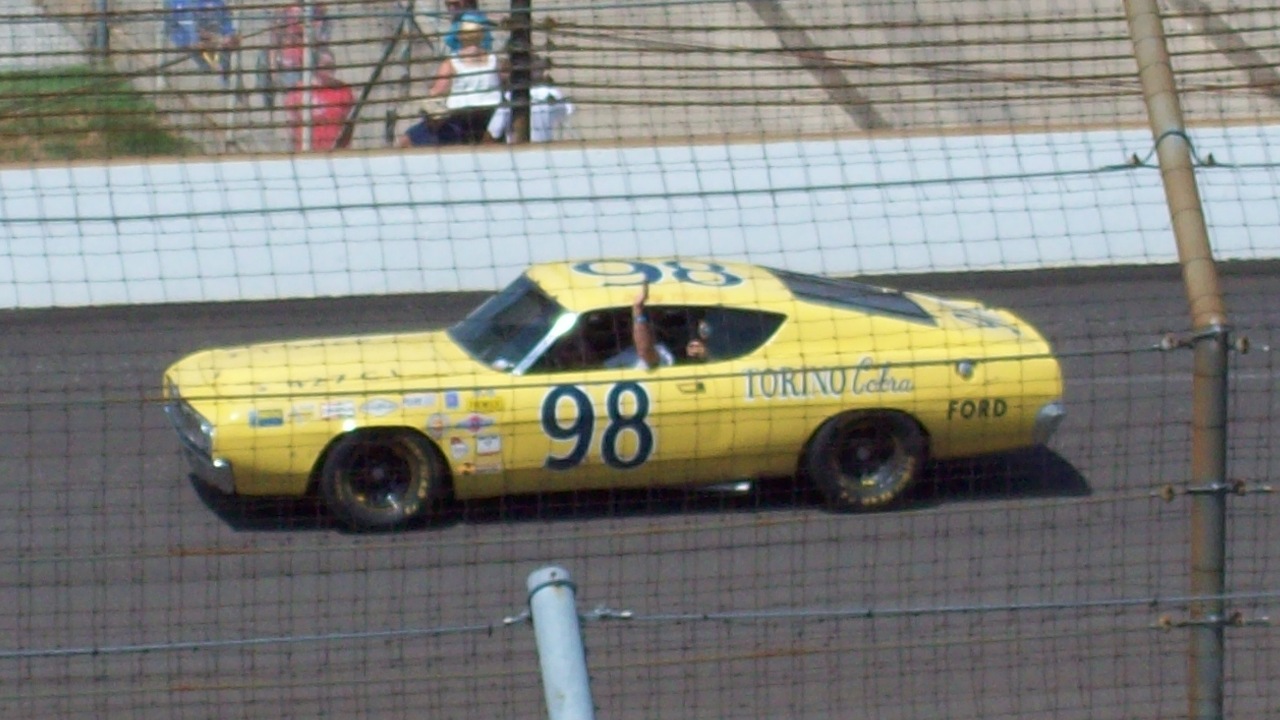
Ford’s response was to create a specialized version of its Fairlane Torino, named Talladega after NASCAR’s newest superspeedway, that would serve as a rolling solution to a set of aerodynamic equations. The goal was not to reinvent the entire platform but to adjust the body where the air mattered most, then pair it with proven big-block power for the track. The Talladega was described as Ford’s answer to Dodge and its wind-tunnel wonder, the Charge, a car designed explicitly to claw back speed on the fastest ovals by turning theoretical drag reductions into real-world top-end advantage.
Homologation, loopholes, and the magic number 500
The Talladega existed because NASCAR required race cars to be based on production models, with a minimum run that forced manufacturers to build what they raced. Back in the late 1960s, NASCAR rules dictated that cars had to be in production and at least 500 of them had to be built before they could appear on the grid. That figure, 500, became the central constraint around which Ford’s engineers and racing partners planned the Talladega program, since it set the scale of how much exotic aero work could be justified.
Ford did not approach that threshold as a marketing opportunity, but as a compliance problem to be solved as efficiently as possible. Accounts of the period describe how Ralph Moody, a key figure in Ford’s racing efforts, recounted that France was convinced Ford had built all the Talladegas they needed to go racing, even as the company managed production and inventory in a way that kept the program lean. The Talladegas that rolled off the line were therefore less a broad consumer offering and more a batch of legal documents in steel, each one a necessary entry in NASCAR’s ledger so the real work could happen on Sunday.
Shaping steel for speed: rocker panels, noses, and ride height
What set the Talladega apart was not wild graphics or showroom theatrics, but a series of subtle body changes that only made sense when viewed through the lens of airflow and rule interpretation. The altered design elements were made to make the Torino Talladega more aerodynamic and included an elongated, stretched forward bumper and nose that smoothed the transition from grille to hood. This extended front end reduced the blunt frontal area that created drag on the standard Torino, trading visual aggression for a cleaner path through the air at superspeedway speeds.
One critical change that many observers never notice is the Talladega’s modified rocker panels. One report notes that these rockers were re-rolled to provide a slightly lower body line, effectively dropping the car closer to the track without overtly violating NASCAR’s ride-height requirements. They allowed the race versions to sit lower in the airstream, reducing lift and drag, while the street cars carried the same basic geometry even if their suspensions and clearances were more conservative. The result was a production body that, in profile and underbody contour, gave Ford’s teams a measurable aerodynamic edge that could be exploited once the cars were prepared for competition.
From Contender to “banned beast”
Ford did not develop the Talladega in isolation, but in concert with its racing partners who understood exactly what was needed to win. Reporting on the program describes how, in the fall of 1968, Ford worked with Moody to begin developing their 1969 Contender, a car that would go on to be recognized as the Talladega. The collaboration focused on turning the Torino platform into a purpose-built superspeedway weapon, with the production run serving as the thin legal veneer over a car that was always intended to live at full throttle.
The intensity of that focus eventually pushed the Talladega into controversial territory. Later accounts refer to the 1969 Ford Torino Talladega Back as a “banned beast,” a reflection of how its combination of aerodynamic bodywork and big-block power tested the limits of what NASCAR was willing to tolerate. As rival manufacturers escalated with their own Aero Warriors, including the Charger Daytona and Superbird, the sanctioning body began to reconsider how far the arms race could go before the cars outpaced both safety and the spirit of stock-car racing. In that climate, the Talladega’s very existence underscored how a car built for racing math could become politically as well as competitively potent.
Why the street Talladega stayed a niche figure
On public roads, the Talladega was almost understated, which helps explain why it never became a mainstream muscle-car celebrity despite its competition pedigree. Period profiles describe bench-seat interiors and relatively plain trim, with the emphasis placed on the mechanical and aerodynamic package rather than luxury or flash. The Torino Talladega’s elongated nose and reworked rockers were present on the street cars, but without the towering wings or flamboyant graphics that made some rival Aero Warriors instantly recognizable in dealer lots.
That restraint was deliberate, because Ford’s priority was to satisfy NASCAR’s production rules while minimizing cost and complexity. The Talladega’s limited run, tied so closely to the 500-unit homologation threshold, meant that it was never marketed as a long-term pillar of the lineup. Instead, it functioned as a specialized tool, a way for Ford to translate wind-tunnel findings and rulebook interpretations into trophies at Talladega Superspeedway and other high-speed ovals. The fact that collectors now regard the Talladega as a rare hot rod superstar only reinforces how thoroughly it was shaped by racing math first and consumer demand a distant second.
More from Fast Lane Only