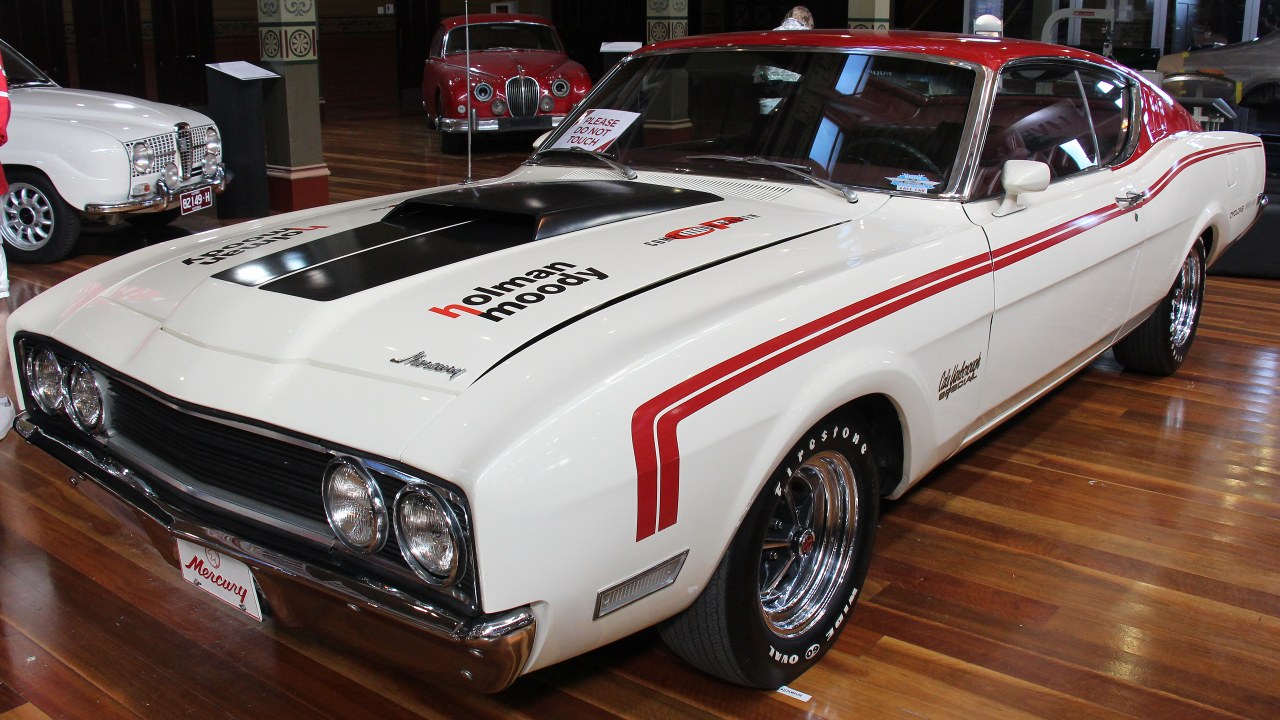
Among the factory muscle cars of the late 1960s, few are as obscure yet as technically ambitious as the Mercury Cyclone Spoiler II. Marketed as a limited-production street machine, it was in reality a thinly disguised racing tool, shaped by NASCAR’s aerodynamic battles and built to satisfy homologation rules rather than showroom fashion. The result was a car that appeared to borrow only a little from its competition cousins, while in truth carrying far more race-bred engineering than Mercury’s brochures ever admitted.
That quiet sleight of hand helps explain why the Spoiler II is both historically important and strangely underappreciated. It shared its basic mission with Ford’s Torino Talladega and other so‑called “aero warriors,” yet it never achieved the same name recognition, even among muscle car enthusiasts. Today, the Mercury Cyclone Spoiler II stands as a reminder of how far manufacturers were willing to go, and how much they were willing to hide, in pursuit of speed on Sunday and sales on Monday.
NASCAR’s aero wars and Mercury’s secret weapon
The Mercury Cyclone Spoiler II was born directly from NASCAR’s aerodynamic arms race, a period when manufacturers stretched rulebooks to gain a few extra miles per hour on superspeedways. To compete with rivals that were reshaping their intermediates into wind-cheating projectiles, Mercury needed a sleeker Cyclone that could slice through the air at racing speeds while still qualifying as a production car. NASCAR homologation requirements pushed the brand to create the Cyclone Spoiler and the more radical Spoiler II, with the regular Spoiler retaining a conventional front end and the Spoiler II adopting a dramatically reworked nose tailored for high-speed stability.
That transformation was not cosmetic. The Spoiler II’s extended front sheetmetal, revised grille opening, and carefully radiused bodywork were engineered to reduce drag and improve airflow around the car at racing velocity. In effect, Mercury took the standard Cyclone and stretched it into a specialized tool for superspeedway duty, much as Ford did with the Torino Talladega, which was described as a largely equivalent vehicle built to the same competitive brief. The road-going Spoiler II thus functioned as a legal fig leaf, allowing Mercury to field a purpose-built race car while presenting it to the public as a limited, if exotic, variant of its intermediate coupe.
How much race car hid under the street clothes
On paper, the Mercury Cyclone Spoiler II looked like a mildly upgraded muscle car, but its structure and specification revealed a far closer kinship to the NASCAR machines it homologated. Period accounts describe a body that was not only lengthened at the nose but also subtly reshaped along the rockers and rear quarters to manage airflow more cleanly, changes that went well beyond the bolt-on spoilers and stripes common in showroom specials. The car’s interior, with a column shifter and front bench seat in many examples, further disguised its true purpose, suggesting a family coupe rather than a competition-bred homologation special.
Under the hood, however, the Spoiler II carried serious hardware. Reports describe the 1969 Mercury Cyclone Spoiler II as a legendary muscle car powered by a 7.0L V8 engine, identified as a 428 cubic inch unit, a displacement that placed it squarely in big-block territory and aligned it with the engines Mercury’s racing teams favored. That combination of understated cabin, radical aero bodywork, and substantial power meant the car was effectively a race car in street trim, borrowing far more from the track program than its restrained marketing language suggested. The disconnect between its modest presentation and its engineering depth is a key part of why the model fascinates historians today.
Shared DNA with Ford’s Torino Talladega
The Spoiler II did not exist in isolation. Within Ford Motor Company’s performance hierarchy, it was the Mercury counterpart to the Ford Torino Talladega, a car developed under the same corporate umbrella to chase NASCAR supremacy. Contemporary descriptions note that a largely equivalent vehicle was produced by Ford as the Torino Talladega, underscoring how closely the two models were aligned in purpose and design. Both cars featured extended front ends, reworked front fenders, and carefully massaged body lines that prioritized aerodynamic efficiency over conventional styling cues.
This shared DNA meant that the Mercury Cyclone Spoiler II benefited from the same wind tunnel thinking and competition feedback that shaped the Talladega, even if Mercury’s branding positioned it as a more upscale or niche alternative. The relationship also helps explain why the Spoiler II could afford to be understated in its advertising: the heavy lifting of public performance image was often carried by Ford’s more visible racing program, while Mercury quietly fielded its own version for brand loyalists and homologation counts. In practice, the Spoiler II borrowed not only the engineering philosophy of the Talladega but also its role as a corporate weapon in NASCAR’s aero wars, despite occupying a smaller footprint in the public imagination.
Production mystery and modern rarity
If the Spoiler II’s engineering story is intricate, its production story is even more elusive. Modern analyses describe the 1969 Mercury Spoiler II as the rarest of the aero warriors, with true production numbers shrouded in mystery. Inconsistent record-keeping and Mercury’s own naming convention quirks have made it difficult for historians to pin down exactly how many cars were built, a problem compounded by the fact that the Spoiler and Spoiler II shared similar branding despite their very different front-end treatments. This ambiguity has only added to the car’s mystique, turning each surviving example into a subject of scrutiny among collectors and marque experts.
Enthusiast communities have responded by cataloging details and authenticity markers, compiling “Details Stories About” the Mercury Cyclone Spoiler II that highlight its status as an “Iconic American Muscle Car” and outline the features that distinguish genuine cars from later clones or modified Cyclones. These efforts often focus on subtle bodywork cues, specific trim combinations, and drivetrain pairings that align with period documentation. The result is a car that, while obscure to the broader public, commands intense attention within a small circle of specialists who recognize how rarely a true Spoiler II surfaces and how much racing history is embedded in each chassis.
The overlooked aero warrior’s legacy
Despite its technical sophistication and direct link to NASCAR competition, the Mercury Cyclone Spoiler II rarely appears in casual conversations about the golden era of muscle cars. When people talk about NASCAR’s aero wars, attention usually gravitates to more flamboyant rivals such as Dodge’s Daytona or Plymouth’s Superbird, leaving the Spoiler II as the aero warrior “you never heard about.” That relative anonymity is partly a function of Mercury’s smaller market presence and partly the result of the car’s understated presentation, which lacked the towering wings and dramatic graphics that made some competitors instant poster material.
Yet for those who look beyond the usual icons, the Spoiler II offers a compelling alternative narrative of the period. Owners like Michael Callahan, who has been associated with a 1969 Mercury Cyclone Spoiler II in Cincinnati Ohio, help keep that narrative alive by driving and displaying cars that embody the quiet extremism of late‑1960s stock car engineering. Their preservation work underscores how much innovation can hide behind a modest badge and a bench seat, and how a car marketed as a limited street model can, in reality, be a thinly veiled race machine. In that sense, the Mercury Cyclone Spoiler II did not simply borrow more than it advertised, it carried an entire chapter of NASCAR history under its sheetmetal, waiting for attentive enthusiasts to notice.
More from Fast Lane Only