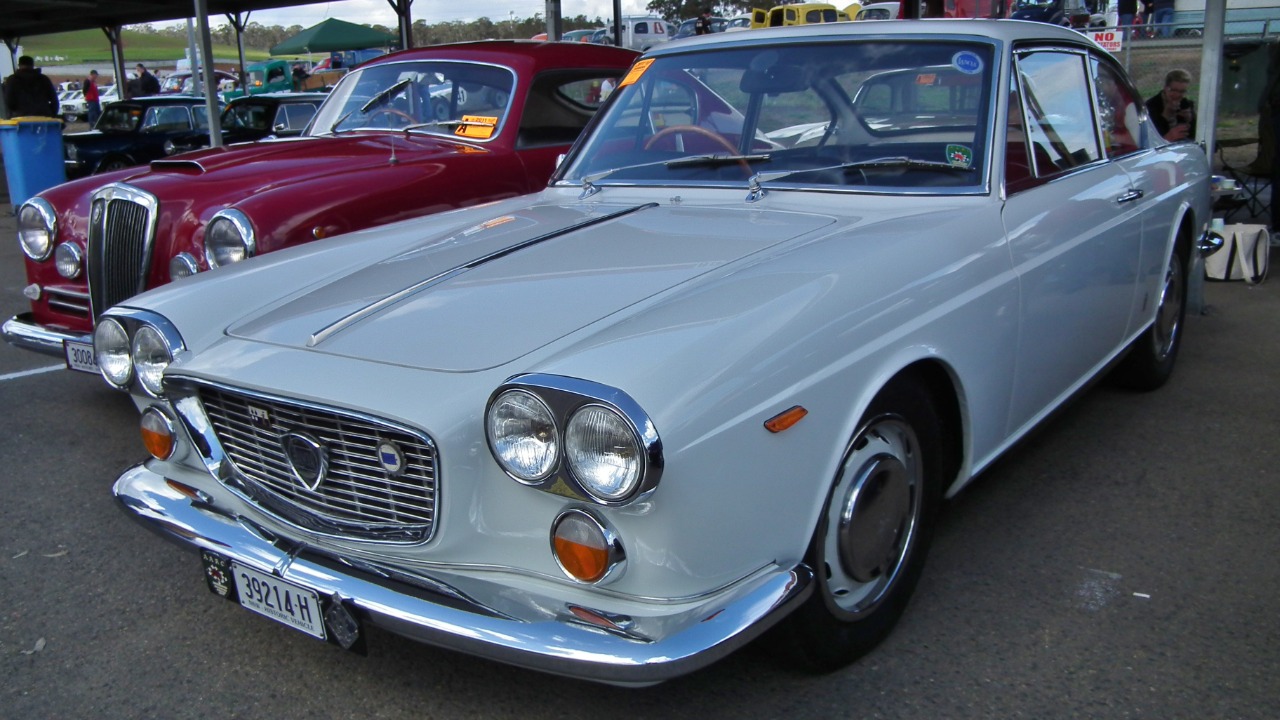
The 1966 Lancia Flavia arrived at a moment when family cars were supposed to be sensible, not visionary, yet it quietly rewrote the rulebook on how a refined European sedan could be engineered. By pairing advanced front wheel drive hardware with crisp Italian styling and a surprisingly sophisticated chassis, it pushed innovation in ways that still feel modern today. I see it as one of those rare cars whose technical daring and aesthetic confidence genuinely shifted expectations for what a mid‑size Italian could be.
Front wheel drive, Italian style
When the Lancia Flavia appeared at the start of the 1960s, it marked a deliberate break from the rear driven norm that dominated Italian roads. The company positioned the Lancia Flavia between its existing models as a fresh branch on the Lancia tree, and that new branch carried a radical layout for Italy. Instead of the traditional rear wheel drive configuration, the Flavia used front wheel drive to deliver secure traction and a more stable feel in poor weather, a choice that made the 1966 versions feel years ahead of many rivals. For a country that prized rear driven sports cars, this was a bold statement that practicality and precision could share the same badge.
That decision was not a gimmick, it was the backbone of the car’s character. Contemporary enthusiasts still describe the 1966 Lancia Flavia as a stylish and sophisticated Italian sedan, known for its innovative front wheel drive layout and distinctive road manners that set it apart from more conservative contemporaries. In period, that meant owners enjoyed a car that felt planted on twisting European roads, with the driven wheels pulling the nose into bends rather than pushing from behind. The fact that a mainstream Italian manufacturer committed to this architecture at scale signaled to the wider industry that front wheel drive could underpin serious, high quality cars, not just utilitarian runabouts.
A chassis built like a precision instrument
What really fascinates me about the 1966 Flavia is how obsessively its structure was thought through. Instead of treating the engine bay as a messy collection of parts, Lancia fixed the entire mechanical structure, including the engine, gearbox, differential, suspension and steering, to a compact subframe anchored to the bodyshell. That approach, detailed in period descriptions of the mechanical structure, gave the car a rigid, precise foundation and helped isolate vibration from the cabin. For drivers, it translated into a sense that the Flavia was carved from a single block rather than assembled from loose components, something that still impresses when you climb into a well preserved example today.
That structural thinking extended to the way the car rode and handled. By concentrating the heavy components on a dedicated frame and tying it carefully into the body, Lancia could tune the suspension to balance comfort with control in a way that felt unusually sophisticated for a mid‑size sedan. The result was a car that soaked up rough surfaces without feeling vague, a trait that owners of the 1966 Lancia Flavia still praise when they compare it with more softly sprung contemporaries. In an era before computer simulations and active dampers, that kind of composure came from meticulous engineering and a willingness to invest in complexity where other manufacturers cut corners.
Brakes, engines and the push for everyday performance
Innovation in the Flavia did not stop at the driven wheels and the subframe. From its launch, the model was engineered to maintain Lancia’s reputation for advanced mechanical solutions, and by the time the 1966 cars arrived, that philosophy was fully baked in. The Flavia saloon had been launched earlier in the decade with a focus on engineering that included all round disc brakes, and those assisted disc brakes carried through to the later convertibles and coupes. For everyday drivers, that meant shorter stopping distances, better resistance to fade on mountain descents and a reassuring pedal feel that matched the car’s poised chassis.
Under the bonnet, the Flavia family evolved into larger capacities that suited the growing weight and ambition of the range. Period specifications for the Lancia Flavia list a cylinder capacity of 1800 cc, with power delivered in a smooth, flexible band that suited both relaxed touring and brisk cross country driving. In 1966, that displacement found one of its most interesting expressions in the Lancia Flavia Sport 1.8 Iniezione, a car whose very name highlights the 1.8 litre engine and its fuel injection system. While carburettors still dominated the market, this injected setup pointed toward a future where precise fuel metering would become the norm, and it showed that Lancia was willing to bring advanced technology to customers who wanted more than just basic transportation.
Design that matched the engineering ambition
For all its mechanical cleverness, the Flavia would not be remembered so fondly if it had not also looked the part. The 1966 Lancia Flavia is often described by enthusiasts as a stylish and sophisticated Italian sedan, and that elegance was no accident. The clean lines, subtle chrome and balanced proportions gave the car a quiet confidence that set it apart from more ornate contemporaries. Earlier in the decade, the Flavia convertible had already shown how the basic package could be transformed into a glamorous open car, and accounts of a 1964 Lancia Flavia Convertible with coachbuilt bodywork describe a shape that exuded elegance and style, a theme echoed in later convertible interpretations.
The design story did not stop with the factory saloon and convertible. The Lancia Flavia Sport Coup, built on the same innovative front wheel drive platform, has been celebrated as Italy’s first series production front wheel drive car, a milestone that gave designers a new set of proportions to play with. Descriptions of the Lancia Flavia Sport highlight how the low bonnet line and cab forward stance, made possible by the transverse layout, created a distinctive profile that still looks fresh. In 1966, that combination of advanced packaging and crisp styling helped the Flavia stand out in a crowded market, proving that technical innovation and visual appeal could reinforce each other rather than compete.
A legacy that still shapes how we see the Flavia
What keeps the 1966 Flavia relevant today is not just its spec sheet, but the way it continues to inspire enthusiasts and collectors. Modern discussions of the model often describe the 1966 Lancia Flavia as a stylish and sophisticated Italian sedan, known for its innovative front wheel drive layout and distinctive character, a description that captures both its technical and emotional appeal. In enthusiast circles, the car is remembered as a turning point where an Italian manufacturer embraced front wheel drive at scale, and that memory shapes how later front driven cars from the country are judged. When I look at the Flavia in that context, it feels less like an outlier and more like a quiet pioneer that made later innovations easier to accept.
The car’s influence also shows up in the way collectors talk about related models and the broader Lancia story. Enthusiast posts that celebrate the 1966 Lancia Flavia as a symbol of Italian elegance and innovation often mention how the Flavia was one of the first Italian cars to feature front wheel drive, placing it alongside earlier models like the 1961 Lancia Flaminia 2.5 in the brand’s evolving narrative of technical daring. That sense of continuity is echoed when collectors such as Marcus Harrison add Flavia variants to their garages, treating them as key pieces in a larger puzzle of Italian automotive history. Even museum displays, such as the Coupe PF at the Manro Classic Auto & Musik Museum in Salzburg Austria, underline how the Coupe PF and its siblings carried the front wheel drive idea into multiple body styles, reinforcing the Flavia’s role as a platform for experimentation rather than a single, static model line.
More from Fast Lane Only: