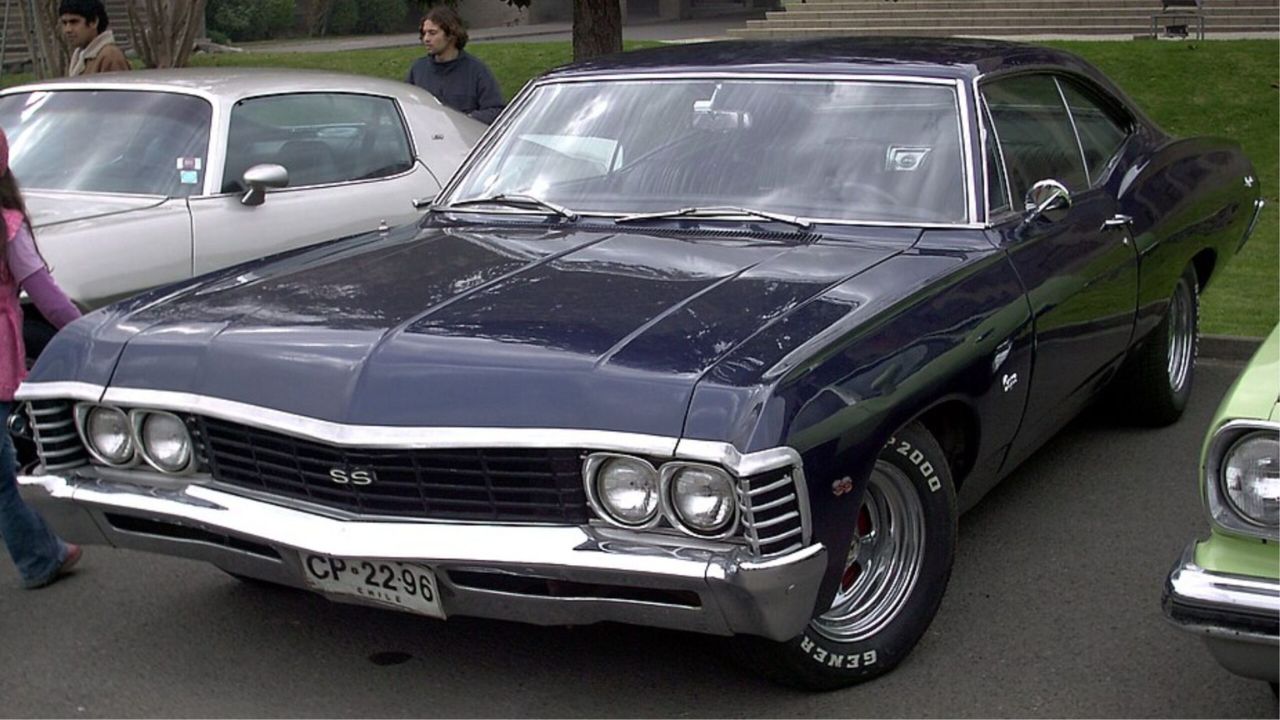
By 1967, the Impala SS wasn’t just a big, stylish Chevrolet you bought for comfort and curb appeal. It sat right in the middle of a market where muscle cars were exploding in popularity, and buyers were suddenly expecting full-size cars to do more than cruise. Chevrolet responded by letting shoppers mix and match hardware that, a few years earlier, might’ve seemed out of place on a large family-friendly coupe or convertible.
Those “surprise” choices didn’t appear out of thin air. They were the result of how Chevrolet structured its option list, how the SS package fit into the full-size lineup, and how fast the performance arms race was moving in the late ’60s. The end result was a car that could be ordered mild or genuinely serious, depending on how you checked the boxes.
The SS package was more than trim, but it wasn’t a separate model
One reason the 1967 Impala SS could be configured in so many ways is that the SS (Super Sport) equipment was offered as a package on the Impala line rather than as a standalone nameplate with a single fixed formula. That packaging approach made it easier for Chevrolet to attach additional performance-related options without forcing every SS buyer into the same spec. You could prioritize looks and interior upgrades, or you could steer the build toward power and handling.
This matters because it explains why some people think of the SS as “unexpectedly” quick when properly optioned. The badge didn’t guarantee the same drivetrain across the board. It opened a door to more aggressive choices, and buyers decided how far to walk through it.
Big-car buyers were starting to demand muscle-car power
In the mid-to-late 1960s, performance stopped being a niche obsession and became a mainstream selling point. Muscle cars were grabbing headlines, and even customers shopping full-size cars were paying attention to horsepower numbers and quarter-mile chatter. Chevrolet had every incentive to keep those shoppers inside its showrooms instead of losing them to a competitor’s high-output package.
The Impala SS lived in a sweet spot for that strategy. It had the size, ride, and presence people expected from a full-size Chevrolet, but it could be ordered with powertrain and chassis options that leaned into the era’s performance mood. In other words, it wasn’t that Chevrolet suddenly got weird—it followed the buyer.
Chevrolet’s parts-bin strategy made “unexpected” combinations possible
Chevrolet was large enough to share engines, transmissions, and heavy-duty components across multiple lines. When you can draw from a wide internal catalog, offering more combinations becomes less risky and less expensive than designing unique SS-only hardware. That kind of modular thinking is a big reason unusual-sounding builds could be ordered through normal dealership channels.
It also helps explain why an Impala SS could be spec’d to handle more power than you might assume from its size. Heavy-duty cooling, stronger driveline pieces, and performance-oriented transmissions weren’t exclusive to one halo model; they were options that could be applied where demand existed. The Impala SS benefited from being part of a huge ecosystem rather than a one-off specialty car.
The engine menu could scale from street-friendly to seriously strong
When people talk about the Impala SS’s “unexpected performance options,” they’re often thinking about how far up the engine ladder you could climb. Chevrolet offered multiple V8 choices across the full-size range in 1967, including big-block availability. That meant the same basic car could be ordered as a comfortable cruiser or as something with the kind of torque that felt more at home in a performance conversation.
What’s important is the idea of range, not a single mythic spec. A buyer could prioritize smoothness and everyday drivability, or check the boxes for more displacement and output. The surprise is less about any one engine existing, and more about the fact that Chevrolet let a full-size SS be built with genuinely aggressive power for the time.
Transmission choices helped define the car’s personality
Power is only half the story, and Chevrolet knew that. Depending on how the car was ordered, transmission options could dramatically change how an Impala SS felt on the road. The right gearbox could make a big engine feel sharper, more responsive, and more “involved,” while an automatic could keep the same car relaxed and effortless.
That flexibility was part of the point. Chevrolet wasn’t building one Impala SS for one type of driver; it was offering a menu. If you wanted the look and presence without the busy feel of a more hardcore setup, you could do that, and if you wanted a more performance-oriented experience, you could chase it through options.
Chassis and brake options mattered more than most people remember
Full-size cars carry their speed differently, so performance options couldn’t just be about horsepower. Suspension tuning, steering feel, and braking capability were all part of making a large car feel confident when driven harder. Chevrolet’s ability to offer heavy-duty or performance-focused chassis components helped make the SS package feel credible beyond straight-line bragging.
This is where “unexpected” really starts to make sense for modern observers. People often assume big ’60s coupes were all float and no control, but option sheets could change the character quite a bit. Even without turning the car into a track tool, the right combination could make it feel tighter and more capable than its size suggested.
Insurance and buyer psychology shaped how Chevrolet offered performance
By the late ’60s, insurers were paying closer attention to performance cars, and that pressure affected how manufacturers marketed and packaged speed. One way to navigate that environment was to make performance available through options rather than forcing it as standard equipment on a single high-profile model. That gave Chevrolet room to satisfy enthusiasts without making every SS a loud, obvious target.
It also matched how people actually shopped. Many buyers wanted the style and prestige of an SS-badged Impala but didn’t necessarily want the most extreme setup. Chevrolet’s option structure let the buyer decide where the line was—powerful, sporty, comfortable, or some blend of all three.
Dealers and local demand influenced what ended up on the street
Another reason these performance combinations feel surprising today is that what you saw depended heavily on where you lived and how a dealership stocked cars. Some dealers ordered more aggressively optioned vehicles because they knew their local market wanted them, while others leaned toward comfort and appearance packages. The car’s reputation in any given region could be shaped by what dealers put on the lot.
And if a buyer didn’t see the exact spec they wanted sitting outside, they could order it. That’s how unusual builds happen: a customer walks in with a specific goal, the salesperson knows the ordering system, and the factory builds it. Decades later, those cars stand out because they don’t match the “average” Impala SS people picture.
It’s the mix-and-match freedom that makes the options feel surprising now
Looking back, the most interesting part isn’t that Chevrolet had performance parts available—it’s that it allowed them to be combined in a full-size SS in ways that could create a legitimately quick, confident car. The 1967 Impala SS could be dressed up, toned down, or turned up, and that flexibility was intentional. Chevrolet was balancing comfort-car expectations with a market that had fallen in love with speed.
So when someone finds a ’67 SS with a stout engine, the right transmission, and supporting hardware, it can feel like a secret the era hid in plain sight. It wasn’t an accident, and it wasn’t a one-size-fits-all muscle car either. It was Chevrolet giving buyers more say in what “SS” meant to them.
More from Fast Lane Only
- Unboxing the WWII Jeep in a Crate
- 15 rare Chevys collectors are quietly buying
- 10 underrated V8s still worth hunting down
- Police notice this before you even roll window down
*Research for this article included AI assistance, with all final content reviewed by human editors.