
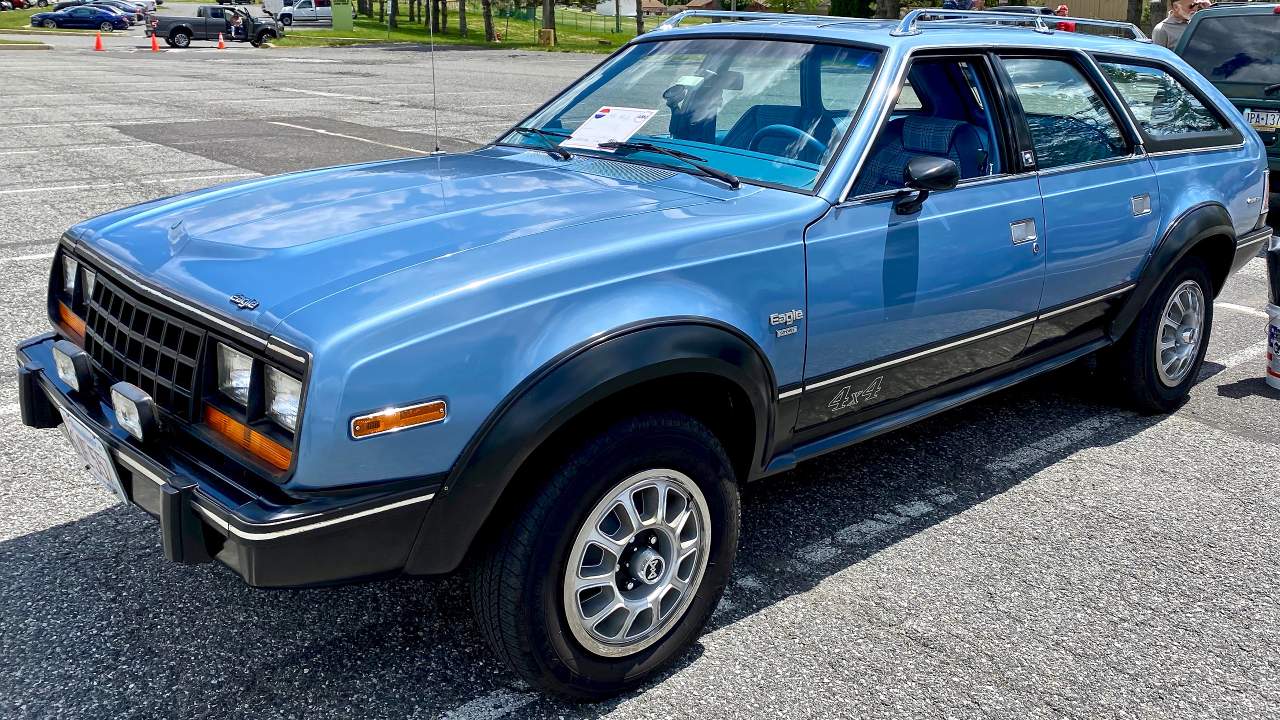
The 1981 AMC Eagle looked like a slightly lifted family wagon, yet it quietly sketched the template for the vehicles that now dominate suburban driveways. By combining carlike comfort with genuine four-wheel-drive hardware, it anticipated the crossover boom that would not fully arrive for decades. I see that single model year as the moment when a struggling American Motors turned a clever engineering experiment into a clear preview of how most people would eventually want their utility vehicles to feel and drive.
A family wagon with Jeep hardware
At a glance, the 1981 AMC Eagle could pass for a conventional station wagon, with a squared-off body and long roof that would not have looked out of place in any supermarket parking lot. The difference sat in its stance and underpinnings, where AMC blended a unibody car shell with a raised ride height and a full-time four-wheel-drive system derived from its off-road know-how. One detailed description captures it as “Part Car, Part Jeep,” a phrase that neatly sums up how the Eagle rode and handled like a passenger car while tackling snow, mud, and rough tracks that a typical sedan could not approach.
This mix was not an accident. American Motors had predicted that buyers would want “something with the mild capabilities of a utility vehicle” without giving up the comfort and fuel economy of a car, a judgment that reads today like a mission statement for the entire crossover category. Contemporary accounts of the American Motors Eagle emphasize that the company took its existing Hornet-based platform, added a sophisticated full-time system to drive all four wheels, and wrapped it in familiar wagon and sedan shapes so the vehicle felt approachable rather than trucklike. When I look at the 1981 Eagle, I see a deliberate attempt to normalize four-wheel drive for everyday families, not just for outdoors enthusiasts.
The 1981 sweet spot: timing, packaging, and demand
The early 1980s were defined by energy crises and a push to downsize American cars, which made the Eagle’s formula unusually well timed. Instead of building a heavy body-on-frame truck, AMC offered a relatively efficient wagon that could still get through winter storms and muddy driveways. One retrospective on the American Eagle notes that American Motors introduced the Eagle at the start of the decade as a “revolutionary driving system,” positioning it as a way to have year-round security without the penalty of a traditional off-roader. By 1981, the concept had matured into a full range of body styles, including the wagon that would become the most recognizable face of the line.
Market response showed that AMC had tapped into a real, if still emerging, demand. Petrol-focused coverage points out that the Eagle sold in excess of “120,000 units” in its first year on sale, a figure that would be respectable for a niche experiment even today. That volume suggests buyers were ready for a vehicle that blurred categories, even if the industry had not yet settled on the “crossover” label. When I consider the 1981 model year, I see it as the moment when the Eagle’s packaging, public awareness, and broader economic context aligned, turning a risky “Hail Mary Hornet” derivative into a credible template for mainstream family transport.
Engineering the first true crossover

Technically, the Eagle did something no other American car had done at scale: it made full-time four-wheel drive a normal, everyday feature in a family wagon. One analysis describes it as the first American car-based vehicle to pair a unibody platform with a permanent all-wheel system, rather than a part-time transfer case borrowed from a truck. Another source goes further, arguing that the AMC Eagle “invented the crossover” roughly twenty years before the term became common, because it fused the stance and capability of a light utility vehicle with the driving manners of a sedan.
Later commentators have echoed that judgment, calling the Eagle “the first crossover SUV” and crediting it with proving that such a blend was commercially viable. A detailed market overview lists “Innovation” and “Impact on the Market” as key themes, noting that The Eagle effectively created the crossover category by showing that buyers would pay for extra traction and a higher seating position if those features came without the compromises of a truck. When I compare the Eagle’s layout to modern all-wheel-drive wagons and compact SUVs, the lineage is direct: car-based construction, a modest lift, and an all-weather drivetrain that is always on, not something the driver has to think about.
From forgotten oddball to modern blueprint
Despite its pioneering role, the Eagle did not immediately reshape the industry. American Motors struggled financially and ultimately disappeared after Chrysler bought out AMC, which meant there was no long-term marketing push to cement the Eagle’s place in the public imagination. One retrospective notes that the AMC Eagle was “Built in the 1980s” and then quietly ended in 1988 after the acquisition, leaving the concept without its original champion. Another analysis describes how Subaru and Audi later “perfected the concept of car-based AWD” after AMC went out of business, expanding on the Eagle’s formula and turning it into a huge global seller.
Yet the basic idea refused to die. A detailed look at how the AMC Eagle became the “accidental blueprint for the modern crossover” points out that it looked like a familiar station wagon, only standing slightly higher off the ground, with just enough lift to hint at extra ability without intimidating drivers. That description could apply word for word to today’s compact crossovers, from a Subaru Outback to a Toyota RAV4. Another piece on the Eagle SX/4, introduced “Before crossovers dominated every suburban driveway,” underlines how the car anticipated the later marketing of “active lifestyle vehicles” by decades. When I trace that arc, I see the Eagle as a concept that the market eventually embraced, even if the original badge did not survive to enjoy the payoff.
Why the 1981 Eagle still feels current
Four decades on, the 1981 AMC Eagle wagon can still pass for a relevant daily driver, which is not something that can be said for many early 1980s experiments. A feature on a preserved 1981 Eagle notes that it was repainted “Approximately 10 years ago” and given a refreshed grille and trim, yet its basic proportions and purpose remain in step with current tastes. The car’s elevated ride height, practical cargo area, and unobtrusive styling would not look out of place parked next to a modern compact SUV. Another video profile of a surviving Eagle Wagon and its road manners highlights how its combination of comfort and all-weather confidence still makes sense on contemporary highways.
Modern commentators increasingly give the Eagle explicit credit when discussing the rise of crossovers. A broad overview of the segment’s history states that “We should also give a nod to what was perhaps the first crossover ever: the AMC Eagle,” acknowledging that the current “king of the road” owes a debt to a car that arrived long before the terminology. A separate analysis of American Motors’ strategy argues that if the company had survived, the Eagle could have evolved into an “amazing machine” that tracked directly with what the market later demanded. When I look at the 1981 model through that lens, it feels less like a quirky footnote and more like a clear, early sketch of the vehicles that now define mainstream automotive design.
More from Fast Lane Only:



Leave a Reply