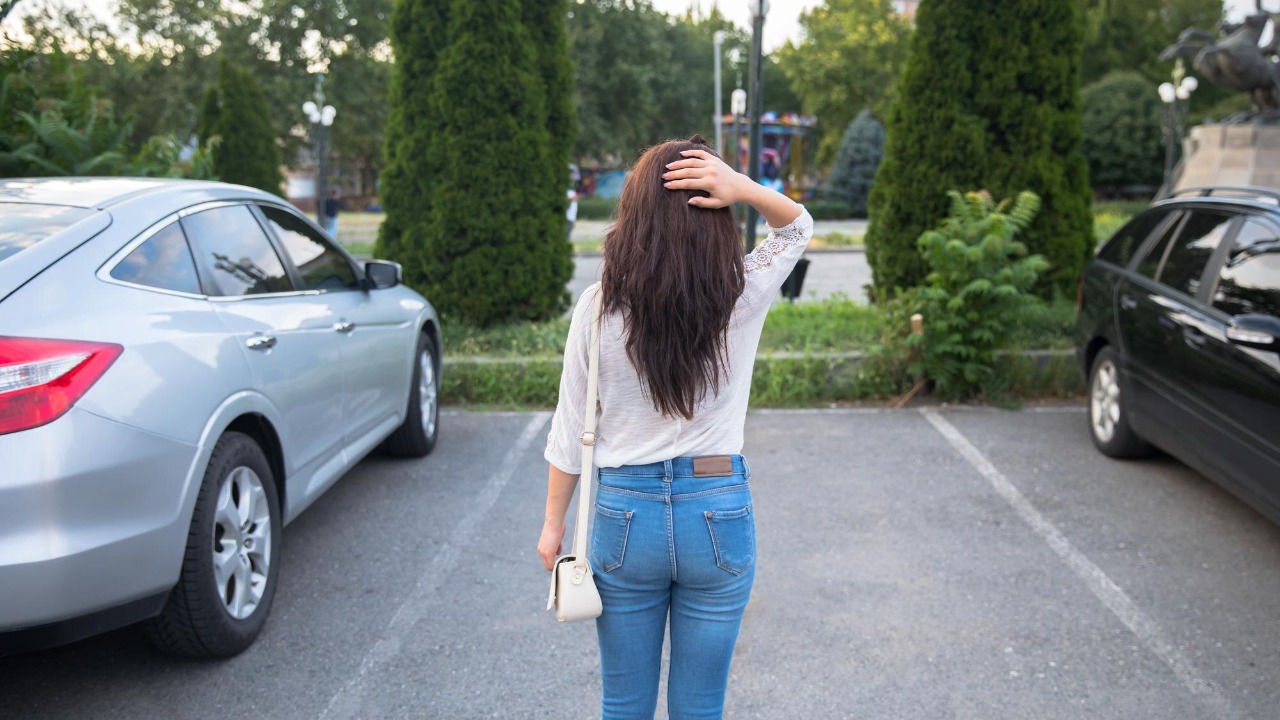
It started like one of those ordinary errands you barely remember later—until it suddenly wasn’t. One woman says she walked back to a parking lot expecting to hop in her car and head home, only to find an empty space where her vehicle had been. No broken glass, no obvious clues, just that sinking feeling that something was very wrong.
What happened next, she says, was a zigzag of confusion: a call for help, a quick scan of surrounding rows, and then an explanation from staff that felt… off. Not “mystery solved,” more like “wait, what?” The kind of answer that raises more questions than it closes.
An empty space where her car should’ve been
According to her account, she’d parked in a lot connected to a busy shopping area—nothing unusual, plenty of cars, lots of movement. She says she took a quick mental note of where she left the car, did her shopping, and returned within what she believed was a normal window of time.
Then she got back to the spot and froze. The car wasn’t there, and she says she didn’t immediately see any signs that a tow truck had been through. It wasn’t the typical “I forgot where I parked” panic either, she insists—she walked the row twice, checked nearby lanes, and still came up empty.
The first thought: theft… or the world’s worst memory glitch
Anyone who’s ever lost a car in a large lot knows the mental spiral: “Did I park on the other side?” followed by “No, I definitely parked here,” followed by “Oh no.” She says she tried to stay calm and did the practical stuff first—retrace steps, check for nearby signage, and look for security or customer service.
As the minutes passed, her worry shifted from “I’m turned around” to “something happened to my car.” She says she called a family member to talk it through and then contacted the business’s front desk to ask whether cars were being towed from the lot that day.
Staff offered an explanation, but it didn’t add up
Here’s where her story gets interesting. She says staff told her the car had likely been moved due to “lot operations,” but couldn’t immediately explain who moved it, where it went, or why her vehicle would be singled out without a warning. In her mind, if a car is going to be relocated, there should be a record, a note, a phone number—something.
She describes the explanation as vague and shifting, with details that didn’t line up from one moment to the next. One person suggested it may have been towed for being in the wrong section, while another implied it might’ve been repositioned for an event or maintenance. But she says she’d seen no clear signs about restrictions where she parked.
A tow that doesn’t look like a tow
Most people imagine towing as a loud, obvious process. Yet in busy lots, it can happen quickly, and drivers often don’t notice. Still, she says the story she was hearing didn’t fit the reality of the space—no posted temporary “No Parking” placards, no cones, no tape, no fresh marks that suggested a truck had recently maneuvered through.
She also says she asked a simple question that should’ve cleared everything up: “Which tow company?” If a tow happened, there’s usually a contracted operator and a paper trail. She claims she didn’t get a straight answer at first, which only made her more suspicious that someone was improvising instead of checking facts.
What often happens in lots like this
Parking lots connected to retail centers, apartment complexes, and event spaces can be surprisingly complicated. Different sections can be controlled by different owners, and enforcement can change depending on the day, the time, or whether there’s a special event. Sometimes the signs are clear; other times they’re technically “there,” but not in a place anyone would reasonably notice.
There’s also the less talked-about reality: cars do get relocated. In some cases it’s for resurfacing, construction, emergency access, filming, or crowd control. When it’s done properly, there’s usually documentation and visible notice—so when someone hears “operations moved it” without proof, that’s understandably hard to swallow.
The moment she started questioning everything
She says the turning point was when she was asked to wait while staff “checked” on it, but the check seemed to produce new versions of the story instead of clarity. She heard suggestions ranging from “maybe you parked somewhere else” to “it might be in a different area,” even though she says she’d already combed the lot carefully.
That kind of back-and-forth can feel like being gently blamed without anyone actually saying it. And to be fair, people do misremember where they parked all the time—lots are basically designed to scramble your brain. But she insists she wasn’t guessing; she was sure of the spot.
Eventually, a location surfaced—just not a satisfying reason
According to her, the car was later traced to another part of the property, though she maintains she never got a clear, consistent explanation for why it was moved in the first place. If the vehicle was towed, she expected a standard process: confirmation, paperwork, fees explained upfront, and a clear point of contact.
Instead, she says she was left with a storyline that felt stitched together. Not necessarily malicious—just messy and unhelpful. And when you’re already stressed, “messy” sounds a lot like “someone’s hiding something,” even if the reality is simply poor communication.
Why confusing explanations happen more than you’d think
A lot of these situations boil down to disconnected systems. Security might know one piece, a property manager might know another, and front-desk staff may be hearing updates secondhand. Meanwhile, tow companies often operate independently and may not report details immediately to the businesses nearby.
There’s also the uncomfortable possibility of an honest mistake—like the wrong vehicle being moved or a section being enforced inconsistently. If that happens, people can get defensive quickly, because admitting error can mean financial liability. Even when no one’s being shady, the incentives don’t exactly encourage crystal-clear explanations.
What people can do if their car “disappears”
If this ever happens to you, the first step is boring but important: make sure it wasn’t simply parked in a different row than you remembered. Walk the perimeter, check nearby levels if it’s a garage, and use a map pin if you dropped one earlier. If you’ve got a car app or connected services, try locating it from your phone.
If it still isn’t there, ask for specifics immediately—who authorized the removal, which company handled it, and where it was taken. Take photos of the spot, nearby signs, and any lack of signage, because details change fast once the questions start. And if you suspect it’s stolen rather than towed, call local law enforcement and your insurer sooner rather than later.
A small mystery that leaves a big impression
In the end, what stuck with her wasn’t just the shock of not finding her car—it was the feeling that the people who should’ve had answers didn’t. She says the whole experience left her second-guessing how secure “normal” errands really are, and how quickly a simple parking job can turn into a full-blown scavenger hunt.
Maybe there’s a straightforward explanation buried under bad communication. Or maybe the details truly don’t match up the way they should. Either way, it’s the kind of story that makes you want to snap a photo of your parking spot next time—just in case the lot decides to play hide-and-seek.
More from Fast Lane Only