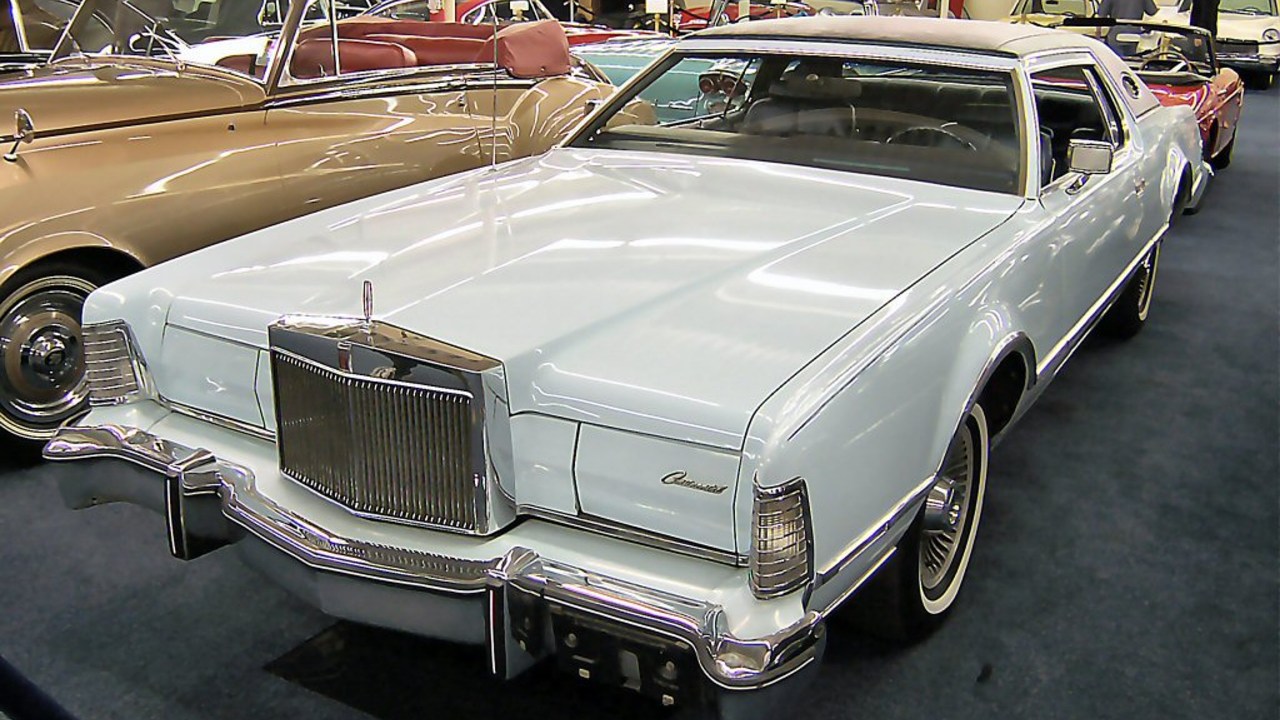
The 1976 Lincoln Continental Mark IV arrived at the peak of America’s taste for excess, a personal luxury coupe that treated size as a feature rather than a flaw. With its vast hood, formal roofline, and unapologetically plush cabin, it showed just how far Detroit was willing to go to define comfort and status from the driver’s seat. Nearly half a century later, it stands as a rolling monument to an era when “big luxury” meant literal acreage of sheet metal and velour.
More than a nostalgic curiosity, the 1976 Continental Mark IV captures a turning point in automotive culture, when traditional American opulence brushed up against looming pressures over fuel, emissions, and changing tastes. Its proportions, engineering, and fashion-driven trim packages reveal how Lincoln tried to keep indulgence alive even as the market’s priorities began to shift.
Size as a Statement
The Continental Mark IV did not merely occupy a parking space, it dominated it. The car stretched to 228.1 inches in overall length, riding on a 120.4 inch wheelbase that gave it the “luxury length” profile prized in the 1970s. Contemporary specifications list a Curb Weight of 5,264 pounds, a Width of more than 79 inches, and a Height, Overall of 53.5 inches, figures that underscore how the coupe combined low, formal stance with sheer mass. The Continental MK IV was described as a large front engine, rear drive vehicle, and that simple description understates how imposing it looked in a driveway or in the fast lane.
These dimensions were not incidental engineering outcomes, they were the product of a design philosophy that equated physical presence with prestige. The long hood and short deck proportions, stretched over that 120.4 inch Wheelbase, created a sense of motion even at rest, while the broad bodywork and substantial Curb Weight signaled that this was not a car built for tight European streets. In an era when American luxury was expected to float over imperfections rather than carve through corners, the Mark IV’s size became its calling card, a visual shorthand for comfort, quiet, and authority.
Designing a Rolling Luxury Lounge
If the exterior announced the Continental Mark IV’s status, the styling details refined the message. Period descriptions highlight Straight panels, bright chrome, hidden headlights, and a Rolls Royce inspired grille, all of which worked together to give the car a formal, almost ceremonial face. Side opera windows in the thick C pillar and an extra pinstripe highline along the flanks added jewelry-like touches that separated the Mark IV from more modest sedans. The overall effect was less sports coupe and more rolling drawing room, a place where the driver and passengers were meant to be seen as much as transported.
Inside, the 1976 Lincoln Continental Mark IV leaned into the idea of a personal luxury lounge. Enthusiasts describe the model as the pinnacle of American personal luxury, with plush seating, extensive sound insulation, and a dashboard that wrapped around the driver in a gentle arc. The 1976 Lincoln Continental Mark IV in bold red has been celebrated as the epitome of 1970s American luxury, massive, elegant, and unapologetically opulent, and that assessment applies equally to the cabin. Materials and color choices, especially in special trim groups, turned the interior into a curated environment rather than a simple cockpit, reinforcing the notion that this was a car for unhurried, indulgent travel.
Power, Comfort, and the Engineering of Effortlessness
Beneath the long hood, the Continental Mark IV relied on displacement and gearing to deliver the effortless motion its image demanded. Standard equipment lists a 460 4V engine paired with a Select Shift automatic transmission, feeding power through a 2.75 rear axle ratio. This combination prioritized smooth, low rev torque and quiet cruising over outright acceleration, aligning with the car’s mission as a highway cruiser. The large front engine, rear drive layout gave the Mark IV traditional American luxury car dynamics, with a soft ride and relaxed steering that encouraged gentle inputs rather than aggressive maneuvers.
The engineering brief extended beyond the powertrain to the way the car isolated occupants from the outside world. The long 120.4 inch Wheelbase and substantial Curb Weight worked with a compliant suspension to soak up road imperfections, while the low Height, Overall of 53.5 inches and wide track contributed to a planted, stable feel at speed. Standard equipment catalogs for the 1976 CONTINENTAL MARK IV list features under Performance that were aimed at making the driving experience as effortless as possible, from power assisted controls to carefully tuned gearing. In practice, the Mark IV delivered a kind of serene progress that matched its visual gravitas, trading sharp responses for a sense of unflappable calm.
Fashion on Four Wheels: Designer Series and Luxury Groups
Lincoln understood that in the mid 1970s, luxury buyers were not just purchasing comfort, they were buying identity. The Continental Mark IV responded with a series of fashion driven editions that turned the car into a canvas for high style. The Designer Series models, which could be added for $1,500 on top of a base price of just over $11,000, offered curated color and trim combinations tied to prominent design names. Like all Mark IVs, these versions shared the same imposing 228.1 inch length and core mechanicals, but their unique paint, vinyl roof treatments, and interior palettes made them rolling fashion statements.
Beyond the Designer Series, Lincoln offered themed Luxury Group packages that pushed the aesthetic even further. Enthusiast accounts of the 1976 Lincoln Continental Mark IV Jade Luxury Group describe a car that epitomized 1970s American luxury, massive, elegant, and unapologetically opulent, with coordinated exterior and interior hues that turned the coupe into a cohesive design object. Another description of a 1976 Lincoln Continental Mark IV notes production of 56,110 units and highlights how specific color and trim combinations, including mid year Luxury Group offerings, allowed buyers to tailor the car’s personality. In this context, the Mark IV was less a single model and more a platform for personal expression, with the Designer Series and Luxury Groups serving as the most visible expressions of that strategy.
Legacy of an Oversized Icon
By the time the 1976 Lincoln Continental Mark IV reached showrooms, the personal luxury coupe formula it represented was nearing its zenith. The model is often remembered as the final year of the Mark IV generation, just before the Mark V arrived with subtly updated styling and a slightly different take on the same basic idea. Enthusiasts and collectors now look back on the 1976 Lincoln Continental Mark IV as a rolling statement of 1970s opulence, a car that distilled the decade’s appetite for size, comfort, and visual drama into a single, unmistakable silhouette. Its massive proportions, bold styling, and opulent interior have led many to describe it as the pinnacle of American personal luxury.
That legacy is visible today in the way surviving examples are celebrated in enthusiast communities and classic car show fields. Descriptions of well preserved cars emphasize Straight panels, bright chrome, hidden headlights, and that Rolls Royce inspired grille, details that still command attention in a world of more restrained crossovers and sedans. The 1976 Continental MK IV, with its 120.4 inch wheelbase, 228.1 inch length, and 460 cubic inch V8, stands as a reminder of a time when American luxury was measured in inches and pounds as much as in technology and efficiency. Unverified based on available sources whether its exact sales figures eclipsed all rivals, but its cultural footprint is undeniable, marking the moment when big luxury truly reached its outer limits.
More from Fast Lane Only