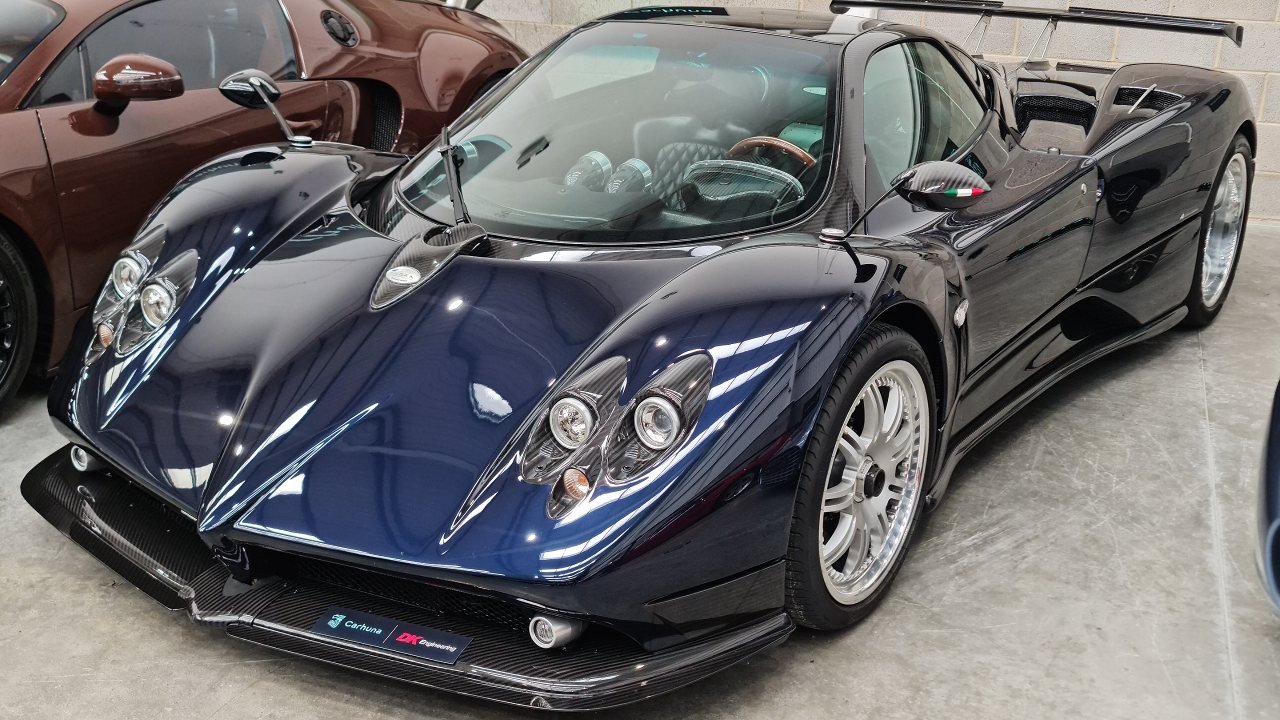
The 2007 Pagani Zonda F arrived at a moment when supercars were still judged first on lap times and spec sheets, yet it insisted that hand‑built artistry deserved equal billing. Instead of hiding its craftsmanship behind paint and plastic, it put carbon weave, exposed metal and bespoke detailing front and center, turning build quality into a spectacle in its own right. I see it as the first modern boutique exotic where the story was not just how fast it went, but how obsessively it was made.
From Fangio tribute to fully fledged icon
The Pagani Zonda F was conceived as a deeply personal project, tying The Pagani Zonda story to the shared philosophy between Horacio Pagani and Juan Manuel Fangio. Rather than chasing volume or mainstream acceptance, it sharpened the earlier Zonda formula into something more intimate and focused, a car that treated every surface as a canvas. The official description of The Pagani Zonda F frames it as a reflection of that relationship, a road car shaped by a world champion’s sense of purity and a designer’s obsession with detail, which is why the F carries Fangio’s initial rather than a conventional performance badge.
That intent shows up in the way the Zonda F balances race‑bred aggression with almost delicate craftsmanship. The car’s bodywork, with its elongated nose, reworked intakes and more intricate rear wing, reads like a sculptor revisiting an earlier piece to chisel in finer lines rather than starting over. Factory material on the Zonda F emphasizes that it was not a clean‑sheet replacement but a carefully evolved chapter in The Pagani Zonda lineage, a car that had to feel more intense to drive while also serving as a rolling gallery of the brand’s maturing design language.
Carbon fiber as couture, not just structure
If there is a single decision that turned the Zonda F into a craft showcase, it is the choice to let carbon fiber step out from under the paint. Zonda F is described as the first car ever to display, on a client’s request, an exclusive bodywork in natural surface carbon fibre, treated as transparent, pure and natural rather than something to be hidden. That move transformed a structural material into a luxury finish, inviting owners and onlookers to read the weave like fabric and to understand that the car’s skin was not a disguise but an honest expression of how it was built.
This approach set a template that later hypercars would follow, but in 2007 it felt almost radical. Instead of relying on bright colors or heavy chrome, the Zonda F leaned on the quiet drama of exposed composite, framed by metal hardware that looked more like watchmaking than mass‑production engineering. Contemporary walkaround footage of a 2007 Pagani Zonda F from Galaxy 89 Cars lingers on those details, from the clear‑coated carbon panels to the intricate fasteners, reinforcing how the car turned its construction into visual theater. By treating carbon as couture, the Zonda F made craftsmanship the headline act rather than a backstage note in the spec sheet.
A cabin that treats every control as a bespoke object
Open the scissor door and the same philosophy continues inside, where Upholstery was a mix of carpet, leather and alcantara and Standard equipment included air‑conditioning and electric windows. That combination sounds almost ordinary on paper, yet in the Zonda F it is executed with a level of care that makes even functional pieces feel like commissioned art. The seats, dashboard and door cards are stitched and sculpted so that no surface looks generic, and the exposed metal switchgear has the weight and tactility of high‑end audio equipment rather than automotive plastic.
Interior tours of the Pagani Zonda F highlight how even minor components are over‑engineered for feel and appearance. The gated shifter, the milled pedals and the instrument binnacle all look as if they were designed first as standalone objects, then integrated into the car. A detailed guide to the Zonda F notes how this extends to elements like the steering wheel and center console, which blend carbon, leather and metal in a way that makes the cockpit feel more like a bespoke studio than a conventional supercar cabin. In an era when many exotics shared switchgear with mainstream models, the Zonda F’s interior made a clear statement that every touchpoint had been created specifically for this car and this clientele.
Mechanical drama with a human touch
For all its focus on craft, the Zonda F never treated performance as an afterthought. At its heart sits a naturally aspirated 7.3 liter V12, a figure that appears prominently in coverage of the Pagani Zonda and underpins the car’s reputation for old‑school drama. In Clubsport specification, the Pagani Zonda F Clubsport is credited with 641 horsepower and 575 lb‑ft of torque, numbers that were formidable at the time and remain impressive in a world now crowded with turbocharged and hybrid hypercars. The way that power is delivered, with a linear surge and a soundtrack that dominates any road or pit lane, reinforces the sense that the mechanical package was tuned as much for emotional impact as for outright speed.
On‑road and start‑up videos of the 2007 Pagani Zonda F, including footage shot in the UK with Shmei 150, capture how the car’s exhaust note and throttle response turn even low‑speed maneuvers into an event. The Clubsport variant’s freer‑flowing exhaust and reworked ECU, detailed in a technical tour of the Zonda F, sharpen that character further, making the car feel more like a race machine that has been tamed just enough for the street. I see this as another facet of the same philosophy that shaped the cabin and bodywork: every mechanical choice, from engine mapping to exhaust routing, is calibrated to make the driver feel the hand of its creators rather than the anonymity of a wind tunnel or spreadsheet.
Scarcity, collectability and the rise of the boutique hypercar
The Zonda F’s status as a craft‑led exotic is reinforced by how few were built and how carefully they are now traded. A listing for a 2007 Pagani Zonda F describes it as one of the most celebrated hypercars ever crafted and part of an ultra‑limited production run, explicitly tying its appeal to the way it embodies Horacio Pagani’s vision for performance and luxury. Another sale listing for a Pagani Zonda F Clubsport notes that the featured car is one of only 19 remaining unmodified F examples, a figure that underlines how tightly collectors now hold on to original‑spec cars and how much value the market places on untouched craftsmanship.
That scarcity has translated into significant financial appreciation. Analysis of the Pagani Zonda market points out that Loud, fun, and extremely profitable, the Pagani Zonda has made its investors millions of dollars, with some cars covering as little as 1,000 km in twenty years. The Zonda F sits at the heart of that story, its blend of visible carbon, bespoke interior work and naturally aspirated power making it a reference point for what a boutique hypercar can be. Even in scaled‑down form, the car’s aura persists, with commentary on model replicas noting that But models like the PosterCars 1:64 version serve a deeper purpose by bridging the gap between admiration and ownership. When a car’s craftsmanship is so distinctive that it carries emotional weight even at 1:64 scale, it is clear that the original succeeded in making artisanal build quality part of its core identity.
Design legacy and the future of handcrafted speed
Nearly two decades on, designers and enthusiasts still treat the Zonda F as a touchstone for how to blend art and engineering. A contemporary design study framed as The Zonda F being more than a tribute to the past describes it as a visionary leap into the future, arguing that its concept embodies a philosophy that transcends mere performance metrics. That perspective aligns with how Pagani itself now talks about the car, with recent reflections on the Zonda F calling it the massima espressione of design, sportiness and driving pleasure, a maximum expression of design, performance and driving pleasure rather than a machine defined solely by numbers.
Modern video tributes to the Pagani Zonda, including short features that invite viewers to witness the king of exotic cars with a roaring 7.3 L naturally aspirated V12, reinforce how the car’s mechanical heart and handcrafted bodywork have become inseparable in the public imagination. Detailed tours produced with the help of DK Engineering continue to dissect the Zonda F’s construction, from its carbon tub to its exhaust routing, treating it as a benchmark for how a low‑volume manufacturer can turn every nut and panel into a storytelling device. Looking across that body of evidence, I see the 2007 Pagani Zonda F as the moment when the hypercar world learned that being fast was no longer enough. To stand apart, a boutique exotic had to show its workings, celebrate its materials and invite the driver into a relationship with the people who built it, not just the brand stamped on its nose.
More from Fast Lane Only: