The Porsche 959 arrived in the mid‑1980s as a technological shock to the supercar world, pairing a twin‑turbo flat‑six with an all‑wheel‑drive system that behaved more like a thinking partner than a crude traction aid. Long before modern torque‑vectoring crossovers and drift‑mode hypercars, this low, compact coupe showed how electronics, all‑wheel drive and aerodynamics could make extreme performance usable. The result was a car that not only outpaced its rivals, but also changed how high‑end manufacturers thought about putting power to the ground.
Nearly four decades later, the 959 still reads like a blueprint. Its adjustable center differential, composite bodywork and obsessive attention to stability under acceleration and braking anticipated the way contemporary supercars balance speed with security. To understand how modern all‑wheel‑drive flagships reached their current sophistication, it helps to start with the 1986 Porsche 959.
What happened
The 959 began life as a Group B rally project, conceived so Porsche could compete at the top level of international rallying while testing ideas that were too radical for its road‑legal 911. Engineers developed a twin‑turbocharged 2.85‑liter flat‑six engine with water‑cooled cylinder heads, derived from the 956 and 962 endurance racers, and packaged it in a body that combined steel, aluminum and Kevlar‑reinforced plastic panels for reduced weight and controlled deformation. Period specifications list power at roughly 450 horsepower and 500 newton‑meters of torque, figures that placed the car near the top of the performance charts among mid‑1980s exotics.
Unlike the rear‑drive 911 Turbo of the era, the 959 used a permanent all‑wheel‑drive system that Porsche called the Porsche-Steuer Kupplung, or PSK. This electronically controlled multi‑plate clutch could vary torque distribution between the front and rear axles in real time, reacting to wheel slip, throttle position and gear selection. Under steady cruising it favored the rear, but under hard acceleration or on low‑grip surfaces it could send more power forward to stabilize the car. Enthusiast accounts describe how this made the 959 feel rear‑biased and agile in normal driving, yet remarkably composed when the driver exploited the full performance envelope.
The car combined this drivetrain with a six‑speed manual gearbox, unusual at a time when most rivals used five speeds, and with height‑adjustable suspension that allowed the driver to raise the ride for poor surfaces or lower it for high‑speed stability. Contemporary technical write‑ups highlight that the suspension used double wishbones and coil springs, along with electronically adjustable damping, which let the 959 switch from compliant road manners to track‑ready stiffness at the touch of a button. That blend of configurability and control helped the car feel approachable even as its performance numbers pushed into new territory.
Performance testing in period recorded a top speed in the region of 317 kilometers per hour, with 0 to 100 kilometers per hour in around 3.7 seconds. These figures made the 959 one of the fastest production cars in the world, yet its party trick was how calmly it reached them. Where some contemporary supercars felt nervous over bumps or on damp roads, the 959 used its all‑wheel drive and aerodynamics to track straight and true. Its bodywork, shaped through wind‑tunnel testing, featured integrated front and rear spoilers, carefully managed underbody airflow and a smooth tail that reduced lift at speed.
Production remained limited. Porsche built approximately 292 road cars, including Komfort and Sport variants, alongside a small number of competition versions for rally and circuit use. The car’s price and complexity meant it was never intended as a mass‑market halo, but rather as a rolling laboratory. Even so, its impact spread far beyond its tiny production run, because the technologies it introduced filtered into later Porsches and influenced how rival manufacturers approached high‑power road cars.
Contemporary coverage of the model highlights how the 959 sat at the intersection of motorsport and road use. Its rally roots were evident in the way it handled rougher surfaces and variable grip, while its interior offered leather trim, air conditioning and power windows that made it usable as a long‑distance grand tourer. That dual personality set it apart from more single‑minded exotics that sacrificed comfort and security in the pursuit of raw speed.
Enthusiast retrospectives describe the 959 as a car that made other supercar makers nervous, precisely because it exposed the limitations of rear‑drive layouts with huge turbocharged outputs. A detailed feature on the all‑wheel‑drive coupe emphasizes how rivals suddenly had to confront the idea that electronics and all‑wheel drive could make a car not only faster off the line but also easier to control at the limit. That shift in expectations would shape the next generation of high‑performance flagships.
Why it matters
The 959 matters because it reframed what a supercar could be. Before it arrived, the prevailing template centered on rear‑drive, mid‑engine machines that demanded significant driver skill to exploit safely. Porsche instead created a car with a rear‑mounted engine and all‑wheel drive that could match or beat those rivals on performance while giving the driver more confidence in poor conditions. By proving that extreme speed and electronic assistance could coexist, the 959 helped legitimize technology that is now taken for granted.
Several detailed histories of the model point to its role as a turning point for the brand itself. The official account of the 959 story explains how Porsche used the car to test ideas that would later appear in mainstream products, including advanced engine management, sequential turbocharging and sophisticated all‑wheel‑drive control. The company would eventually apply lessons from PSK to the 964‑generation 911 Carrera 4, which brought electronically managed all‑wheel drive to a broader customer base. In that sense, the 959 served as a bridge between pure motorsport experiments and road‑car evolution.
From a historical perspective, many analysts place the 959 among the most significant high‑performance cars of the late twentieth century. A survey of the most important supercars of the past five decades cites the 959 as a benchmark because of its combination of speed, innovation and usability. The car did not simply add more power or a higher top speed, it integrated a suite of technologies that worked together to change the driving experience. That systems approach is now standard practice in high‑end engineering, where aerodynamics, suspension, electronics and powertrain are developed as a package rather than as separate components.
The 959 also expanded the definition of what counted as a supercar. Its 2+2 layout, relatively upright greenhouse and all‑weather capability challenged the idea that a halo car had to be a stripped‑out, temperamental machine. Owners could drive a 959 in the rain, on imperfect roads and over long distances without the constant fear of sudden oversteer or mechanical fragility. That usability influenced later generations of performance cars from multiple brands, which increasingly prioritized everyday comfort alongside track capability.
On a technical level, the car’s all‑wheel‑drive system anticipated modern torque‑vectoring setups in its ability to move power around proactively. While PSK did not apportion torque across individual wheels, its variable front‑rear split based on driving mode and sensor feedback foreshadowed the logic behind current performance‑oriented systems. The idea that a computer could interpret grip levels and driver intent, then adjust torque accordingly, was still novel in the mid‑1980s. Today, similar thinking underpins everything from high‑end sports sedans to electric hypercars.
Retrospective technical analyses, such as those compiled on dedicated model pages for the Porsche 959, stress how advanced the car’s materials and construction were for its time. The use of Kevlar in the body panels, aluminum in the doors and hood, and a Nomex floor helped reduce weight while maintaining rigidity and safety. These choices signaled a move toward composite construction that would later become common in supercars and eventually trickle down to more accessible performance models.
From a cultural standpoint, the 959 has become a reference point whenever a manufacturer claims to build a technology showcase. Its limited production and high price have only reinforced its mystique, yet its real legacy lies in how ordinary modern performance cars feel in comparison. Features like adjustable suspension settings, complex traction control and multi‑mode all‑wheel drive are now expected in this segment. The 959 was an early proof of concept that such complexity could work reliably on the road.
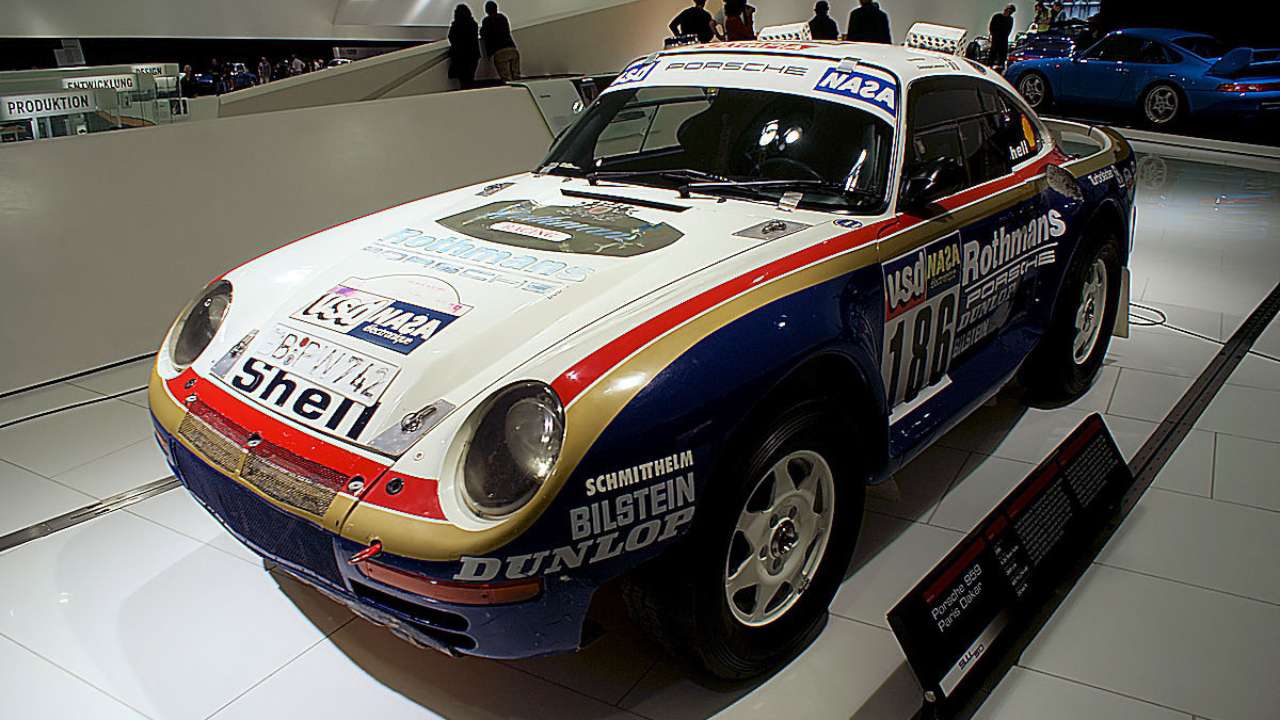
The car’s competition record also contributed to its reputation. Rally‑spec 959 derivatives competed in events such as the Paris‑Dakar Rally, where the combination of power, ground clearance and all‑wheel drive proved its worth over rough terrain. That crossover between desert rally stages and autobahn cruising gave the production 959 a credibility that marketing alone could not provide. Drivers knew the hardware had been tested under extreme conditions before it reached showrooms.
Modern evaluations often compare the 959 with its contemporary rival, the Ferrari F40. Where the Ferrari pursued lightness and raw feedback with rear‑drive and minimal driver aids, the Porsche prioritized stability, technology and all‑weather capability. Both approaches have their adherents, but the trajectory of the broader market suggests that the 959’s philosophy has had more lasting influence. Subsequent generations of supercars from many brands have moved closer to the Porsche template of combining high outputs with sophisticated electronics and, increasingly, all‑wheel drive.
Enthusiast guides that dissect the 1986 Porsche 959 highlight how the car still feels surprisingly modern to drive. Reports describe strong traction out of tight corners, secure braking from high speed and a sense that the chassis and electronics are working with the driver rather than against them. That character aligns closely with what buyers expect from a contemporary all‑wheel‑drive supercar, underlining how far ahead of its time the 959 really was.
What to watch next
Looking ahead, the 959’s legacy continues to shape how manufacturers approach all‑wheel‑drive performance, especially as electrification changes the mechanical layout of high‑end cars. Modern electric and hybrid supercars often use multiple motors to distribute torque between axles and even individual wheels, a concept that echoes the 959’s emphasis on active power management. The core idea remains the same: use technology to give the driver more control and confidence while unlocking higher levels of performance.
As brands revisit their back catalogues for inspiration, the 959 provides a template for balancing heritage with innovation. Some manufacturers have launched limited‑run models that reinterpret classic shapes with modern powertrains and electronics. In that context, the 959 stands as an early example of a car that looked familiar to brand loyalists yet introduced radical hardware beneath the skin. Future projects that aim to blend nostalgia with cutting‑edge engineering are likely to follow a similar path.
Collectors and historians are also paying closer attention to how the 959 fits into the broader story of supercar development. Lists of influential high‑performance models, such as the overview of key supercars across the past half‑century, increasingly treat the 959 as a reference point when evaluating newer entries. When a manufacturer claims that a new flagship represents a step change in technology, comparisons to the 959’s impact are never far behind.
More From Fast Lane Only: