Some cars fade into the background. Others earn their place in history. The 1955 Chevrolet Bel Air didn’t just arrive—it made a statement. With clean, confident styling and a brand-new small-block V8 under the hood, it marked a turning point not just for Chevy, but for the direction of American cars as a whole.
It wasn’t overdesigned or underpowered. It was sharp, capable, and hit the market at just the right moment. What followed was more than strong sales—it was the beginning of something bigger. The Bel Air didn’t just ride through the ‘50s; it helped shape them.
The 1955 Bel Air Kicked Off the Tri-Five Era

1955 marked the beginning of what many refer to as the “Tri-Five” Chevys — the Bel Airs produced from 1955 through 1957. That first year set a tone that would influence American car design for years. The styling was clean, confident, and intentionally forward-looking compared to the ’54 models.
Chevy wasn’t just updating sheet metal; it was aiming to reposition itself in a rapidly modernizing market. The ’55 Bel Air represented a shift in design language that moved away from conservative post-war cars and into something sleeker and far more road-conscious.
A New Small-Block V8 Changed Everything

One of the biggest changes in 1955 was under the hood — the introduction of Chevrolet’s small-block 265 cubic inch V8. It was a lightweight, compact engine that made 162 hp in its base form, with an optional “Power Pack” version rated at 180 hp. Torque was solid too, with around 260 lb-ft depending on setup.
This engine was reliable, easy to work on, and offered more power without bloating the car’s weight. It was a massive improvement over the straight-six, which still came standard, and it gave the Bel Air real credibility on the street.
Chevrolet Offered More Than Just Style
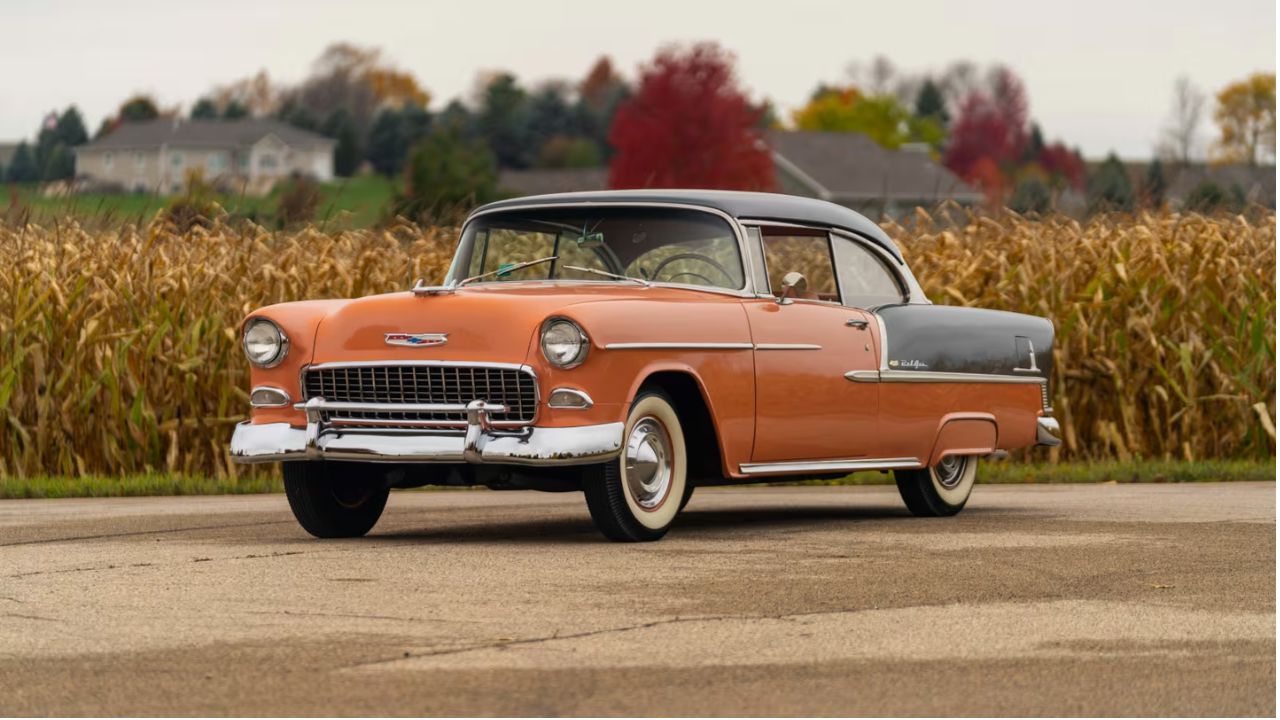
It’s easy to get caught up in the looks, but the 1955 Bel Air was also one of the most technically competent cars Chevy had built at the time. The car rode on a new frame, had improved handling thanks to updated suspension geometry, and even came with an optional Powerglide automatic transmission.
Manual transmission versions used a column-shifted three-speed, which was still common at the time. The brakes were drum all around, but stopping distances were reasonable considering the Bel Air’s roughly 3,200-pound curb weight.
The Design Was Crisp, Not Overdone

Chevy’s design team walked a careful line with the 1955 Bel Air. The car had just enough chrome to stand out, but not so much that it crossed into cartoonish territory. It had a wide grille, subtle tail fins, and a clean beltline that made it look planted and purposeful.
This wasn’t a car designed just to be flashy — it was supposed to feel “new” without being ridiculous. Even today, it manages to strike that balance, especially in two-tone paint schemes that show off the body lines.
Interior Comfort Was a Selling Point

For 1955, Chevrolet wanted the inside of the Bel Air to feel just as updated as the outside. They included a fresh dashboard design, new switchgear, and upholstery patterns that actually felt tailored rather than utilitarian. It had full carpeting, two-tone vinyl options, and a broad range of trim styles depending on body type.
It’s worth noting that the Bel Air trim level sat at the top of Chevy’s lineup, so you could get things like a tissue dispenser, electric clock, or even power windows — features that were still uncommon in mainstream American cars.
You Could Order It Six Different Ways

The 1955 Bel Air wasn’t limited to just one or two body styles. Buyers had six configurations to choose from: 2-door sedan, 4-door sedan, convertible, 2-door hardtop (called the Sport Coupe), 4-door station wagon, and the iconic Nomad two-door wagon.
This range gave the Bel Air wide appeal, from practical family cars to eye-catching cruisers. Chevy understood how important variety was, and the brand made it easy for people to buy a car that actually suited how they lived — and how they wanted to be seen.
The Bel Air Set Sales Records for Chevy

Chevrolet sold over 1.7 million cars in 1955, and the Bel Air led the charge. The brand took the top spot in U.S. sales that year, surpassing longtime rival Ford. The combination of sharp styling, strong performance, and a competitive price tag helped make it a breakout year.
The marketing push was just as strong. Chevy pitched the Bel Air as a car that was finally “as new as tomorrow,” and buyers responded in droves. It wasn’t just popular in hindsight — it was a hit right off the assembly line.
Built All Over the Country

Chevrolet produced the 1955 Bel Air in multiple plants across the U.S., including Flint, Michigan; Los Angeles, California; and Janesville, Wisconsin. The decentralized production model allowed GM to meet demand quickly and efficiently across different regions.
Having assembly plants spread out also meant that parts were sourced locally when possible, and delivery times were shortened. For collectors today, decoding the VIN can help trace which plant a specific car rolled out of — a small detail, but one that adds a bit of historical texture.
It Made Waves in Film and Pop Culture

The ’55 Bel Air has held onto its cultural relevance through the decades. It’s shown up in everything from Two-Lane Blacktop to American Graffiti, and it remains a go-to symbol of the mid-1950s car scene. Its timeless silhouette and unmistakable grille give it immediate recognition.
More than just screen time, though, the Bel Air played a real role in the rise of car culture. It was the kind of car people worked on in driveways, took to weekend races, and lined up at burger joints with. It became part of people’s lives, not just their garages.
Still Respected on the Road Today

Even now, 70 years later, a well-kept 1955 Bel Air still turns heads. It’s a car that gets noticed, but also respected — not for being flashy, but for what it represents. Owners today often keep them stock or mildly modified, preserving that original character without stripping away its charm.
Part of what keeps the ’55 relevant is how well-built it was to begin with. The bones are solid, the drivetrain is simple to service, and parts availability is still good thanks to the Bel Air’s popularity. It’s one of those rare classics that’s as enjoyable to drive as it is to look at.
Like what you read? Here’s more by us:
*Created with AI assistance and editor review.