Stellantis has agreed to sell Brampton Assembly Plant in Ontario to Roshel, a Canadian defence technology company. The two signed an asset purchase agreement on November 9. Roshel will take the plant and its equipment, and neither side disclosed the price.
For muscle car fans, the address carries weight. Brampton built the modern Dodge Challenger from 2008 to the end. Hellcat production started there in 2014, beginning with the very first car. The plant also built the Demon and, at the end, the last Challenger of all.
Now its next chapter looks very different. Roshel makes armoured vehicles. Instead of muscle cars, the company plans to use the site for advanced defence manufacturing.
What the Brampton Assembly Plant deal includes

According to the Stellantis announcement, Roshel will acquire the plant and its associated equipment. The companies will also set up a framework to explore working together on vehicle technologies and related defence services around the world.
Stellantis tied the sale to its FaSTLAne 2030 plan. That plan targets about 80% capacity use across its North American plants by 2030. In short, an idle plant works against that goal.
The deal still has steps to clear. Stellantis expects it to close by the end of 2026. However, closing depends on the usual conditions, plus government and regulatory approvals.
What it means for Brampton’s workers
The plant’s union workers have been on paid layoff for three years. Stellantis CEO Antonio Filosa addressed them directly. “After three years of paid layoff, we remain committed to working with Unifor on a fair resolution,” he said.
Unifor fought this sale from the start. When Stellantis first signed a memorandum of understanding with Roshel in September, Carscoops reported that the union’s Brampton local was “strongly opposed.” The union said the move threatened members’ wages, pensions and benefits.
Ottawa has also weighed in. When Stellantis moved the planned Jeep Compass work out of Brampton, the federal government said the move put the company in default of its funding agreement, The Logic reported.
The plant’s last plan had pointed somewhere else. Brampton was supposed to build the redesigned Jeep Compass. Later, though, Stellantis moved that work to the United States. Meanwhile, the company says it still employs more than 10,000 Canadians, with operations in Windsor and Etobicoke and a research centre in Windsor.
Who Roshel is
Roshel is headquartered in Brampton, so the plant stays with a local company. It builds armoured vehicles, and it has deployed more than 2,500 of them to Ukraine, according to the release.
Roman Shimonov, Roshel’s founder and CEO, said the company plans to “create a new Centre of Excellence for advanced manufacturing” at the site. He also said it would support Canada’s defence industry and bring manufacturing space and jobs to the Toronto area. Neither company gave a hiring figure in the announcement.
The timing fits Roshel’s plans. In September, The Logic reported that the company was looking for more manufacturing space. At the same time, it was chasing a multibillion-dollar contract to supply vehicles to the Canadian military.
The plant gives it plenty of room. According to Stellantis’s own plant fact sheet, the assembly building covers 2.95 million square feet on 269 acres. A separate 230,000-square-foot stamping plant sits beside it.
From AMC to the Challenger Hellcat
The building itself dates from 1986. American Motors built it, and Chrysler took it over when it bought AMC in August 1987, according to the plant’s Stellantis fact sheet. In June 1992, it began building the LH sedans: the Chrysler Concorde, Dodge Intrepid and Eagle Vision.
Rear-wheel-drive cars arrived in the next decade. The Chrysler 300 and Dodge Magnum launched there in 2004, and the Dodge Charger followed in 2005. Then, in May 2008, the Challenger SRT8 started production. The regular Challenger followed that August.
Challenger SRT Hellcat production began in 2014. The car paired a supercharged 6.2-liter V8 with 707 horsepower. Dodge then auctioned VIN 0001, built at Brampton, at Barrett-Jackson in Las Vegas that September. It sold for $825,000, AutoGuide reported, with the money going to the Las Vegas charity Opportunity Village.
The last Challenger off the line
Later, on September 11, 2017, the plant started building the Challenger SRT Demon. Its final act came in 2023 with the Demon 170. That car is rated at up to 1,025 horsepower on E85 fuel. Dodge capped the run at 3,300 cars, with 300 of them for Canada, and the base price was $130,890.
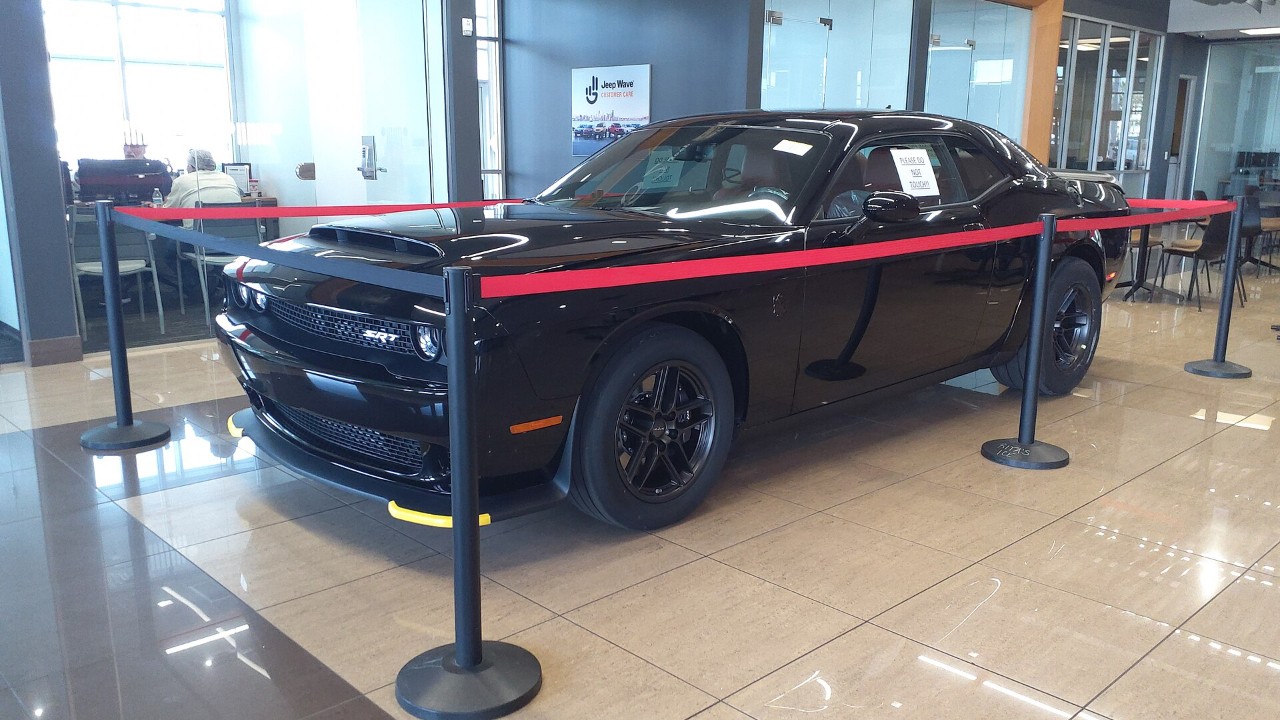
The last Challenger to leave Brampton was a Pitch Black Demon 170 with yellow accents. It rolled off the line on December 22, 2023, and the plant has built no cars since. If the sale closes as planned, Brampton Assembly Plant will pass to Roshel by the end of 2026.
More from Fast Lane Only