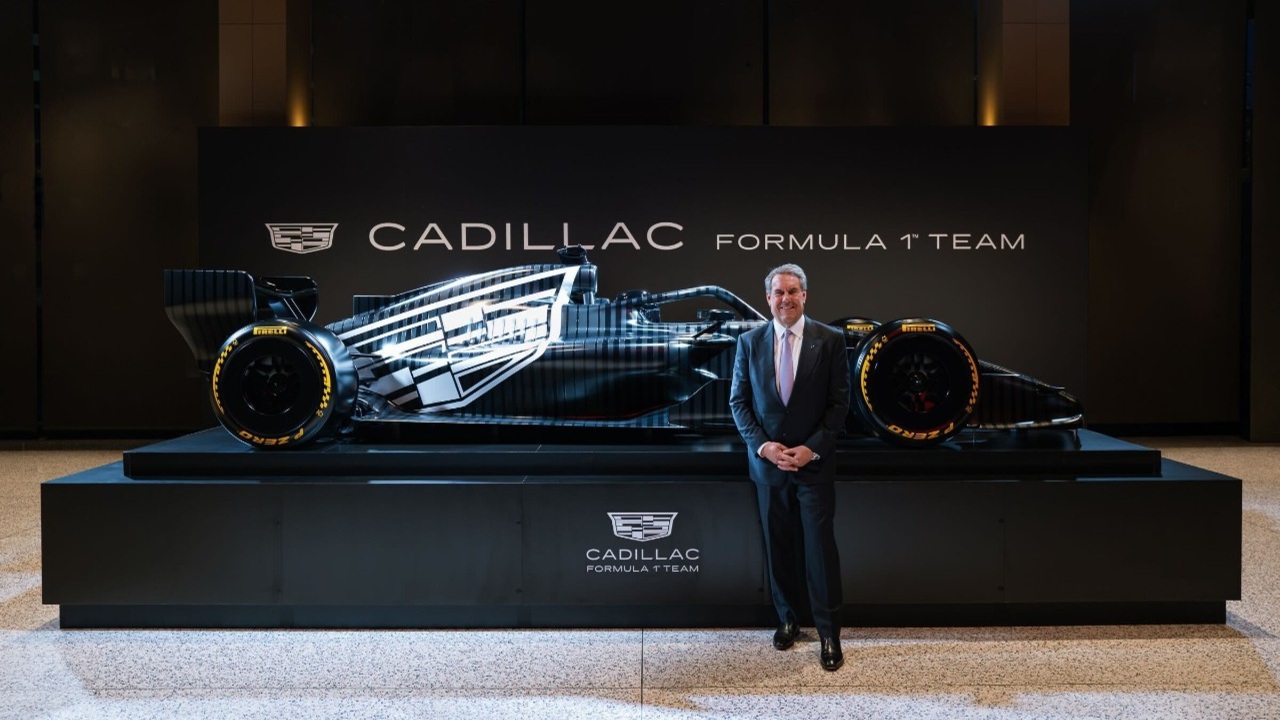
Cadillac has chosen to arrive in Formula 1 not with a splash of color, but with a sheet of black. For its first appearance at the Barcelona Shakedown, the Cadillac Formula 1 Team has revealed a monochrome livery that turns the car into a rolling statement of intent, pairing a stealth aesthetic with a carefully curated nod to the brand’s past. The design is more than a test-week disguise, it is Cadillac’s first visual manifesto in a championship that is about to undergo sweeping technical change.
By going back in black for its debut, Cadillac is using the Barcelona Shakedown as a stage to define how it wants to be seen in the paddock: premium, modern, and unapologetically American. The livery’s details, from the camouflaged surfaces to the names etched into the bodywork, signal that this is not a tentative toe in the water but a fully formed identity arriving on day one.
Monochrome as a mission statement
I see Cadillac’s decision to launch its first Formula 1 livery in a monochrome palette as a deliberate break from the technicolor noise that usually surrounds new cars. The team has opted for a black base with a camouflaged pattern, a look that fits neatly with the stripped-back designs many teams favor for early running, yet it also reads as a premium, almost couture interpretation of the classic test livery. According to Cadillac, the concept links directly to a modern take on the iconic Cadillac crest, translating the brand’s familiar geometry into a subtle, tonal surface treatment rather than overt color blocking.
That choice matters because it tells me Cadillac is not trying to shout its way into Formula 1, it is trying to look like it belongs there from the first lap. The monochrome approach creates a striking and high-end appearance that aligns with the company’s broader design language in its road cars, while the camo effect serves the practical purpose of disguising the bodywork’s shape during the Barcelona Shakedown. In a field where early test images are scrutinized frame by frame, a black, pattern-heavy livery gives Cadillac a measure of secrecy without sacrificing brand recognition.
Honoring founding members on the bodywork
Beneath the black surface, Cadillac has embedded a more personal story into its first Formula 1 car by incorporating the names of the founding members of the project into the livery. I find that decision revealing, because it frames the Barcelona Shakedown not just as a technical milestone but as a moment of recognition for the people who pushed the program from concept to reality. The names are integrated into the design rather than splashed across it, which keeps the overall look cohesive while rewarding closer inspection with a layer of human detail.
This gesture also positions the team as a collective effort rather than a faceless corporate exercise. By inscribing those founding members into the car’s visual identity, Cadillac is effectively saying that its Formula 1 entry is built on specific individuals and their work, not only on a brand logo. In a sport where new entrants are often judged on how quickly they can become “proper” racing outfits, that subtle roll call on the bodywork helps establish a sense of continuity and culture from the outset of the Barcelona Shakedown.
Using camo to manage expectations and data
From a competitive standpoint, I read the black camo livery as a classic Formula 1 tactic executed with Cadillac’s own stylistic twist. Early running is as much about hiding as it is about testing, and the team has embraced a pattern that makes it harder to pick out the precise contours of the car in photographs and video. The dark, patterned finish breaks up reflections and panel lines, which complicates the task for rival engineers trying to reverse engineer aerodynamic concepts from long-lens shots taken around Barcelona.
At the same time, the livery helps manage public expectations. A monochrome, camouflaged car signals that this is a shakedown configuration, not the final polished product that will race throughout the season. By leaning into that language of disguise, Cadillac buys itself room to evolve the design and the underlying package before the first Grand Prix, while still presenting a car that looks intentional and cohesive. The black finish, far from being a placeholder, becomes a controlled first impression that keeps the focus on the fact of Cadillac’s arrival rather than on any single design detail.
Connecting Cadillac’s heritage to Formula 1’s future
What strikes me most about this first livery is how it tries to bridge Cadillac’s long-standing luxury image with the forward-looking, regulation-shifting era Formula 1 is entering. The team has described the monochrome concept as a modern interpretation of the Cadillac crest, and that is a telling phrase. Instead of simply pasting a road-car badge onto a race car, the designers have abstracted the brand’s visual DNA into a pattern that feels at home in a high-tech environment like the Barcelona Shakedown, where new rules and new machinery are converging.
That approach suggests Cadillac understands that Formula 1 is not just another marketing platform, it is a design and engineering laboratory watched by a global audience. By aligning the livery with the brand’s premium positioning while acknowledging the sport’s appetite for innovation, the team is trying to signal that its entry is part of a broader strategy, not a one-off experiment. The black, crest-inspired camo becomes a visual shorthand for Cadillac’s ambition to be seen as both a heritage name and a credible player in the next phase of Formula 1’s evolution.
Setting expectations for the season ahead
As a first public statement, the Barcelona Shakedown livery sets a clear tone for how Cadillac intends to operate in the paddock. The car looks serious, almost understated, which in my view is a conscious counterpoint to the hype that often surrounds new entrants. By choosing a restrained, monochrome design that still carries intricate detail, the team is effectively promising substance over spectacle, inviting judgment on performance and execution rather than on a loud paint job.
That does not mean the livery is purely temporary or disposable. Cadillac has indicated that the monochrome concept is tied to the identity of the Formula 1 program, even as the car that will compete throughout the season evolves. I expect elements of this black, crest-derived aesthetic to persist in some form, whether in the base color, the patterning, or the way the brand’s iconography is integrated into the bodywork. For now, though, the Barcelona Shakedown car serves its purpose: it introduces Cadillac to Formula 1 with a look that is both strategically opaque and unmistakably on brand, a back-in-black debut that leaves room for the story to build from here.
More from Fast Lane Only