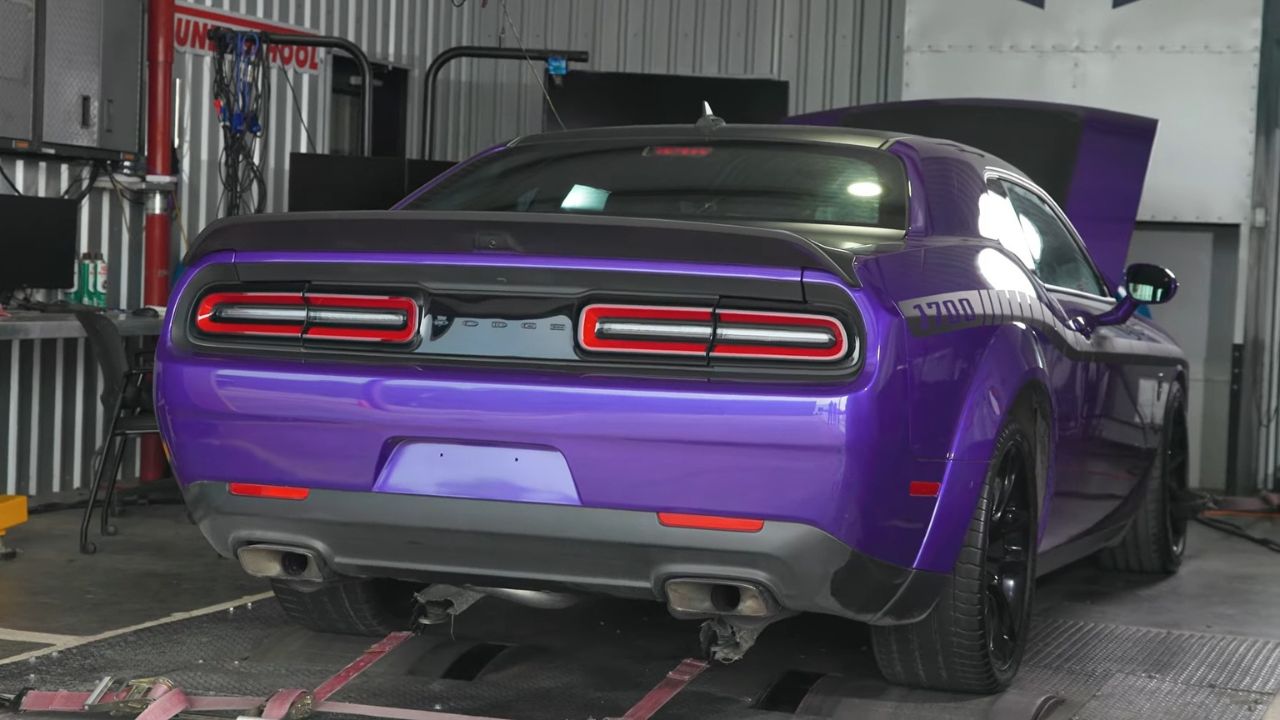
The Dodge Challenger SRT Demon arrived from the factory as a drag-strip special, but Hennessey’s latest build pushes it into territory usually reserved for seven-figure exotics. By chasing four-figure torque numbers and pairing them with a streetable package, the Texas tuner has turned an already outrageous muscle car into something that behaves more like a hypercar in a straight line.
This transformation is about more than a dyno sheet. It illustrates how far modern American performance has come, and how tuners are now matching or beating the output of halo machines from Europe while starting with cars that once rolled off mainstream dealer lots.
What happened
Hennessey Performance has taken the supercharged 6.2‑liter HEMI V8 in the Dodge Challenger SRT Demon and reworked it with the same philosophy it applies to its most extreme builds. The company already has form with four‑figure projects, including a 1,000 horsepower upgrade for the C7 Corvette ZR1 that it promotes as offering hypercar performance from a relatively attainable starting point. The Demon program follows that template but with even more emphasis on low‑rpm thrust.
The stock Demon is already far from ordinary. Its factory supercharged V8 is rated at 840 horsepower on 100‑octane fuel and 770 pound‑feet of torque, figures that let it rip quarter‑mile passes in the 9‑second range on drag radials. Hennessey’s package replaces key components in the induction and fueling systems, recalibrates the engine management, and revises the exhaust so the blower can move more air and the engine can safely burn more fuel. The result is a Demon that surges past the four‑figure mark not just in horsepower but, more significantly, in torque.
On the dyno, the tuned Demon produces torque figures that rival or exceed what some modern hypercars deliver at the crank. While the exact number varies with fuel and tune, the package is aimed squarely at four digits. That translates to more than 1,000 pound‑feet available in a broad plateau, delivered through the car’s eight‑speed automatic and drag‑optimized rear axle. For a rear‑drive coupe that still carries full interior trim and road‑legal equipment, that output sits in rare company.
Hennessey also addresses the rest of the drivetrain so it can survive repeated hard launches. The Demon’s transmission calibration is updated to manage the flood of torque without constant slip, and the differential and half‑shafts are inspected or upgraded to handle the load. Drawing on long experience with high‑power rear‑drive cars, the company shapes the way this Demon puts its numbers to the pavement.
Cosmetically, the build keeps the car recognizable as a Demon, with only subtle badging and optional wheels or tires hinting at what is happening under the hood. That restraint is deliberate. The goal is a car that still looks like a factory Dodge at a glance, then delivers a shock when the driver rolls into the throttle.
Why it matters
Hennessey’s Demon project matters because it shows how far the performance envelope has shifted for street‑legal American cars. A decade ago, four‑figure torque was confined to low‑volume hypercars with bespoke powertrains. Now a tuner can start with a mass‑produced coupe sold through conventional dealerships and, with a catalog of parts and calibration work, reach similar output while retaining air conditioning, infotainment, and a factory‑style interior.
The shift is not just about bragging rights. Hypercar‑level torque changes how a car drives at any speed. With more than 1,000 pound‑feet on tap, the Demon can generate towering acceleration from low rpm, so highway passes require only a small squeeze of the pedal. On a prepped drag strip, that torque translates into violent launches that compress the driver into the seat and threaten to overwhelm even sticky rear tires. The experience is less about top speed and more about the immediacy of the thrust.
There is also a cultural angle. The Demon arrived near the end of the Challenger’s production run, at a moment when many manufacturers are pivoting toward electrification and downsized engines. By taking that last‑of‑the‑line muscle car and elevating its combustion engine to hypercar‑like output, Hennessey is effectively building a monument to the supercharged V8. For enthusiasts who grew up around big‑displacement American engines, this car represents a high‑water mark before emissions rules and corporate strategies push the market in a different direction.
At the same time, the build raises questions about how much power is usable on public roads. Four‑figure torque can easily overwhelm traction on street surfaces, and even with modern stability control, the margin for error shrinks as output climbs. Hennessey positions its Demon package as a dual‑purpose car that can run at the drag strip and still cruise on the highway, but exploiting its full performance safely will require track time and driver discipline.
From an economic standpoint, projects like this also highlight the value proposition of tuned American performance cars. Starting with a Dodge Challenger SRT Demon, which already carried a premium price when new, and adding a high‑end Hennessey package is not cheap. Even so, the total outlay still undercuts the cost of many European exotics that offer similar straight‑line performance. For buyers who prioritize acceleration and torque over badge prestige or mid‑engine handling, that tradeoff is compelling.
Hennessey’s work on the Demon also fits into a broader pattern in the tuning world. The company has applied similar four‑figure strategies to trucks, SUVs, and sports cars, creating a portfolio of vehicles that blur the line between tuner special and low‑volume manufacturer. Each project reinforces the idea that hypercar‑grade numbers are no longer limited to factory‑built halo models. Instead, they are becoming a benchmark that specialist builders can hit across multiple segments.
What to watch next
The next phase for this Demon build will play out on drag strips and test tracks, where real‑world performance can be measured against the dyno sheet. Quarter‑mile times, trap speeds, and 60‑foot launches will show how effectively the car converts its torque into motion. Given the stock Demon’s ability to run in the 9‑second range, a well‑driven Hennessey version on proper tires should push deeper into that territory, provided traction and safety equipment keep pace with the power.
Regulation and enforcement will also shape how long cars like this remain viable. As emissions rules tighten and noise limits become more stringent, tuners may face more hurdles in certifying extreme builds for street use. The Demon’s supercharged V8 already operates near the edge of what regulators will accept, and further modifications must thread a narrow path between performance and compliance. Future packages may lean more on flex‑fuel capability or alternative fuels to keep output high while staying within legal limits.
Another factor to watch is how electric performance cars influence the appeal of high‑horsepower internal‑combustion builds. Battery‑electric models such as the Tesla Model S Plaid and Rimac Nevera already deliver staggering torque figures with instant response. Hennessey’s Demon counters with visceral sound, mechanical engagement, and a more traditional drag‑racing feel. Enthusiasts and buyers will decide whether the emotional experience of a roaring V8 is enough to keep demand strong as electric acceleration becomes more common.
The used market will provide a separate signal. As factory Demons age and change hands, the availability of Hennessey‑modified examples will test how collectors value tuner involvement compared with original condition. Some buyers may prize a fully documented Hennessey build as the ultimate expression of the platform, while others will chase low‑mileage, untouched cars. The price gap between those two camps will say a lot about how the hobby views extreme tuning in the long term.
Finally, attention will turn to what Hennessey and other builders do with the next generation of American performance cars. With the Challenger and Charger lines transitioning away from pure V8 power toward different architectures, tuners will need to adapt their recipes. If they can extract similar four‑figure torque numbers from downsized or hybridized engines, the spirit of this Demon will live on in new forms. If not, this build may stand as one of the last and wildest expressions of the classic supercharged muscle car formula.
More From Fast Lane Only: