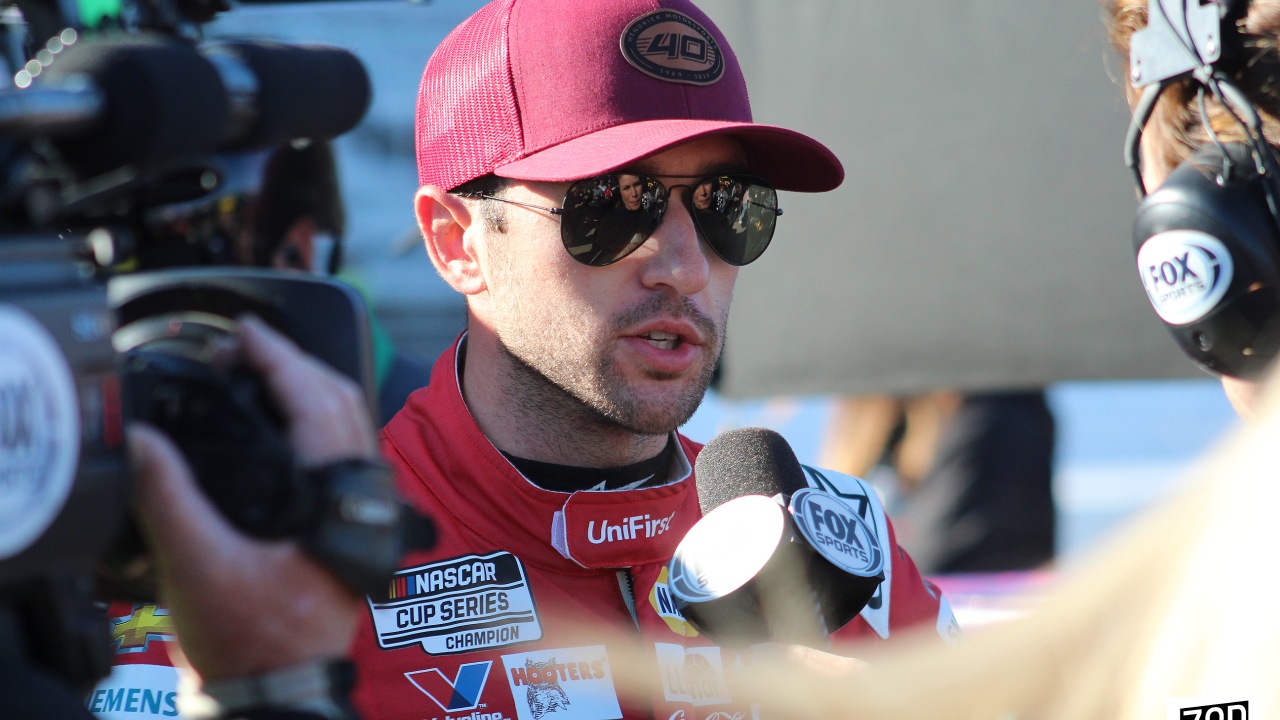
The return of NASCAR’s traditional Chase format has turned the competitive landscape on its head, and few drivers are studying the implications more closely than Chase Elliott. As the series abandons its one-race finale in favor of a 10-race championship run, Elliott is weighing how his trademark consistency, his Hendrick Motorsports backing, and his own reservations about the system shape his path back to the Cup title.
In a garage already recalibrating around the new rules, Elliott has been unusually candid about both the advantages he sees and the flaws he cannot ignore. His self-assessment, set against the broader reset of NASCAR’s postseason, offers a revealing window into how one of the sport’s most methodical racers is sizing up his odds.
The Chase returns and reshapes the title fight
I start with the format itself, because Elliott’s confidence or concern only makes sense once the new rules are clear. NASCAR has scrapped the multi-round elimination system and restored a single 10-race Chase, with a one-time points reset that locks in 16 drivers and then lets them race straight through to the finale. That reset, applied at the start of the Chase, creates a compressed field in which regular-season performance still matters but no longer funnels into a winner-take-all championship event at one track.
In the 2026 NASCAR Cup Series, there will be one points reset to seed those 16 drivers, and from that moment the title will be decided over the full 10-race stretch rather than through staggered cuts. NASCAR is effectively reverting to the structure it first implemented when it launched The Chase, abandoning the one-race championship that President Steve O’Donnell had already signaled was nearing its end. The move follows a nearly two-year internal study into playoff options and restores a format that once helped define the modern era of the Cup Series.
Why Elliott believes the new system fits his strengths
With that framework in place, I see why Elliott has been quick to frame the change as a personal opportunity. His reputation has been built less on streaky dominance and more on steady, repeatable performance across a variety of tracks, the exact profile that tends to be rewarded over a 10-race run. Elliott has said plainly that he likes his odds more under this structure, pointing to his ability to string together solid finishes rather than relying on a single perfect afternoon.
That view is echoed in the way observers describe his record, noting his knack for consistency and his habit of keeping himself in contention deep into seasons even when he is not piling up wins. Elliott has indicated that the new Chase format improves his chances of winning another Cup Series championship with Hendrick Motorsports, especially in a year when he expects to be competitive but not necessarily dominant every week. When he says, “I like my odds now, for sure,” he is not boasting about raw speed, he is betting on his capacity to avoid disastrous weekends over a long playoff stretch.
The “nice compromise” and the problem Elliott still sees
Even as he leans into the upside, Elliott has not treated the format change as an unqualified victory. He has described NASCAR’s new championship structure as a “really nice compromise,” a phrase that captures both his approval and his awareness that no system will satisfy every driver or fan. The compromise, in his view, lies in balancing the drama that executives want with a more statistically grounded way to crown a champion, one that does not hinge entirely on a single race.
Yet Elliott has also been clear that he has a notable problem with the new playoff design. He has voiced concern that the structure can still undervalue a season-long body of work, particularly if a driver dominates the regular season and early Chase races but suffers a mechanical failure or gets swept into a late crash. That tension between spectacle and merit is not new in NASCAR, but Elliott’s willingness to call it out, even as a former champion who stands to benefit, underscores how seriously he takes the idea that the Cup Ser title should reflect the best overall campaign rather than the best-timed hot streak.
How Hendrick’s depth and the betting markets frame his chances
When I look beyond Elliott’s own words, the competitive context around him reinforces why he feels cautiously optimistic. Fellow Hendrick Motorsports drivers, including Kyle Larson, are also expected to thrive in a format that rewards sustained excellence, and there is a sense that the organization’s depth could be a decisive asset over 10 playoff races. Reports on whether the new Chase could help Hendrick note that Elliott’s consistency, combined with the team’s engineering strength, positions him as one of the drivers most likely to capitalize on the change.
The betting markets, which tend to blend recent performance with structural shifts like this one, offer another lens. Early 2026 NASCAR Cup Series championship odds list names such as Kyle Larson and Denny Hamlin near the top, with Larson highlighted as a leading Driver in projections and Hamlin frequently cited as a favorite in Cup Series Championship discussions. Elliott has appeared in similar odds tables as part of the top tier, often grouped with Larson and other proven contenders, a sign that bookmakers see him as a realistic threat rather than a long shot. Those markets had Hamlin at a “400” favorite line for a previous title shot, and while Elliott has not always matched that level of pre-season favoritism, the new format’s emphasis on consistency narrows the gap between outright speed merchants and methodical point collectors like him.
From one-race chaos to a 10-race grind
For drivers, the psychological shift from a one-race finale to a 10-race Chase is as significant as the mathematical one, and Elliott’s comments reflect that reality. Under the old system, a year’s worth of work could be undone by a single mistake at Phoenix, a late caution, or a pit road miscue, a dynamic that left even elite drivers like Denny Hamlin chasing an elusive first Cup Series crown despite repeated trips to the Championship 4. The restored Chase format still carries risk, but it spreads that risk across a longer window, which tends to favor drivers who avoid self-inflicted wounds and manage their seasons with a long view.
Elliott has already lived both sides of that equation, winning the 2020 Cup title in a winner-take-all setting while also enduring seasons where one bad break in the finale erased months of solid work. His reaction to the new format suggests he would rather test himself in a 10-race grind than roll the dice on a single afternoon, even if that means accepting that the Chase can still produce surprises. In that sense, his self-assessed “good odds” are less a prediction of dominance and more an acknowledgment that, in a system designed to reward balance and resilience, his particular skill set and the resources of Hendrick Motorsports give him a credible path back to the top of the Cup Series.
More from Fast Lane Only