The 1967 Chevrolet Camaro did not arrive as a leisurely styling exercise. It was a crash program, born of corporate anxiety and bruised pride, built because General Motors could no longer ignore a single rival. That rival was the Ford Mustang, and the rush to answer it shaped everything from the Camaro’s hidden code name to the way it drove on the street.
The Mustang that forced GM’s hand
In the early 1960s, Ford did something General Motors had not quite anticipated. The Ford Mustang created a new kind of affordable sporty car that young buyers could actually own, and it sold at a pace that stunned the industry. After the Mustang, described in one period account as having sold over 100,000 units in just four months, executives inside General Motors had hard evidence that this was no fad.
General Motors leadership responded in August 1964 by giving the green light to a dedicated Mustang fighter. Internal planning documents framed the new program as a direct answer to the Ford Mustang, not as a vague sporty coupe. The goal was to match or exceed the Ford in every dimension that mattered to buyers. The new car would be longer, lower and wider, with more room inside and a broader range of performance options. It would also need to hit showrooms quickly, before Ford could entrench its lead with fresh variants and more aggressive marketing.
Within Chevrolet, that mandate translated into a high-pressure development sprint. Engineers and product planners were told to create a car that could be sold in huge numbers at a modest base price, yet still carry the kind of performance hardware that would satisfy enthusiasts. The Mustang had shown that style and image could move metal, but General Motors wanted its answer to feel more sophisticated in ride and handling, not just louder or flashier.
From XP 836 and Panther to Camaro
The program that eventually produced the Camaro began life inside Chevrolet as a coded project rather than a public nameplate. Corporate documents identified the early concept as XP 836, a designation that reflected internal engineering practice rather than any marketing plan. One later account of the project noted that Chevrolet’s own version of a muscle car was first titled XP 836, then given the more theatrical code name Panther.
The Panther label hinted at how aggressively Chevrolet wanted to stalk the Ford Mustang. Designers sketched low rooflines and long hoods that projected speed even at a standstill. The internal nickname also helped keep the project semi-secret while the company refined the final product and the marketing team sifted through a long list of possible public names. At one stage, Chevrolet reportedly considered roughly 2,000 potential names before settling on one that felt both new and in line with the brand’s existing image.
When the final decision came, the new car was christened Camaro. Official explanations at the time played with the idea that Camaro suggested camaraderie and friendship, but insiders understood that the name was chosen primarily because it sounded distinct in advertising copy and could be registered globally. Whatever the etymology, the label quickly became attached to a very specific mission: beat the Ford Mustang at its own game.
The first production version of the Chevrolet Camaro arrived in the fall of 1966 as a 1967 model. According to technical summaries, the first generation Camaro was classified as an American pony car and stayed in production through the 1969 model year. It rode on a new rear-wheel-drive platform with a unibody structure and a separate front subframe, a configuration that helped keep weight under control while providing a solid base for performance tuning.
Rushed to market, engineered to compete
Speed to market shaped the engineering decisions behind the 1967 Camaro. Chevrolet could not afford a clean-sheet design that would take many years to reach showrooms, so the team leaned heavily on existing General Motors components. Suspension layouts borrowed from other midsize and compact models, and many drivetrain pieces were already familiar to dealers and mechanics. This parts-bin strategy allowed the company to compress development time while still offering a wide range of engines and options.
From the outset, the Camaro was designed to cover a broad spectrum of buyers. Entry-level cars came with inline six-cylinder engines that kept the base price low and fuel bills manageable, while higher trims offered V8 power for drivers who wanted more performance. The catalog eventually included small-block and big-block V8s, four-speed manual transmissions, floor shifters and heavy-duty suspension packages. This flexibility reflected a clear lesson from the Ford Mustang: the same basic car could be sold as a thrifty commuter or a weekend drag-strip regular.
Historical analysis of the program notes that Chevrolet’s marketing division, sometimes described as the See the USA group, had committed to building a Mustang competitor as early as August 1964. By the time the first cars reached dealers, the company had already lined up a full suite of advertising campaigns and racing efforts to reinforce the Camaro’s performance image. A detailed retrospective on the first generation Camaro describes how Chevrolet historian Michael Lamm traced this commitment to that mid-1964 decision, which locked in the schedule and forced the rapid development cycle.
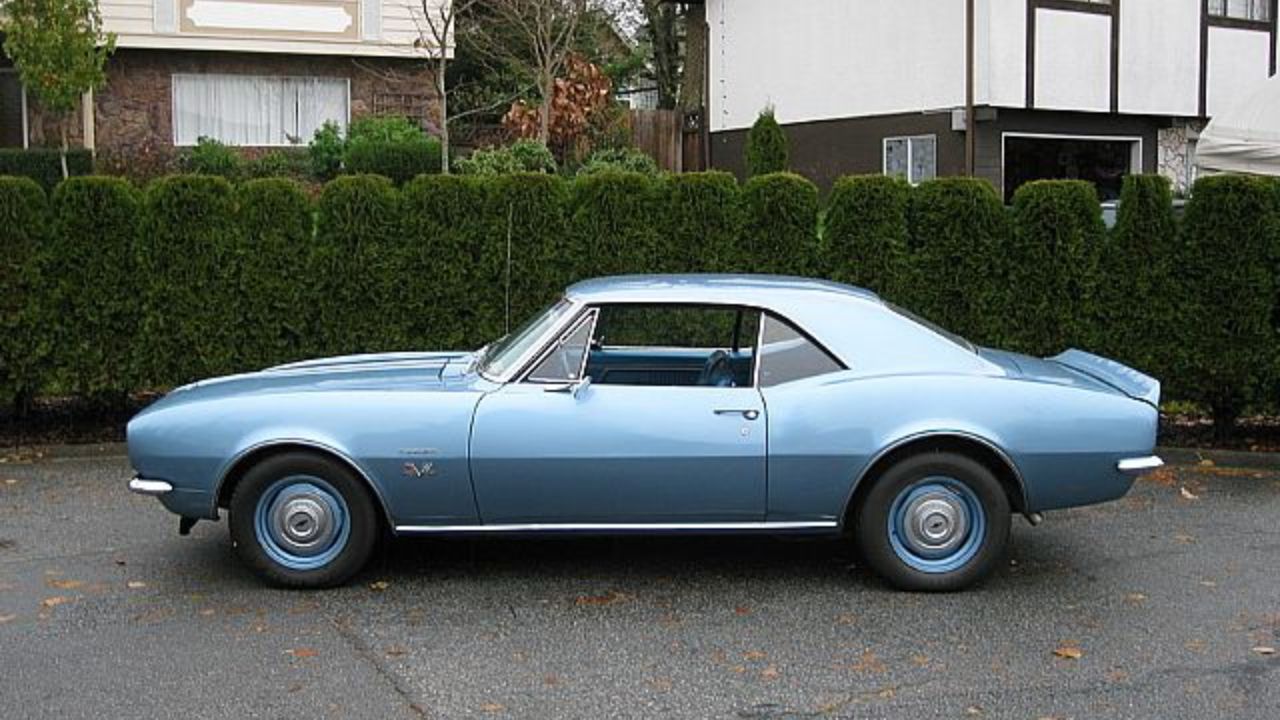
Despite the time pressure, the design team managed to give the Camaro a distinctive look. The long-hood, short-deck proportions echoed the Ford Mustang, but the Camaro’s body sides were more sculpted, and the roofline flowed into the rear fenders with a slightly more aggressive stance. The front fascia offered hidden headlamp options on some models, and the rear quarter windows and C-pillar treatment gave the coupe a unique profile in traffic.
The 1967 launch: Chevy steps into the pony car fight
By the time the first 1967 Chevrolet Camaro models reached showrooms, the car’s mission was clear. It was Chevrolet’s answer to the Ford Mustang, and it signaled General Motors’ full entry into what enthusiasts were already calling the pony car class. A widely shared description of the 1967 Chevrolet Camaro notes that the car marked the debut of one of the greatest muscle car rivalries in American automotive history, a rivalry that would carry through generations of Camaros.
The launch lineup reflected Chevrolet’s intent to match or surpass the Mustang in variety. Buyers could choose from coupe and convertible body styles, multiple trim levels and a long list of appearance and performance packages. The RS package added hidden headlights and special exterior trim, while the SS package delivered more aggressive suspension tuning and more powerful V8 engines. For buyers who wanted the most track-focused variant, the Z 28 package combined a high-winding small-block V8 with heavy-duty brakes and suspension components that were designed with road racing in mind.
Contemporary accounts emphasize that Chevrolet marketed the Camaro as a car that could be tailored to individual tastes. A detailed overview of the first generation Camaro describes how buyers in the United States could specify everything from basic six-cylinder commuters to high-specification V8 coupes with upgraded brakes, suspension and interior trim. This flexibility was a direct response to the way Ford had sliced the Mustang lineup into many distinct versions for different customers.
Chevrolet also leaned into motorsport to validate the Camaro’s performance image. The Z 28 package was developed in part to homologate the car for Trans Am racing, where it would face the Ford Mustang on road courses across North America. The racing program helped refine the car’s suspension tuning and brake performance, and the resulting improvements filtered back into showroom models. For buyers, this meant that the Camaro was not just styled like a race car but could actually hold its own on a track.
Design details and the SS halo
Within the 1967 lineup, the Chevrolet Camaro SS quickly emerged as a halo model. The SS badge signaled more than cosmetic upgrades. It brought larger-displacement V8 engines, stiffer springs, upgraded shocks and often front disc brakes, all intended to deliver stronger acceleration and better control at higher speeds. Enthusiast groups describe the 1967 Chevrolet Camaro SS as an iconic American muscle car that represents the spirit of late 1960s performance culture.
Styling cues reinforced that message. SS models typically wore bolder striping, unique badging and sometimes a distinctive hood with simulated or functional air inlets. Inside, buyers could order bucket seats, console-mounted gauges and sport steering wheels that made the cabin feel more like a cockpit than a family sedan. The combination of visual drama and real mechanical upgrades helped the SS stand apart from base models and gave Chevrolet a strong answer to Ford’s higher-performance Mustang variants.
The broader Camaro design language also contributed to its identity. The car’s front fenders featured subtle flares that suggested muscle without resorting to exaggerated bulges. The rear end treatment used simple, horizontal tail lamps that contrasted with some of the more ornate designs of the era. This relative restraint helped the Camaro age gracefully and made it an attractive canvas for later modifications.
Technical references on the first generation Chevrolet detail how the car’s dimensions and structure supported this balance of style and function. The relatively low overall height, the long wheelbase for a compact coupe and the use of a separate front subframe all contributed to a stance that looked planted while still delivering acceptable ride comfort. These choices were not purely aesthetic. They reflected Chevrolet’s desire to deliver a car that felt more refined than some of its rivals, even as it chased the same youthful audience.
American muscle with a long shadow
The 1967 Chevrolet Camaro quickly became more than just a business response to the Ford Mustang. It helped define what many enthusiasts now consider classic American muscle, a blend of aggressive styling, accessible performance and everyday usability. Enthusiast communities describe the 1967 Chevrolet Camaro as a classic American muscle car that marked the beginning of the Camaro line, introduced as a direct competitor to the Ford Mustang and celebrated today as a vintage icon.
From a historical perspective, the car’s significance lies in how quickly it went from corporate reaction to cultural fixture. Within a few years, the Camaro name was as strongly associated with American performance as the Mustang itself. The rivalry between the two became a recurring theme in advertising, motorsport and enthusiast debate. Owners argued over quarter-mile times, handling balance and styling preferences, but both sides recognized that the competition had pushed each manufacturer to build better cars.
That competitive pressure also influenced the broader market. Other manufacturers, including Chrysler and American Motors, launched their own pony cars and muscle coupes in response to the success of the Mustang and Camaro. The late 1960s became a crowded field of V8-powered two-doors, each trying to carve out a niche with unique styling, performance packages or pricing strategies. In that environment, the Camaro’s blend of engineering pragmatism and bold image helped it stand out.
Technical retrospectives often highlight how the Camaro’s chassis and suspension tuning gave it an edge in handling compared with some rivals that focused more narrowly on straight-line speed. The combination of a relatively stiff structure, well-located rear axle and carefully tuned front suspension allowed the car to feel composed in corners, particularly when equipped with the higher-performance packages. This balance made the Camaro attractive not only to drag racers but also to drivers who wanted a car that could handle twisty roads and road course events.
From factory fresh to pro touring benchmark
Decades after the last first generation Camaro left the factory, the 1967 model continues to shape modern enthusiast culture. Restomod and pro touring builders often treat the original design as a starting point for contemporary performance upgrades. One detailed profile of a 1967 Chevy Camaro describes how the first generation car, particularly in its 1967 to 1969 form, has become a favorite platform for modern suspension, braking and engine modifications aimed at road course and braking competitions.
These builds often retain the original body lines and overall proportions while replacing or upgrading almost every mechanical component. Modern coil-over suspension systems, rack-and-pinion steering conversions and high-performance disc brakes transform the way the car drives, bringing it closer to contemporary sports car standards. Under the hood, builders frequently install fuel-injected V8 engines that deliver far more power and reliability than the original carbureted units, while still honoring the car’s muscle car heritage.
The popularity of such projects underscores how well the original design has aged. The 1967 Camaro’s relatively clean lines and straightforward structure make it easier to modify than some more ornate or complex contemporaries. The availability of reproduction parts and aftermarket support also reflects sustained demand. Enthusiasts can buy new body panels, interior components and performance parts that allow them to restore or reinvent these cars according to their own preferences.
At the same time, collectors continue to value well-preserved or correctly restored examples of the 1967 Camaro, particularly rare variants such as early Z 28s or SS models with specific engine and option combinations. Detailed fact sheets on the 1967 Camaro emphasize how the car entered the pony car race as the Mustang competitor and went on to spawn many varied and distinctive versions. That diversity gives today’s collectors and restorers a wide range of historically accurate configurations to pursue.
The legacy of a rushed response
Looking back, the story of the 1967 Chevrolet Camaro illustrates how competition can accelerate innovation. General Motors did not set out to create a new cultural icon in isolation. It reacted to a specific threat from the Ford Mustang and moved quickly to counter it. The compressed timeline forced Chevrolet to leverage existing components, streamline decision-making and focus sharply on what buyers wanted in a sporty, affordable car.
The internal evolution from XP 836 to Panther and finally to Camaro captures that urgency in shorthand. Each step represented a move from engineering concept to marketing reality, compressed into a few short years. By the time the first production cars rolled out, the Camaro carried the weight of corporate expectations and the hopes of dealers who wanted a strong entry in a booming segment.
Enthusiast recollections and historical summaries of the early Chevrolet Camaro often highlight personal experiences with 1967 and 1968 models. Owners remember the way the cars sounded, the feel of the manual shifters and the sense of freedom that came with owning a relatively affordable performance machine. Those memories help explain why the Camaro, like the Mustang, has remained a touchstone for generations of enthusiasts.
More from Fast Lane Only