Every Dnepr motorcycle traces its roots to a German design from the late 1930s, and the Kyiv factory kept building flat-twin sidecar machines on that idea for half a century. However, BMW dropped its own R71 in 1941. Meanwhile, in Kyiv, the family tree kept growing.
It is easy to dismiss these bikes as crude copies. Yet they served soldiers, farm workers and families on muddy Soviet back roads. KMZ built hundreds of thousands of them before production in Kyiv ended.
These are our picks, seven Dnepr and KMZ models that lasted longer and did more than anyone had a right to expect. The verdict is our opinion. However, the years, engine sizes and build numbers come from the specialist histories and period tests we checked.
1. 1950s KMZ M-72

The M-72 started the Kyiv story. It came from the BMW R71, a 750 cc side-valve twin that BMW designed to replace the R12. The R12’s pressed-steel frame struggled with sidecar loads, so the R71 used a tubular steel frame instead.
Still, BMW’s own R71 was not a hit. The company phased it out in 1941 after about three years. How the design reached Soviet engineers is still debated. Research cited by RideApart suggests the Soviets built it under a BMW license rather than copying it.
At first, production ran at other Soviet plants. Before the war, the motorcycle factories sat in Moscow, and they moved to Irbit and Kyiv during it, according to RideApart. Then, in 1949, the Kyiv Motorcycle Plant (KMZ) received the M-72 tooling from the Gorky works. Its first batch of M-72s used 500 engines supplied by the Irbit factory.
Our take: a design its creator abandoned after three seasons became the seed for decades of Kyiv production. After all, few motorcycles get a second life like that. RideApart counts the MT-11 that rolled out of the same factory in the 1980s among its descendants.
2. 1958–1976 Dnepr K-750

The K-750 was KMZ’s first big update. In 1958, it replaced the plunger-framed M-72N with a modern swingarm frame. The rear now used coil springs and hydraulic shock absorbers, and the sidecar got a swingarm of its own. For riders, that meant both the bike and the sidecar finally had proper swingarm suspension.
Meanwhile, the 750 cc side-valve engine was simple and slow. According to the model history at GAZ69.org, its output rose from 22 to 26 hp as the compression ratio went from 5.5 to 6.0. In addition, the civilian version had no reverse gear.
Yet that simplicity was the point, and GAZ69.org calls the K-750 a “fabulous machine.” KMZ built 292,781 K-750s of all versions over roughly 18 years. In 1964, it also launched the MV-750 military model, which added two-wheel drive to the sidecar wheel with a differential.
Our take: the K-750 had the numbers of a workhorse, not a showpiece. A run of nearly 300,000 for a side-valve twin with no reverse tells you buyers wanted toughness over speed.
3. 1971 Dnepr MT-9

The MT-9 moved Kyiv into the overhead-valve age for good. Its 650 cc OHV flat twin made 32 hp. It was also the first Dnepr with turn signals as standard, to meet new traffic rules.
However, the real headline was the gearbox. The MT-9 added a reverse gear and an automatic declutching mechanism in the foot pedal. For a heavy sidecar rig, backing out of a parking spot without a push was a big step forward.
Soon, riders outside the USSR got to know Dnepr bikes, too. From 1973 to 1979, an importer sold Dnepr bikes in Britain under the Cossack name. Today, the UK owners’ site Cossack Motorcycles calls the MT-9 “simply the best of the OHV Dneprs.” It praises the smooth motor and notes that the MT-9 did not have the crank-snapping problem of later models.
Even so, the bike had flaws. Its 6-volt dynamo and the K301 carburetor, which the same site calls “famously awful,” need patience. Despite that, KMZ built 189,463 MT-9s by 1976, according to GAZ69.org. Our take: that is a big number for a 32 hp sidecar machine.
4. Late-1970s Dnepr MT-10-36

The MT-10 line brought Kyiv into the 12-volt era. In fact, the MT-10 was the first Soviet motorcycle with 12-volt electrics. The MT-10-36 that followed in the late 1970s raised output to 36 hp.
Moreover, the update went beyond power. The 36 used a 150-watt alternator with an external regulator in place of the old dynamo. It also brought indicators, a new headlight, a one-piece saddle and a parking brake.
Underneath, KMZ kept what already worked. GAZ69.org describes the MT-10-36 as built on an “old reliable frame.” That frame and the familiar 650 cc flat twin meant that parts and know-how carried over from earlier bikes.
The one weak spot, however, was the carburetor. The MT-10-36 kept the K301 as standard. On the other hand, in our view the 12-volt charging was a far bigger gain than the carburetor was a loss.
Our take: the MT-10-36 was the bridge between the old Dnepr and the modern one. It kept the MT-9’s reverse gearbox and gave the bike the electrics it needed. GAZ69.org lists its run as 1976 to 1984, a long life for a stopgap update.
5. 1978 Dnepr MT-12

The MT-12 was KMZ’s off-road answer for rural buyers. The factory unveiled it in late 1977 as the first Dnepr with a driven sidecar wheel for civilians. It kept the 750 cc side-valve engine from the K-750, rated at 26 hp, because that engine pulled well at low revs.
A reduction gear split the drive. GAZ69.org says it sent 36% of the torque to the sidecar wheel and 64% to the rear. It also kept 6-volt electrics, a sign of its simple farm-road purpose.
In the summer of 1980, the Soviet magazine Za Rulem tested one for about six months. As Techinsider recounts, the tester rode it from Kyiv to Moscow. Later, on farm roads, it pulled other vehicles out of mud and climbed loose sand.
The test also found problems. The speedometer failed at 500 km, and many fasteners worked loose. Overall, fuel use came to about 10 liters per 100 km, against a rated 9. Even so, KMZ built about 200,000 MT-12s. Our take: as the last side-valve Dnepr, it carried the M-72’s old engine layout into a new job on the farm.
6. 1980s Dnepr MT-11
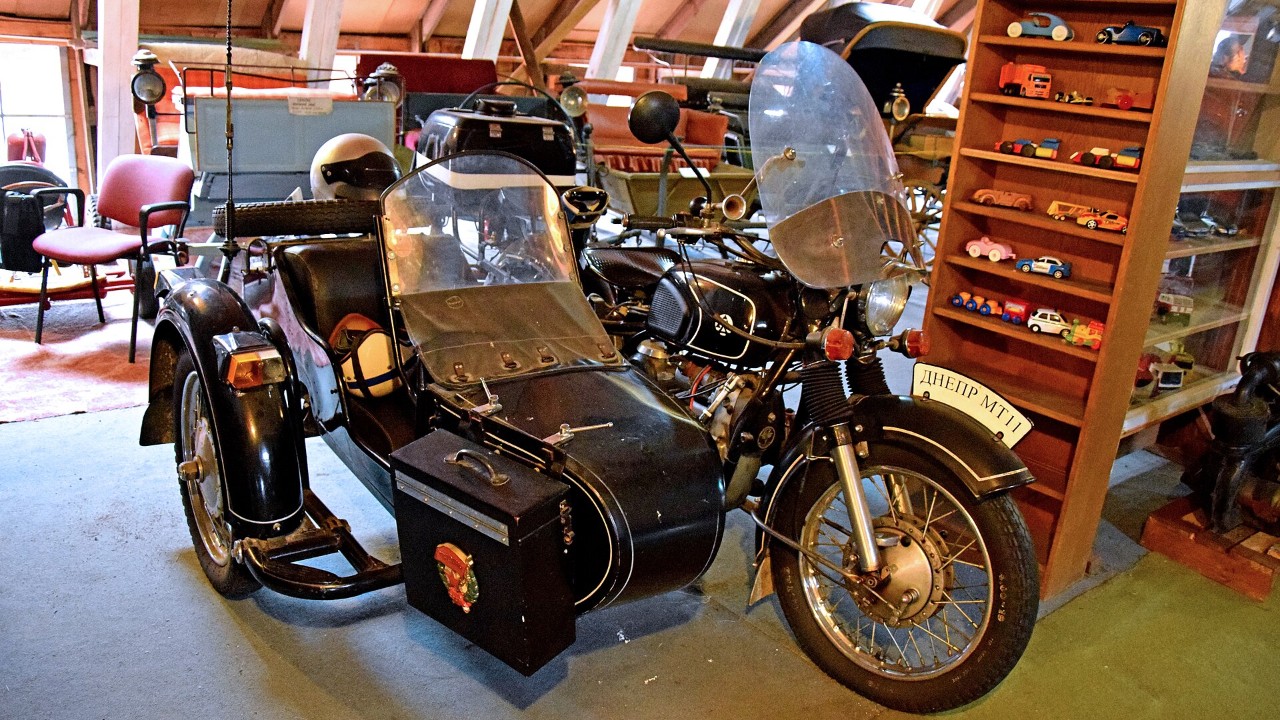
The MT-11 is the Dnepr most people picture today. Production began in the mid-1980s, and it became the most common model in the line. GAZ69.org puts output at 708,792.
RideApart notes that its output started at 32 hp and rose over the production run. Top speed was about 105 km/h, or just over 65 mph. In addition, it used a four-speed gearbox with reverse and drove only the rear wheel. The MT-11 also added a twin-leading-shoe front brake and a paper air filter.
Even so, it was not flawless. Cossack Motorcycles notes that the MT-11 has a reputation for snapping cranks. A Russian buyers’ guide from Bibimot says the engines last roughly 20,000 to 50,000 km with proper care, and they dislike running low on oil.
The design itself, however, kept working for decades. RideApart reports that the MT-11 saw use during the 2022 war in Ukraine. Our take: a civilian design from the 1980s doing that kind of work is what outliving expectations looks like. If you want to compare it with other long-lived machines, see our list of motorcycles that outlived expectations.
7. 1986 Dnepr MT-16

The MT-16 arrived in 1986 to replace the MT-12. It took the MT-11’s basic concept and added two-wheel drive. As a result, rural riders got the driven sidecar wheel without the old side-valve engine, and Bibimot notes that the MT-16 used the MT-11’s engine.
In particular, the gearbox was clever. On sidecar versions, reverse drove both the rear wheel and the sidecar wheel. GAZ69.org also notes that one later engine version raised compression from 7.0:1 to 8.5:1. By comparison, a solo version had its reverse blocked at the factory.
In our view, the MT-16 marks the peak of the Kyiv sidecar idea. It combined the overhead-valve engine with all-terrain drive, decades after the M-72 first rolled out. It also shared its flat-twin layout with BMW’s modern boxers, a lineage you can see in our look at the BMW R1250GS.
Production in Kyiv has since ended. Yet the name survives. As of 2022, Ukrainian e-bike maker Delfast owned the Dnepr intellectual property, and it plans to use the Ukrainian spelling “Dnipro” for the brand, according to RideApart.
More from Fast Lane Only