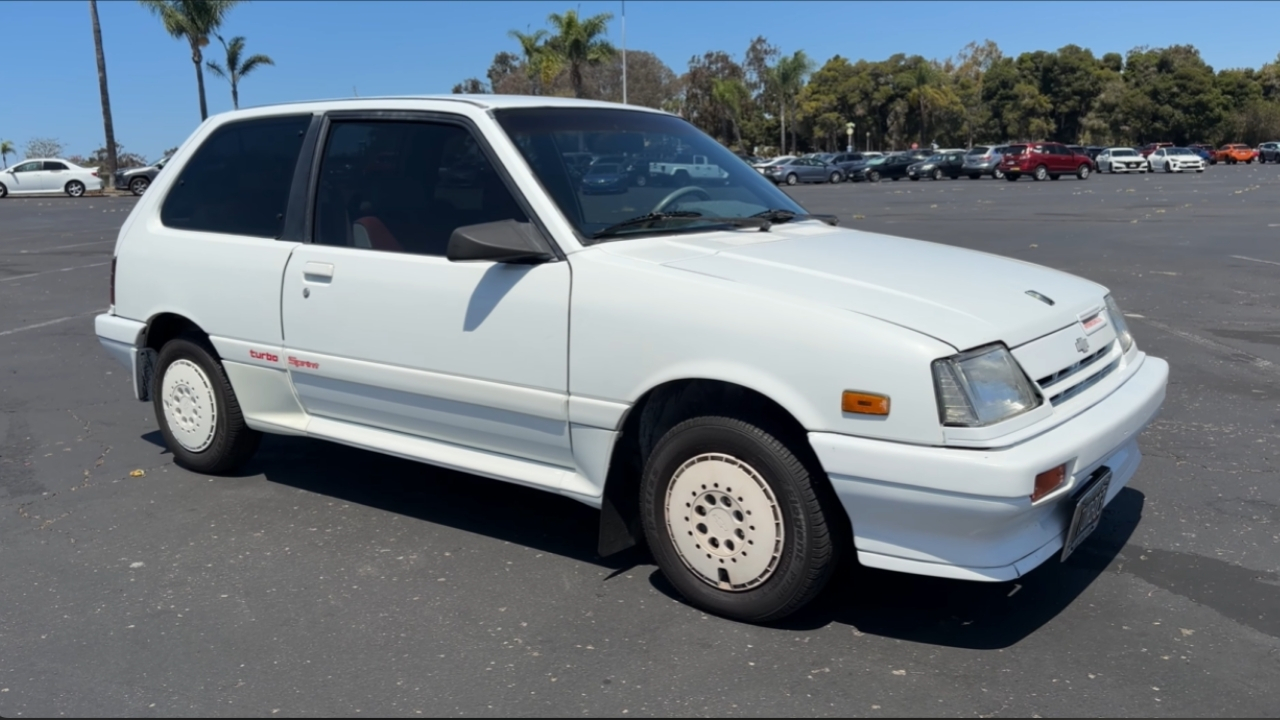
Some cars earn obscurity through rarity or a short production run. Others earn it by being forgettable from the day they launched, and then somehow becoming even less remembered decades later. The 1988 Chevy Sprint Turbo lands firmly in the second category, and Doug DeMuro recently spent twenty minutes explaining exactly why that’s part of its charm.
The Sprint Turbo wasn’t just a niche trim level. It was the performance version of a car most people have never heard of in the first place, built during an era when Detroit automakers were scrambling to answer the fuel crisis with smaller, more efficient options. Few of those answers turned out as strange, or as thoroughly forgotten, as this one.
What makes the Sprint Turbo worth revisiting isn’t raw performance. It’s the sheer number of small, slightly absurd decisions packed into a car nobody was expecting much from in the first place.
A Chevy That Started Life as a Suzuki
The Sprint’s origin story has almost nothing to do with Chevrolet engineering. After the 1970s fuel crisis pushed American buyers toward smaller, more efficient cars, General Motors found itself without much to offer in that segment. Rather than build something from scratch, GM bought a stake in Suzuki, which already had a compact, fuel-efficient car in production. That car was sold in Japan as the Suzuki Cultus, and rebadged for the American market as the Chevy Sprint starting in 1985.
The Sprint Turbo arrived two years later in 1987 as the sportier version of that formula. The base Sprint used a 1.0-liter three-cylinder engine producing just under 50 horsepower. The Turbo added forced induction to that same small engine, bumping output to roughly 70 horsepower, a 40 percent increase that sounds more dramatic than it does in practice. With a curb weight of only about 1,600 pounds, the car didn’t need much power to feel reasonably quick for its class, even if it was never going to compete with the era’s more serious hot hatches.
A Car That Really Wanted You to Know It Had a Turbo
If the Sprint Turbo’s performance numbers were modest, its badging campaign was not. The car featured “Turbo Sprint” lettering on both sides and again across the rear, alongside a dedicated grille cutout with a decal that simply read “intercooler,” pointing out an engine feature most buyers likely didn’t fully understand but were clearly meant to be impressed by anyway.
Inside, the steering wheel skipped the usual Chevy or Sprint badge entirely in favor of a plain “Turbo” emblem front and center. A dashboard light inside the tachometer illuminated under hard acceleration with the same word, seemingly just to reinforce a point the rest of the car had already made several times over. DeMuro noted he doesn’t believe the light was actually tied to boost pressure, more likely present just to remind the driver they were in something turbocharged, in case the multiple exterior badges hadn’t already made that clear.
The Small Details That Make It Genuinely Weird
Some of the car’s more memorable quirks weren’t intentional design flourishes so much as cost-cutting shortcuts. The horn buttons on the steering wheel spokes were molded from the same plastic piece regardless of position, which meant the button on the lower-left spoke ended up completely upside down since it used the identical mold as the others. The leather wrap on the steering wheel showed visible, un-tucked seams at the spokes, a detail that reads less like an intentional styling choice and more like a budget constraint nobody bothered to hide.
Practicality took a similar back seat elsewhere. A storage cubby existed only on the passenger side of the rear seats, leaving rear-seat passengers on the driver’s side without anywhere to store loose items. A payload capacity label in the door jamb capped total occupant and cargo weight at 688 pounds, which works out to roughly four 170-pound adults with absolutely no luggage, a number that makes clear this car was designed with a different market’s average passenger weight in mind.
Surprisingly Fun for a Car Built to Be Cheap
Despite the low expectations that come with a three-cylinder economy car pushing 70 horsepower, the actual driving experience left a stronger impression than anticipated. The unassisted manual steering felt light and direct thanks to the car’s minimal weight, and while there was some understeer under hard cornering, the overall experience came across as buzzy, engaging, and more entertaining than a car in this class had any real obligation to be. No mechanical issues surfaced during the drive, a notable outcome for a car pushing 40 years old.
It’s not a fast car by modern standards, or even by the standards of its own era. Rivals like the Volkswagen GTI or Peugeot 205 GTI operated in a different performance tier entirely. But for buyers who wanted a taste of sportiness without the price tag those options carried, the Sprint Turbo occupied a strange, budget-friendly niche of its own.
A Dead End That Quietly Led Somewhere Else
The performance version didn’t last. When the platform was redesigned in 1989, the turbocharged hot hatch variant disappeared entirely, a casualty of GM’s broader goal of using the Suzuki partnership to sell economical, fuel-efficient cars rather than niche performance models. That redesign became the Geo Metro under GM’s new Geo brand, while Suzuki began selling its own version in the U.S. for the first time as the Suzuki Swift.
In the end, the Sprint Turbo never got a true successor, and its brief moment in the spotlight faded almost as quickly as it arrived. What’s left behind is a genuinely strange artifact of 1980s automotive ambition: a cheap economy car dressed up with just enough turbo branding, mismatched hardware, and oddball details to make it stick in the memory of anyone who happens to come across one today.
More from Fast Lane Only: