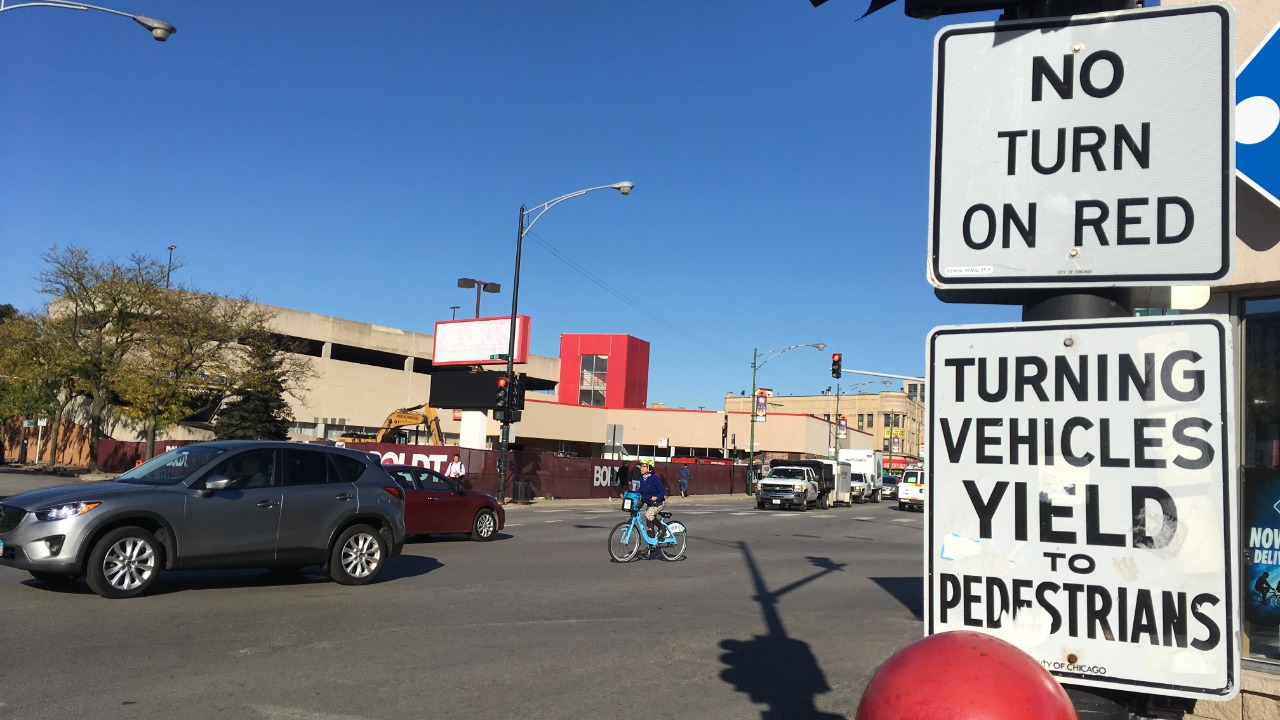
If you’ve found yourself inching up to a red light, glancing at a brand-new sign, and thinking, “Wait… am I allowed to go or not?” you’re not alone. Across a growing number of intersections, updated “Right on Red” signage is leaving drivers second-guessing what used to feel like a simple, if slightly nerve-wracking, move.
The result is a familiar scene: one driver stops and stays put, another honks politely (or not-so-politely), and pedestrians wonder who’s about to do what. It’s not that people forgot the rules—it’s that the rules now depend on more specific conditions than many of us are used to reading at a glance.
What’s changed: more “conditional” signs
For years, most drivers learned the same baseline idea: you can usually turn right on red after a complete stop, unless a sign says you can’t. That “unless” used to be a big, obvious “NO TURN ON RED,” and it was easy to spot even while you were also watching cross traffic, cyclists, and the pedestrian countdown.
Now, many cities are adding signs that don’t simply ban or allow the move—they qualify it. You might see wording like “No Turn on Red When Pedestrians Present,” “No Turn on Red 7AM–7PM,” or “Right on Red After Stop” paired with an arrow or additional plaque.
Why drivers feel thrown off
The trouble is that intersections already demand a lot of attention. When you’re checking mirrors, scanning for a cyclist in the bike lane, and confirming whether that person at the curb is about to step off, your brain isn’t thrilled to also parse small print and time windows.
Even confident drivers can miss a detail, especially at night or in bad weather when signs are harder to read. And if you’re not sure, most people default to the safest choice—waiting—until someone behind them interprets that as hesitation and starts providing “feedback” with the horn.
The general rule (and why it’s not universal)
In much of the U.S. and Canada, the common framework is: you may turn right on red after coming to a complete stop, but only if it’s permitted in that jurisdiction and there’s no sign prohibiting it. You still have to yield to pedestrians and cross traffic, and you can’t roll through like you’re negotiating a four-way stop with vibes alone.
But here’s the catch: rules vary by state, province, and sometimes by city. Some places restrict right on red more broadly, and others allow it but add intersection-by-intersection limits, which is where the new signage comes in.
How to read the new signs without overthinking it
Start with the simplest approach: treat every red light as “stop and decide,” not “stop and go.” Come to a full stop at the stop line (or before the crosswalk), then look for any sign that changes the default.
If the sign says “NO TURN ON RED,” that’s the end of the story—don’t turn. If it adds conditions, the sign isn’t trying to trick you; it’s telling you exactly when the city wants you to wait, usually to reduce conflicts with people walking or biking.
The most common “new” variations you’ll see
One big one is “No Turn on Red When Pedestrians Present.” Translation: if anyone is in the crosswalk or stepping into it, you wait—even if you think you’ve got space. In practice, drivers may need to be extra patient at busy corners because “present” can mean more than just “directly in front of your bumper.”
Another frequent version: time-based restrictions like “No Turn on Red 7AM–7PM” or “Mon–Fri.” These pop up near schools, downtown corridors, or transit-heavy streets where foot traffic spikes at predictable times. If you’re driving outside the restricted window, the usual right-on-red rule may apply, but you still have to stop and yield.
You’ll also see “Right on Red After Stop,” which sounds redundant but is often installed where drivers used to roll through. It’s basically the sign equivalent of a raised eyebrow from the transportation department: yes, you can turn, but you’re going to stop properly first.
Why cities are doing this in the first place
The push is largely about safety and clarity at intersections where conflicts are common. Right turns on red can be risky because the driver’s attention often goes left to look for a gap in car traffic, while pedestrians are coming from the right (and cyclists may be approaching alongside the curb).
Transportation agencies also say conditional signs are a compromise. Instead of banning right on red everywhere—which can frustrate drivers and affect traffic flow—they target the intersections and time periods where crashes or close calls are more likely.
What you should do at the light (the practical checklist)
First: stop completely. Not a “California stop,” not a slow roll—actually stop behind the crosswalk or stop line so you’re not blocking people who are crossing.
Second: scan in a full circle. Look left for vehicle gaps, straight ahead for signal changes, and right for pedestrians and cyclists; then check the crosswalk again because people move faster than you think when you’re focused on traffic.
Third: obey the sign’s condition exactly. If it’s time-based, check the hours; if it’s pedestrian-based, assume the cautious interpretation; if it’s a full prohibition, wait for green.
Why some drivers still turn (and why that doesn’t make it okay)
A lot of confusion comes from habit. People have been turning right on red at the same corner for years, so when a new restriction shows up, it can take time for behavior to catch up—especially if the sign is easy to miss.
There’s also the social pressure factor: if the car behind you expects you to go, it can feel awkward to wait. But you’re the one who gets the ticket—or worse, causes a collision—so it’s worth ignoring the honk and following the posted rule.
What to watch for in the months ahead
Expect more of these signs, not fewer, as cities update intersections for growing pedestrian and bike traffic. Some places are also pairing signage with signal tweaks like leading pedestrian intervals (where pedestrians get a head start) or dedicated right-turn arrows, which can further change what you’re allowed to do on red.
If you’re ever unsure, the safest move is simple: stay stopped and wait for green. You might lose 20 seconds, but you’ll avoid the kind of mistake that can ruin someone’s day—or your own.
More from Fast Lane Only