Ford’s EcoBoost badge has become shorthand for small engines that hit like bigger ones while using less fuel, but it is often dismissed as “just a turbo.” In reality, EcoBoost is a tightly integrated package of technologies that changes how air and fuel move through the engine, how combustion happens, and how emissions are controlled. Understanding what it actually does helps explain why a 1.5 liter or 2.7 liter EcoBoost can replace older V6 and V8 engines in everything from compact SUVs to the Ford F-150.
EcoBoost in plain language: downsizing without feeling slow
At its core, EcoBoost is Ford’s way of shrinking engine size without shrinking performance. Instead of relying on a big displacement V6 or V8 to make power, Ford uses smaller four and six cylinder engines that breathe more efficiently and burn fuel more precisely, so they can deliver the same or higher output with less gasoline. Ford’s own description of the EcoBoost engine highlights that it is designed to deliver powerful performance and better fuel economy than larger displacement engines, with strong torque and responsive acceleration that feel anything but economy focused.
That balance is not marketing spin, it is baked into how the engines are calibrated and built. Ford notes that EcoBoost engines are intended to deliver maximum power while using minimal fuel, with the goal of matching or beating the horsepower and torque of bigger, naturally aspirated engines while cutting consumption and emissions. In practice, that means an EcoBoost engine can emit up to 15 percent fewer greenhouse gases and use up to 20 percent less fuel than a comparable non turbocharged engine, all while delivering superior performance when the driver asks for it.
Why EcoBoost is more than “just a turbo”
Turbocharging is the most visible part of EcoBoost, but it is only one leg of a three part strategy. Ford explicitly frames EcoBoost as “Triple Technology for a Stronger Engine,” combining turbocharging, direct fuel injection, and variable valve timing into a single system. The turbo uses exhaust energy to spin a small turbine that forces more air into the cylinders, which lets a smaller engine behave like a larger one under load. On its own, that would add power, but it would not guarantee efficiency or clean combustion.
The second leg is direct fuel injection, which Ford lists as a key element under its EcoBoost Engines Technologies. Instead of spraying fuel into the intake manifold, a high pressure system injects fuel directly into the combustion chamber at precisely controlled moments. That allows a finer fuel mist, better mixing with the incoming air, and more complete combustion, which improves both power and fuel economy. The third leg, variable valve timing, constantly adjusts when the intake and exhaust valves open and close, helping the engine breathe efficiently at low rpm for torque and at high rpm for power. When these three technologies are tuned to work together, the result is a compact engine that can cruise efficiently at light throttle, then deliver a strong surge when the turbo spools and the valves and injectors respond in sync.
How EcoBoost actually works inside the cylinder
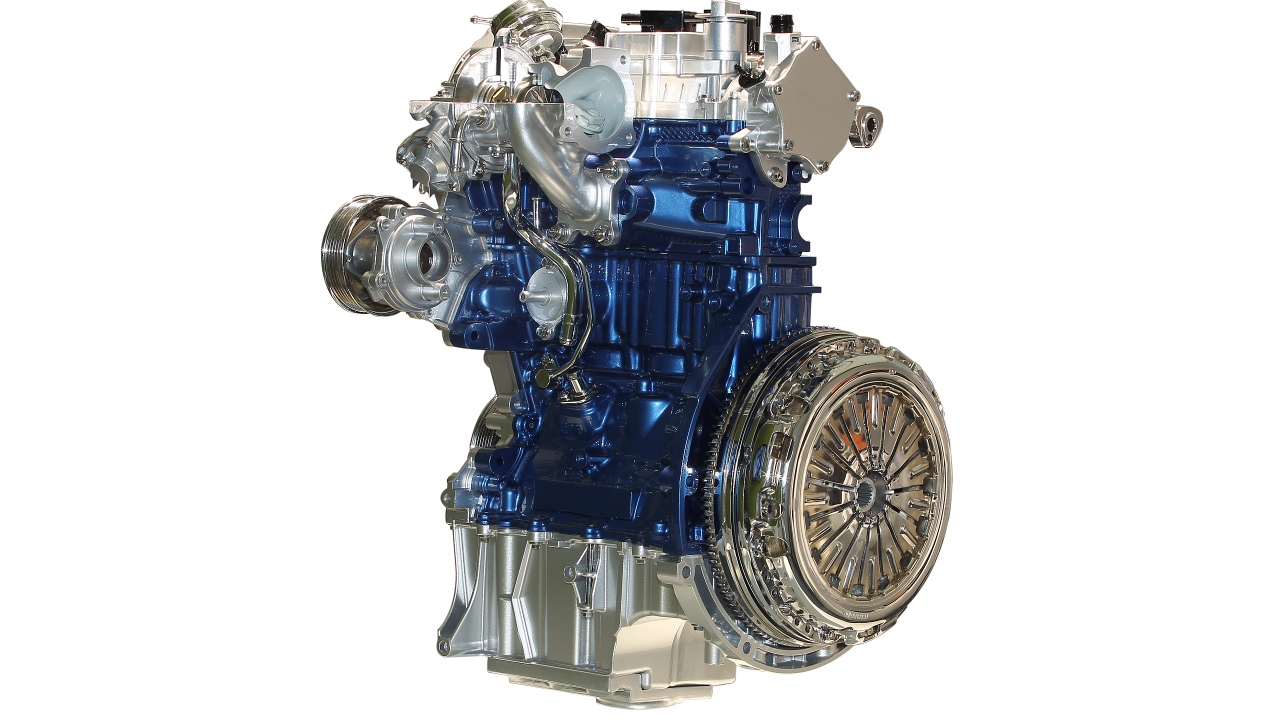
To see why EcoBoost is not a simple bolt on turbo, it helps to look at what happens inside each cylinder. In a conventional port injected engine, fuel enters the cylinder once per cycle after being sprayed into the intake air stream, and some of that fuel can cling to surfaces or fail to burn completely. Ford’s EcoBoost approach uses direct injection so that fuel is sprayed directly into the combustion chamber under high pressure, with timing and quantity tailored to each combustion event. One explanation of EcoBoost notes that this precise control means more of the fuel ends up being consumed, which translates into more energy extracted from every drop of gasoline.
Air management is just as important. Ford’s own technical breakdown of EcoBoost technology explains that air and fuel enter the intake system in a carefully managed way, with the turbocharger compressing the intake charge and the engine control unit adjusting boost, spark, and valve timing in real time. By tightly coordinating how air is packed into the cylinder and how fuel is injected and ignited, EcoBoost engines can run higher compression and leaner mixtures under certain conditions without knocking. That is a significant departure from older turbo setups that simply cranked up boost; EcoBoost uses electronics, injection hardware, and valve control to make forced induction a normal, everyday part of the engine’s operation rather than a crude add on.
Real world performance, efficiency, and emissions
On the road, the payoff from this technology stack is clear in both performance numbers and fuel use. Ford emphasizes that EcoBoost engines deliver powerful performance and better fuel economy than larger displacement engines, and dealer level guides describe how these engines “punch well above their weight,” noticeably increasing output per liter compared with traditional designs. A typical EcoBoost four cylinder can match or exceed the torque of an older V6 at lower rpm, which is why models like the Ford Escape, Ford Explorer, and Ford F-150 have been able to downsize engines without feeling sluggish in everyday driving.
The efficiency story is not just about miles per gallon, it is also about emissions. One overview of EcoBoost notes that an EcoBoost engine can emit up to 15 percent fewer greenhouse gases and use up to 20 percent less fuel than a comparable non turbocharged engine, thanks to the combination of turbocharging, direct injection, and variable valve timing. That environmental focus is becoming more visible in hardware changes. For example, reporting on the 2026 Ford F-150 EcoBoost explains that the truck is getting a Gasoline Particulate Filter on its EcoBoost engines, a device that captures fine soot particles in the exhaust. The same report notes that this change trims output slightly, with the 2.3 liter EcoBoost I4 turbocharged engine in the Ford F-150 now making 18 horsepower less than before, a tradeoff that illustrates how emissions rules are shaping the next generation of EcoBoost tuning.
Reliability, maintenance, and what buyers should watch
Any time an engine packs more technology into a smaller package, buyers worry about long term durability. On that front, the available reporting is cautiously positive. A detailed look at ownership patterns concludes that Ford EcoBoost engines are generally reliable, especially when properly maintained, and explicitly answers the question “Are Ford EcoBoost Engines Reliable?” with “Yes, Ford EcoBoost engines are generally reliable.” That assessment points out that most current EcoBoost units have matured past early teething issues, with improvements in cooling systems and timing chain reliability compared with the first generation designs.
That does not mean EcoBoost engines are maintenance free. The same reliability analysis stresses that regular oil changes with the correct specification, timely spark plug replacement, and attention to cooling system health are more important on a turbocharged, direct injected engine than on a simpler naturally aspirated one. Direct injection can be prone to intake valve deposits in some designs, and turbochargers depend on clean, high quality oil for long life. Ford’s own guidance on EcoBoost Engines Technologies highlights efforts to reduce internal friction and save more energy, but those benefits assume the engine is serviced on schedule. For buyers, the takeaway is that EcoBoost is not a fragile science project, but it does reward owners who follow the maintenance book rather than stretching intervals or ignoring warning signs.
More from Fast Lane Only: